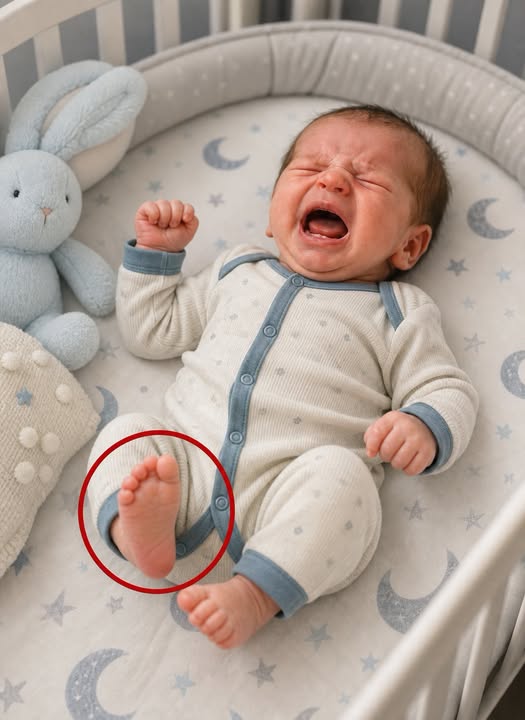
The screaming would not stop.
Two exhausted parents, one reassuring diagnosis, and a baby on the brink of losing his tiny foot. Night after night, their newborn cried with a desperation they could not understand. They tried feeding him, rocking him, changing him, walking through the house with him in their arms, and doing everything they had been told might soothe a colicky baby. But nothing worked for long. What doctors first called “just colic” was actually something far more sinister, hidden in the smallest and easiest-to-overlook part of his body.
A single strand of hair had become a medical emergency.
The family had done everything they thought responsible parents were supposed to do. Their home was prepared, the baby was being watched carefully, and they had already sought medical advice when the crying became unbearable. Yet one crucial detail remained unnoticed. Everyone was focused on the baby’s screaming, his feeding, his stomach, and the possibility of colic. No one had carefully examined his tiny feet.
Then, during another desperate attempt to figure out what was wrong, the father looked down at his son’s leg and toes.
Something did not look right.
What seemed like an insignificant detail turned their safe, well-planned home into a nightmare. His baby’s toe was swollen and discolored, and the more they looked, the more alarming it became. They rushed for medical attention, where doctors finally discovered what had been hiding beneath the swelling.
They later learned the term: **hair tourniquet syndrome**.
A single strand of the mother’s hair, likely shed during postpartum hair loss, had twisted around the baby’s toe and tightened with every tiny movement. Because newborn fingers and toes are so small, even something as thin as a human hair can become dangerously constricting. The hair gradually tightened, cutting deeper into the soft skin and interfering with blood circulation.
As swelling developed, the situation became even more difficult to recognize. The hair began to disappear beneath the swollen tissue, making it almost invisible. What had started as something microscopic had turned into a serious threat to the baby’s toe—and potentially to the entire foot.
The parents were horrified.
They kept thinking about all the times they had tried to comfort him, wondering how such a tiny problem could have caused so much pain. They also realized how easily the condition could be missed. The baby had been crying, but crying in a newborn is common. Colic was an easy explanation, especially when there were no obvious signs of illness elsewhere.
But everyone had been looking in the wrong place.
No one at the clinic had checked his feet carefully. The focus had been on his crying and possible stomach discomfort rather than on a complete examination from head to toe. The overlooked detail had nearly cost the baby his tiny foot.
Surgeons eventually removed the embedded strand of hair under magnification. Working with extraordinary care, they released the pressure around the toe and restored blood flow. The procedure was delicate because the hair had become so tightly embedded that removing it without damaging the already swollen tissue required extreme precision.
Then they waited.
Slowly, the baby’s toes began to regain their normal color. The circulation improved, and with it came the hope that the damage could be reversed. The immediate danger began to pass, and the terrifying possibility of amputation was finally put aside.
For his parents, however, the emotional shock remained.
They replayed every moment in their minds—the crying, the sleepless nights, the first medical visit, the attempts to soothe him, and the moment his father finally noticed something was wrong. They realized how easily they had trusted the first explanation because it seemed reasonable. They also understood that the warning had been there all along, hidden in a place no one thought to check.
The experience changed the way the father looked at unexplained crying.
Now, he tells their story to every new parent he meets, not to create fear, but to encourage careful attention. His message is simple: when a baby cries inconsolably and something feels wrong, don’t automatically assume it is “just colic.” Remove the socks and clothing, gently check every finger and every toe, look for swelling, redness, discoloration, or anything wrapped tightly around the skin, and seek medical attention if something seems abnormal.
A single strand of hair had nearly caused a devastating injury.
And the lesson the family carried away was just as small but powerful: sometimes the answer is hiding in the smallest detail. When a newborn cannot tell you where it hurts, a careful look can make all the difference.