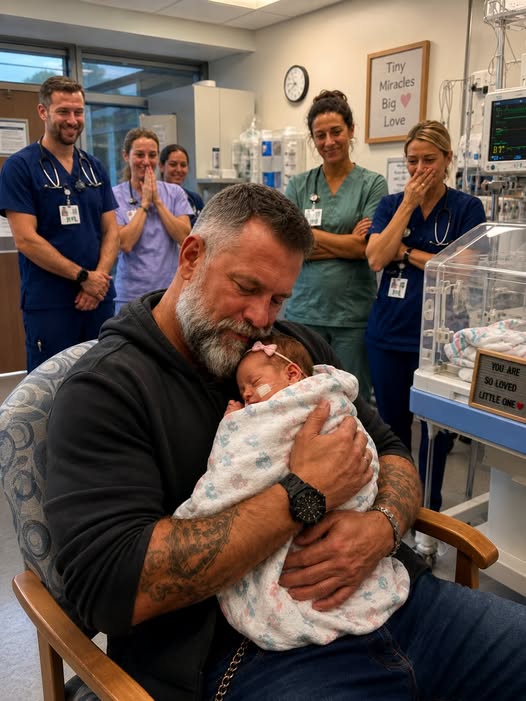
The first time the giant biker walked into our NICU, every instinct screamed that he did not belong.
Tattoos covered his arms, heavy boots struck the hospital floor, and his enormous body looked more suited to roaring engines, crowded bars, and storms than the quiet, fragile world of a neonatal intensive care unit. Nurses watched him carefully as he stood beside an incubator holding a baby who had no one waiting at her side. The contrast was almost unsettling—a man who looked as though he could frighten an entire room standing quietly beside a newborn small enough to fit against his chest.
Then he sat down.
He opened his arms, gathered the tiny baby carefully against him, and refused to move for twelve straight hours. What he was really holding was not just a baby. He was holding a piece of his own past, a grief he had carried silently for nearly three decades, and perhaps the chance to finally give someone the tenderness he had once been too afraid to offer.
He came to us looking like trouble and sat down like penance. For twelve hours, he remained in the same chair, barely shifting as the nameless, unwanted newborn rested against the tattoo on his chest that read **AVA**. To anyone who did not know his story, the name might have seemed like nothing more than ink. But it was the name of his daughter.
His own daughter had lived only nine days in a different NICU.
Twenty-seven years earlier, he had stood in another hospital room facing a kind of helplessness no parent should ever have to know. Ava was impossibly small, fragile, and slipping away. Fear overwhelmed him. He wanted to reach for her, wanted to hold her close, but he was terrified that his hands were too large, that he might hurt her, or that touching her would make the reality of losing her impossible to deny. So he hovered instead. He watched. He waited. And before he could find the courage to truly hold his daughter the way he wished he had, she was gone.
For twenty-seven years, he carried the memory of a girl he barely dared to hold.
The grief never completely disappeared. It simply became quieter, buried beneath work, life, years, and the tough exterior he learned to wear. But the tattoo remained. Ava remained. And somewhere inside him lived the memory of those nine days and the regret of all the tenderness fear had stolen from him.
In our unit, he chose differently.
When he saw the newborn who had been left without anyone to hold her, something inside him changed. He did not ask whether she was his responsibility. He did not ask who had abandoned her or why. He simply reached out. He held her carefully, supported her tiny head, and stayed.
When the baby’s mother eventually returned, shaking and overwhelmed, he did not judge her. He stepped back when she was ready, giving her space to reclaim her place beside her child. There were no accusations, no speeches, and no demand for explanations. He understood that sometimes people break under pressures no one else can see. His job, as he saw it, was simply to make sure the baby had warmth until her mother could return.
And he kept coming back.
He held the children of night-shift workers who could not always be there during every difficult hour. He held the babies of soldiers whose families were separated by duty. He held newborns whose mothers were recovering and unable to leave their beds. He became a quiet presence in the background of a place filled with alarms, machines, uncertainty, and fragile lives.
The nurses began to understand that the tattoos, boots, and intimidating frame had never told the whole story.
The man who looked like trouble had become one of the gentlest people in the room.
He never needed recognition. He did not tell dramatic stories about himself or demand gratitude from the families. He simply sat down, opened his arms, and stayed as long as someone needed him. Sometimes the babies slept against his chest. Sometimes their tiny fingers curled around one of his massive fingers. Sometimes the monitors hummed while he stared silently at the fragile life resting against him.
Quietly, without speeches, he became proof that tenderness is not about appearance.
It is about staying.
The past could never give him a second chance with Ava. Nothing could change those nine days, erase the fear he had felt, or rewrite the moments when he wished he had reached out sooner. But perhaps the past had given him something else: a reason to become the steady warmth he once wished he could have been.
Every baby he held carried a different story. Every family arrived with a different kind of pain. Yet he offered them the same simple gift—his presence. He could not promise that every child would be okay. He could not control what happened beyond those hospital walls. But for those hours, he could make sure no tiny baby had to face the coldness of an empty chair alone.
In those harsh, humming rooms, surrounded by machines and whispered conversations, his greatest act was remarkably simple.
He showed up.
And when a fragile newborn needed someone to hold her, he did not let go.