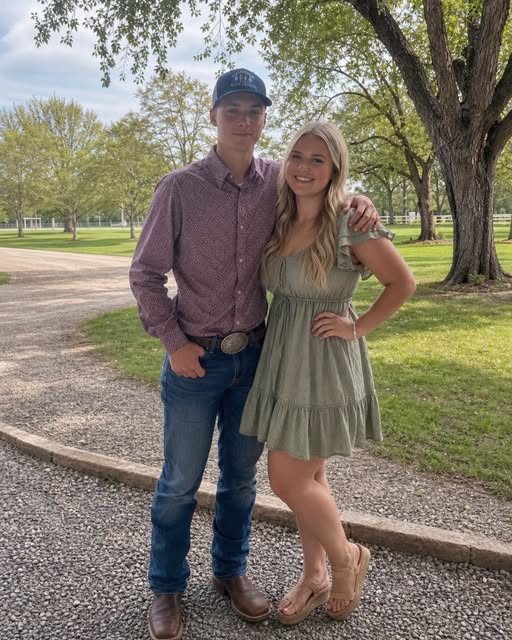
He had waited his whole life for this moment.
One last summer. One last chance to prove himself in the arena. After years of practice, early mornings, dusty roads, long days on the ranch, and countless hours spent learning the craft he loved, 18-year-old Ace Patton Ashford stood closer than ever to the rodeo future he had dreamed about since childhood.
He was so close.
Then an open field, a sick cow, and a trusted horse turned an ordinary ranch task into a tragedy no one could have imagined. In only a few seconds, everything Ace had been working toward—his future, his dreams, his plans, his next ride—was suddenly gone.
The young man who had spent his life around livestock and horses was taken from the world he loved in the middle of something that had once seemed like another normal day.
They say rodeo kids are born with dust in their veins and courage in their bones.
Ace Patton Ashford was one of them.
At just 18 years old, he was already building the kind of reputation that comes from dedication rather than simply talent. Rodeo was not something he casually participated in. It was woven into the life he knew, into the places he spent his time, the people around him, and the goals he had carried since he was young.
He was only weeks away from reaching a lifelong rodeo goal he had chased since childhood.
That makes the timing even more heartbreaking.
He was not looking backward.
He was looking ahead.
Friends and those who knew Ace remember a young man with an easy smile and a quiet determination underneath it. He was not necessarily the loudest person in the room, but he had a willingness to work, to learn, and to keep pushing when something became difficult. Whether he was in the arena or working on the ranch, he understood that success did not come from wishing for it.
It came from showing up.
Again.
And again.
And again.
That mindset was part of what made the tragedy so difficult for the people who knew him. Ace had spent so much of his young life preparing for the future that seemed to be waiting just ahead.
Then came August 12.
Ace was helping with a sick cow in an open field when a freak accident unfolded in an instant. His horse dragged him, and a routine task became a devastating loss.
There was no time for the future he had imagined.
No final ride on his own terms.
No chance to see how far his talent and determination might have taken him.
Just a terrible moment that left family, friends, and an entire rodeo community trying to understand how someone so young could be gone so suddenly.
The aftermath was filled with a kind of silence that felt almost unnatural.
Arenas that normally echoed with movement and excitement became places of remembrance. Ropes that would usually be handled with anticipation hung still. Young competitors who had once looked across the arena at Ace now had to confront the reality that he would not be standing beside them again.
Rivals became mourners.
Competitors became friends gathered in grief.
And a community built around courage was forced to face one of life’s most painful reminders: courage cannot protect anyone from every accident.
For those who knew Ace, the loss was not simply the death of a talented young roper.
It was the loss of a son, a friend, a competitor, a ranch kid, and a young man who still had so much life ahead of him.
Eighteen is supposed to be the beginning of possibilities.
There should have been more summers.
More competitions.
More early mornings.
More mistakes to learn from.
More victories to celebrate.
More goals to chase.
More ordinary days that would eventually become memories.
Instead, those who loved Ace are left carrying memories of the life he had already lived and imagining all the moments that should have come next.
That is one of the cruelest parts of sudden loss.
People do not only mourn what happened.
They mourn everything that will never happen.
The future that once seemed certain disappears with the person, leaving everyone behind to imagine the birthdays, competitions, family gatherings, milestones, and quiet everyday moments that will now exist only in memory.
Yet Ace’s story will not disappear.
It will continue in the people who knew him and in the young riders who enter arenas carrying the same dreams he once carried. Every time a young roper saddles a horse, every time someone steps into an arena with nerves and determination, there will be a reminder of how precious those moments really are.
Rodeo has always demanded courage.
But Ace’s story adds another meaning to that word.
Courage is not simply climbing into the saddle.
It is pursuing something you love even when it is difficult.
It is waking up early and doing the work.
It is getting back up after failure.
It is believing in a dream before anyone else can see where it might lead.
Ace did those things.
He was still doing them when his life was suddenly interrupted.
The people left behind may never find a satisfying explanation for why such a terrible accident happened. Sometimes there is no explanation that can make the loss feel fair. There is only the responsibility of remembering the person rather than allowing the tragedy to become the only thing people associate with them.
Ace was more than the way he died.
He was the young man who smiled.
The competitor who kept working.
The ranch kid who understood horses and livestock.
The eighteen-year-old who was still chasing a dream he had carried since childhood.
And perhaps that is the memory his community will hold closest.
Not simply the final moment, but everything that came before it.
The dust.
The horses.
The arena.
The friendships.
The ambition.
The dream.
The young man who believed there would be another ride waiting for him.
There wasn’t.
But his story can still remind everyone who follows the same path to treasure the ride they have today.
Because every time a young roper saddles up, there is a future they cannot see yet.
There are goals still waiting.
There are people waiting at home.
There are memories still to be made.
Ace’s story is heartbreaking precisely because he had so much more ahead of him.
But it is also a reminder that the moments we sometimes treat as ordinary are anything but ordinary.
Every ride is precious.
Every arena matters.
Every goodbye matters.
And no future is ever promised.