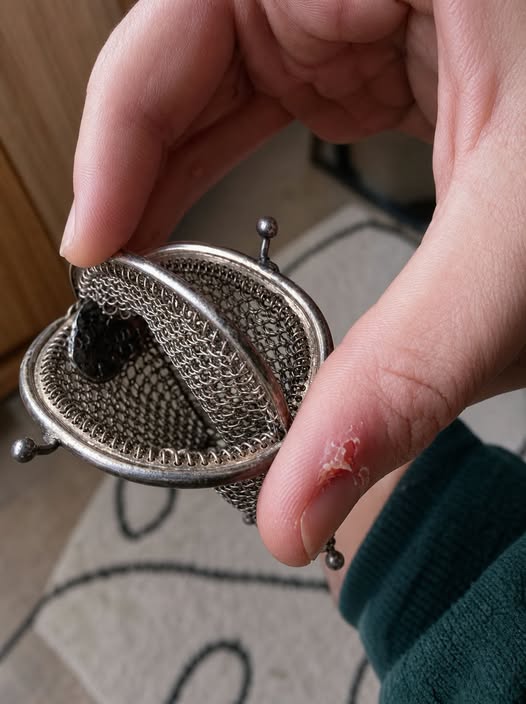
A gloved hand reaches for a purse no larger than a sparrow—and suddenly, the room takes notice.
Silver catches the light. A tiny clasp snaps shut. A delicate chain shifts against a dress. No one needs to say anything aloud, because everyone understands what the object is quietly communicating. Money. Taste. Refinement. Ambition. In Victorian society, even something as small as a purse could become part of the language of status.
These miniature accessories were never merely containers for coins. They were objects meant to be seen.
A woman might carry one into a theater balcony, a formal gathering, a dinner, or a grand household filled with servants, and the little silver purse could speak before she ever did. Its size, craftsmanship, decoration, and method of carrying it all offered subtle clues about the person who owned it and the world she belonged to.
Each Victorian silver purse held more than money.
It held a performance.
In a culture deeply concerned with appearances, personal possessions became powerful tools for communicating identity. The smallest details could matter. Hallmarks could reveal the quality and origin of the silver. Engraving could transform a practical object into something deeply personal. The length and style of the chain could affect how the purse was worn, while its placement on a chatelaine at the waist could make it visible as part of a larger arrangement of keys, tools, and household accessories.
Nothing about it had to be loudly announced.
The message was often understood through details.
A lavishly chased silver purse could suggest prosperity and refinement. A simpler design could communicate restraint or practicality. Some were made from solid silver, while others were plated or decorated in ways that allowed owners to participate in the fashion without necessarily possessing enormous wealth.
That distinction matters because objects like these were never only about wealth itself.
They were also about aspiration.
A purse could represent the kind of life a woman wanted to project, even if her circumstances were more complicated than the polished object suggested. It could be an expensive indulgence carefully saved for, a wedding gift marking a new chapter, or a treasured possession passed through a family. The object could say, in its own small way, “This is who I am,” or perhaps, “This is who I hope to become.”
The purse also occupied an interesting position in Victorian domestic life.
A woman’s belongings were often closely connected to the responsibilities expected of her. The small purse hanging at her side might contain only a modest amount of money, but the object itself could symbolize a degree of personal authority. It was something she could own, carry, display, and use within a society where women’s financial and social independence was often heavily restricted.
That makes these tiny accessories more fascinating than their size would suggest.
They were portable declarations of identity.
They moved through public and private spaces, from elegant social gatherings to the routines of everyday life. They might hang from a waist, disappear into a handbag, or rest beside other personal possessions. Every movement could cause the silver to catch the light, turning an ordinary object into a subtle visual statement.
And then time intervened.
The coins disappeared.
The dresses vanished.
The rooms where these purses once moved through eventually changed or disappeared altogether.
But the purses survived.
Today, many carry visible evidence of their long lives. Tarnish settles into engraved scrollwork and decorative patterns. Linings become worn and frayed. Clasps loosen from decades of opening and closing. Chains develop signs of repeated use. Small scratches and dents remain where polished surfaces once reflected the light perfectly.
Those imperfections are not simply damage.
They are evidence.
They tell us that these objects were actually used by real people rather than created merely to sit behind glass. Every worn clasp and softened edge hints at countless moments when someone reached for the purse, opened it, carried it, or fastened it back into place.
That is what makes an old silver purse so compelling.
Its beauty is only part of the story.
The wear may be even more important.
A perfectly preserved object can tell us how something was designed. A worn object can tell us that someone depended on it. It can reveal habits, routines, preferences, and even fragments of a person’s social life.
Imagine one purse as a wedding gift.
Another as a carefully saved-for luxury.
Another hanging every day from a woman’s waist as she managed the responsibilities of a household.
Another perhaps carried only for special occasions, brought out when appearance mattered most.
Each object could have followed a completely different path, even if they look nearly identical today.
And that is where the romantic image of the Victorian past becomes more complicated.
It is easy to look at silver purses and imagine elegant dresses, grand houses, candlelit rooms, and effortless sophistication. But the objects themselves quietly resist that simplified picture. They remind us that Victorian life was also shaped by rigid class structures, expectations, financial limitations, domestic labor, and unequal opportunities.
The silver may have been beautiful.
The world surrounding it was not always beautiful.
These purses therefore survive as more than antique accessories. They are fragments of social history. They reveal how people communicated status, how women navigated expectations, how consumer goods became symbols of identity, and how ordinary possessions could carry emotional meaning long after their owners were gone.
Their contents may have vanished generations ago.
Their owners’ names may be forgotten.
The hands that once opened their tiny clasps are gone.
But the objects remain.
Tarnished, scratched, sometimes imperfect, yet still capable of telling a story.
A Victorian silver purse was small enough to disappear into a hand, but its meaning could extend far beyond its size. It could represent wealth, aspiration, femininity, domestic authority, family memory, or simply the pleasure of owning something beautiful.
And perhaps that is why these miniature objects continue to fascinate us.
They do not shout from the past.
They whisper.
They ask us to look beyond the polished silver, beyond the romantic image of Victorian elegance, and notice the human lives that once surrounded them.
Because every worn clasp, every faded lining, and every engraved surface carries a quiet reminder:
History is not always preserved in grand buildings or famous documents.
Sometimes, it survives in something small enough to fit in the palm of your hand.