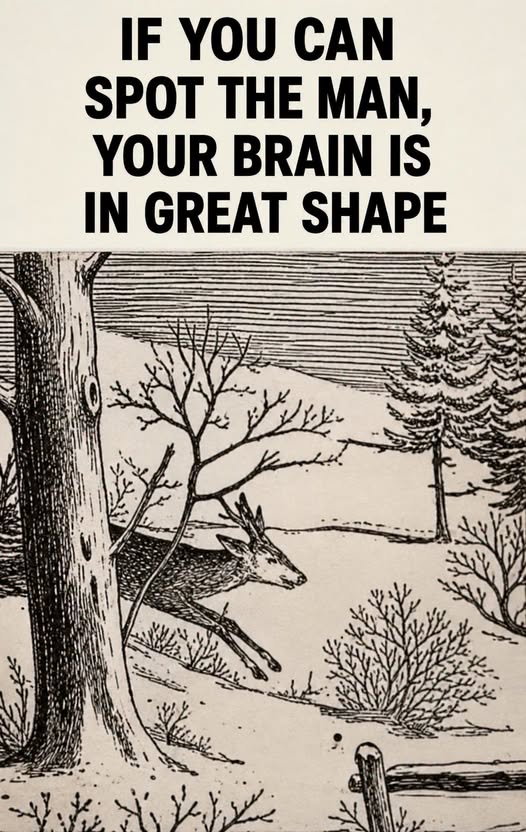
At first glance, the forest looks completely innocent. Snow blankets the ground, tall trees stretch quietly into the distance, and a deer appears to be caught in a graceful leap through the winter air. It feels like a peaceful photograph of nature frozen in a single beautiful moment. But then you look a little closer—and something feels strangely out of place. Hidden among the branches, shadows, and rough shapes of the trees is a man’s face. Most people completely miss it at first. Then, the instant it comes into focus, it becomes almost impossible to ignore. Look carefully at the large tree trunk on the right side and follow the shapes created by the surrounding branches and snow. A face is hiding there in plain sight.
What appears to be an ordinary winter landscape slowly transforms into something much more intriguing—a visual puzzle that challenges the way your brain interprets what your eyes are seeing. The hidden man’s face is not actually drawn into the image. Instead, it is created by the natural outlines and negative spaces already present in the scene. The large tree trunk on the right forms the basic structure, with its curved edge creating the impression of a forehead, nose, and cheek. Nearby branches and small openings between the snow-covered shapes seem to become eyes, while darker spaces suggest a mouth and chin. Once your brain connects those separate details, the illusion suddenly becomes unmistakable.
And that is what makes the image so fascinating. Before you notice the face, your attention naturally follows the deer. It is the most obvious subject, moving against the quiet white landscape. The trees simply look like trees, and the shadows appear to be nothing more than ordinary patterns created by winter light. But after someone points out the hidden portrait, your perception shifts completely. Suddenly, the deer no longer dominates the scene. The tree becomes a forehead. A branch becomes an eyebrow. A dark patch becomes an eye. The peaceful forest begins to feel strangely alive—as though someone has been quietly watching from the shadows the entire time.
This kind of illusion works because the human brain is constantly searching for familiar patterns. We instinctively try to recognize faces, even when the shapes in front of us are incomplete or accidental. A few curved lines, a dark opening, and the right arrangement of shadows can be enough for the mind to create an entire person where none was intentionally placed. It is a reminder that seeing is not always as simple as looking. Our eyes collect information, but our brains decide what that information means.
That is also why these hidden-image puzzles can feel almost unsettling once the secret has been revealed. Nothing in the photograph has actually changed. The snow is still snow. The branches have not moved. The deer is still suspended in its leap. The tree remains exactly where it was. Yet your experience of the entire image is suddenly different because your brain has found a new pattern hiding inside it.
Before you saw the face, you could look at the forest without thinking twice. Afterward, every glance seems to lead back to it. You may even wonder how you managed to miss something that now appears so obvious. That strange feeling is part of the appeal of optical illusions: they expose the difference between what is physically present and what we actually perceive.
The hidden face turns an ordinary winter photograph into a small psychological experiment. It shows how easily attention can be directed toward one subject while another remains concealed in the background. We often assume that if something is directly in front of us, we must have noticed it. But the truth is that we constantly overlook details because our brains prioritize certain shapes, movements, and expectations over others.
In this case, the leaping deer captures your attention first. It gives the scene a clear focal point, allowing the hidden portrait to remain almost invisible. Only when you deliberately search the right side of the image do the strange shapes begin to make sense. And once they do, the forest seems to tell an entirely different story.
That single moment of recognition is what makes these visual mysteries so addictive. There is a brief instant when confusion turns into discovery, followed by the satisfying realization that the answer was sitting in front of you all along. The image does not need to change. You do.
Sometimes, all it takes is a different angle, a little patience, or someone pointing out one tiny detail to completely transform the way you see something familiar. And in this snowy forest, one hidden face is enough to prove just how much can remain invisible—even when it is hiding in plain sight.