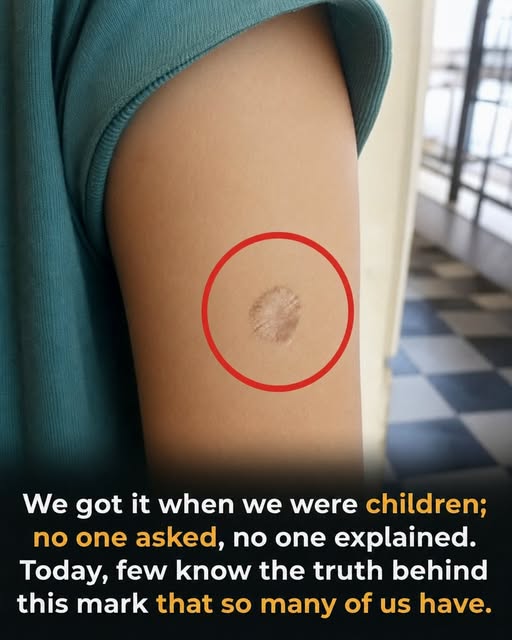
That small circle on an older person’s arm is not a flaw, and it was never meant to be something to hide. It is a relic of a war humanity once fought in terror—a war against a disease that seemed almost impossible to stop. A war fought in crowded cities, remote villages, hospitals, homes, and frightened communities around the world. And remarkably, it is a war we actually won. Behind that faded mark are stories of fevers, suffering, mass graves, desperate parents, frightened children, and a virus that showed no mercy and refused to spare almost anyone it reached. Yet, against overwhelming odds, humanity pushed back.
That little round scar is the quiet echo of smallpox, a disease that once terrified entire generations. Long before vaccination became widely available, smallpox could spread rapidly through communities, leaving survivors permanently scarred and sometimes blind, while countless others never survived the infection. For centuries, families lived with the knowledge that an ordinary illness could suddenly become a deadly catastrophe. Children could become sick within days, entire households could be devastated, and communities could lose people in numbers that are difficult to imagine today.
The disease did not care about wealth, status, geography, or nationality. It crossed borders and moved between communities with frightening efficiency. There were no modern antiviral treatments capable of stopping it, and once someone became seriously ill, families often had little more than hope to hold onto. The scars left behind on survivors became permanent reminders of what the disease had taken from them.
Then came one of the most ambitious public-health efforts in human history.
Health workers traveled enormous distances by foot, truck, jeep, boat, and airplane. They crossed mountains, rivers, deserts, forests, and crowded neighborhoods carrying something incredibly valuable: vaccine. In some places, workers traveled for days simply to reach a handful of people. In others, vaccination teams moved from village to village, organizing lines and recording who had received protection. Schools, community centers, medical clinics, and temporary stations became places where people gathered, often knowing that a tiny puncture could mean the difference between life and death.
Families waited their turn. Children held out their arms. Health workers worked long hours under difficult conditions. There was no single dramatic moment when the disease suddenly disappeared. Instead, eradication came through millions upon millions of individual actions—one person vaccinated, then another, then another, repeated across continents until the virus had fewer and fewer places left to survive.
The technique itself became recognizable. Instead of the familiar injection many people know today, the smallpox vaccine was often administered using a special bifurcated needle. A quick series of tiny punctures introduced the vaccine into the skin, eventually producing a small blister and, after healing, the distinctive round scar that remained for decades.
For those who received it, the mark might have seemed insignificant. Just a small circle on the upper arm. Something they rarely thought about. But that circle represented an enormous collective effort. It represented scientists developing and improving vaccines, doctors treating the sick, nurses and health workers traveling into difficult areas, governments cooperating across borders, and ordinary families accepting vaccination in the hope of protecting themselves and their children.
The scar became a quiet symbol of resistance—not resistance through weapons or armies, but through science, persistence, organization, and cooperation.
And then came a moment that once would have seemed almost impossible.
In 1980, the World Health Organization declared smallpox eradicated. The disease that had haunted humanity for centuries had been eliminated from natural circulation. It became the first and remains the only human infectious disease to have been completely eradicated through vaccination and coordinated public-health action.
Think about what that means.
Humanity did not simply learn to live with smallpox. We did not merely reduce its numbers or find a way to manage it. We drove it out of the human population. A disease that had killed enormous numbers of people and left generations carrying its scars was finally stopped.
That fading circle on an older person’s arm is therefore more than a medical curiosity or a forgotten childhood memory. It is a tiny piece of living history. It is evidence of a time when millions of people participated, knowingly or unknowingly, in one of the greatest public-health achievements the world has ever seen.
For some, the scar may bring back memories of school vaccinations, nervous children waiting in line, or parents explaining why the small mark would remain. For others, it may simply be something they have carried for so long that they stopped noticing it. But beneath that ordinary appearance is an extraordinary story.
It tells us that diseases once considered unstoppable can be defeated. It reminds us that scientific progress does not happen through one person alone, but through generations of researchers, health workers, communities, and families working toward the same goal.
Most importantly, it offers a lesson that remains relevant long after the disease itself has disappeared.
Humanity is capable of extraordinary things when knowledge is combined with determination and cooperation. The scar may be small, but the story behind it is enormous. It carries memories of fear, loss, sacrifice, perseverance, and ultimately victory.
So the next time you notice that little round mark on an older person’s arm, look at it differently. It is not simply a scar.
It is a reminder of a disease that once seemed unstoppable—and of a world that refused to surrender to it.
It is a quiet monument carried on the skin.
A tiny circle that tells one of humanity’s biggest stories: **we faced something terrifying, we worked together, and we won.**