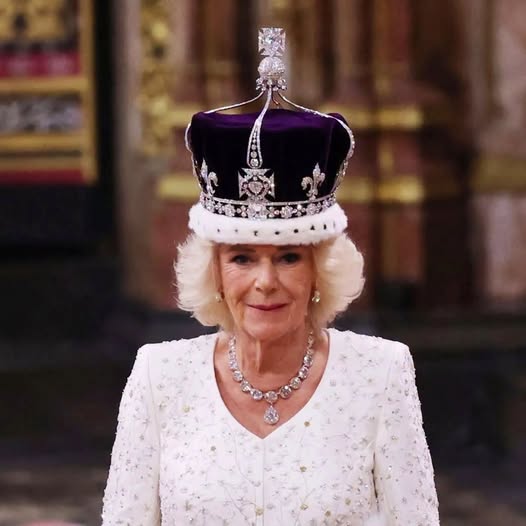
The crown glittered. But it was the woman beneath it that made the world stop.
In one unforgettable image, decades of scandal, doubt, criticism, and whispered resentment seemed to collide with duty, power, and unexpected grace. Millions stared at Queen Camilla beside King Charles III, asking the same question: had she finally claimed the role that so many once insisted she should never hold? The answer was more complicated than a single photograph could reveal.
When Queen Camilla appeared crowned beside King Charles III, it represented more than another ceremonial image. It marked the culmination of one of the most dramatic transformations in modern royal history. For years, Camilla had been defined by controversy, comparisons, and the shadow of the past. Yet the historic Queen Mary’s Crown resting on her head told a different story — one centered on acceptance, continuity, and a monarchy attempting to adapt to a changing public mood.
The decision to reuse and adapt a historic crown carried its own message. Rather than introducing an entirely new symbol of grandeur, the palace embraced an object already filled with history. The omission of the disputed Koh-i-Noor diamond also avoided one of the monarchy’s most sensitive imperial associations, while the emphasis on adapting an existing crown reflected a preference for sustainability over pure spectacle.
Every detail seemed to carry meaning. The Cullinan stones, the fleur-de-lis, the preserved craftsmanship, and the familiar shape of the crown connected Camilla to generations of royal history while simultaneously creating an image that belonged to the present. It was old symbolism presented through a new chapter.
That contrast may be why the photograph traveled so far and so quickly. It was not simply a picture of a woman wearing a crown. It represented the extraordinary ability of royal imagery to reshape perception. A figure once viewed primarily through the lens of controversy was suddenly being presented as an established part of the institution she had spent decades approaching from its edges.
For supporters, the moment suggested that time, duty, and persistence can eventually change even the harshest public judgments. For critics, it remained a reminder of the complicated history behind the crown. But regardless of personal opinion, the image carried undeniable symbolic power.
Camilla’s journey to the throne was never going to be an ordinary royal story. Too much history stood behind it, and too many memories remained attached to her name. Yet beneath the glitter of the crown was a quieter message: institutions survive not by remaining frozen in the past, but by finding ways to carry that past forward.
That is what made the image so compelling. It captured not just a queen, but a monarchy attempting to evolve beneath the heaviest burden of all — memory.