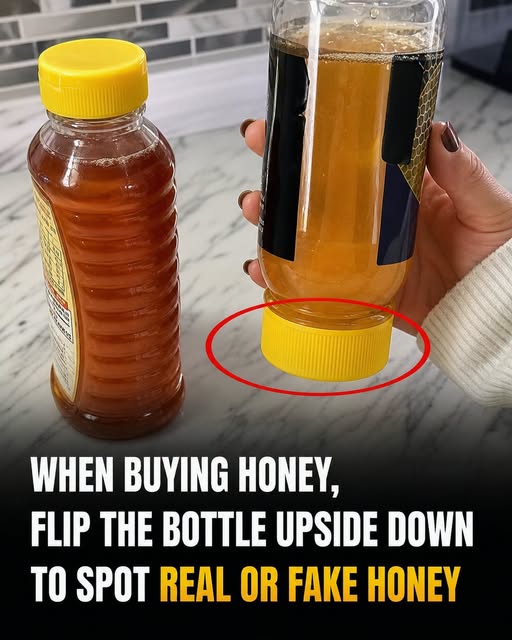
The bottle flips, the bubble slowly rises, and the verdict seems immediate. Fake. Real. Pure. Diluted. Millions watch, convinced that one simple upside-down trick can expose a massive food fraud. But the reality is far more complicated. Temperature, floral source, storage conditions, moisture, and even the season can change how honey looks, moves, and flows. That little bubble cannot reveal purity on its own.
Turning a bottle of honey upside down may be satisfying to watch, but it tells you very little about whether the honey is genuine. A slow-moving bubble only shows that the honey is thick under those particular conditions. Warm a jar of genuine honey and it can become noticeably thinner. Chill another honey and it may become thicker. Different flowers, moisture levels, and natural crystallization can completely change the texture without providing reliable evidence of adulteration.
The same problem applies to popular kitchen tricks that promise certainty. Burn tests, thumb tests, water tests, and patterns forming in a glass may look convincing online, but they confuse normal physical behavior with scientific proof. Sophisticated additions can be extremely difficult to identify without proper laboratory testing, which is why experts rely on multiple analytical methods rather than one dramatic household experiment.
For consumers, the most useful tools are actually much less exciting: buying from trusted beekeepers or transparent brands, checking origin and batch information, and being cautious when a price seems impossibly low. If something genuinely seems suspicious, keeping the receipt and batch number and submitting a formal complaint can create real accountability.
Because when it comes to honey, **a viral trick may make a great video—but it doesn’t make a reliable test.**