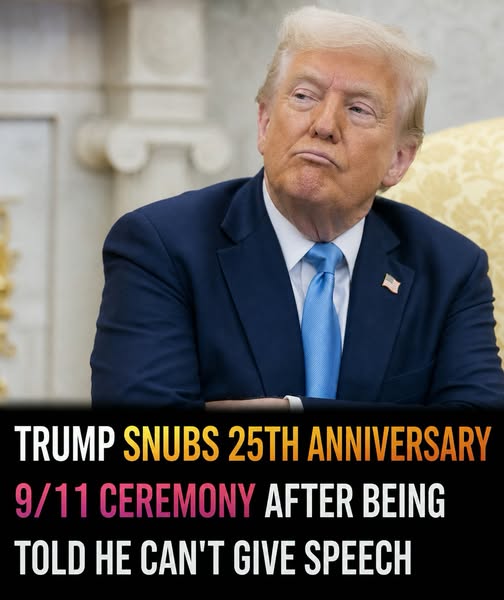
He wanted the microphone. They wanted silence. Twenty-five years after the deadliest terror attack on American soil, Donald Trump is walking away from Ground Zero — and heading to the Pentagon instead. Behind that decision is a little-known rule, a clash of ego and grief, and families who refuse to let their day be pulled into another political spectacle. What should be a solemn anniversary has once again become a story about who gets to speak, who is asked to remain quiet, and whether honoring the dead sometimes means stepping aside.
For months, Trump’s team treated the 25th anniversary at Ground Zero as a given: advance staff scouted the site, schedules shifted, and his presence was quietly assumed. Then came the reminder from memorial organizers: a standing rule since 2012, born from bitter fights over the site’s rebuilding — no speeches from politicians, no exceptions. The ceremony, they insisted, belongs to the dead and those who read their names, not to any president, past or present. The policy was designed to protect the character of the remembrance and prevent the anniversary from becoming another political stage.
That rule may sound simple, but its significance runs much deeper. The September 11 ceremonies have always carried an unusual emotional weight because the names being read belong to real people whose families continue to live with the loss. For relatives, the anniversary is not an abstract historical event. It is the date when a husband, wife, son, daughter, parent, sibling, or friend was taken from them. The ceremony is therefore built around remembrance rather than politics, with the reading of the names serving as the central voice.
Faced with a choice between attending in silence or speaking elsewhere, Trump chose a different stage. He will stand at the Pentagon, where remarks are allowed, while Vice President JD Vance joins former Presidents Bill Clinton, George W. Bush, and Barack Obama in New York. The split-screen image will be stark: one ceremony defined by enforced quiet, another by a president’s voice, both claiming to honor the same wound.
The contrast is likely to attract enormous attention because Trump has never been a politician who avoids the microphone. Public remarks are central to his political identity, and his rallies and speeches have long been part of the way he connects with supporters. But Ground Zero is different. The site carries a ritual of its own, one deliberately designed to keep political personalities from overpowering the names of the victims.
That creates an unusual tension. A president attending a memorial is normally expected to speak, offer condolences, and frame the historical significance of the moment. Yet in New York, the organizers have established a different expectation: the president can attend, but the ceremony itself does not belong to him. The silence is not an omission. It is part of the tribute.
For the families, that distinction matters. Over the years, September 11 remembrance ceremonies have repeatedly been pulled into broader political arguments, especially when public figures use the anniversary to make statements about current events. Families who have spent decades protecting the memory of their loved ones have often insisted that the day should remain centered on those who died rather than whoever happens to hold political power.
That is why the decision to move the president’s appearance to the Pentagon carries symbolic weight. The Pentagon was itself one of the sites attacked on September 11, 2001, when hijackers crashed American Airlines Flight 77 into the building. Nearly 200 people were killed there, including people inside the Pentagon and passengers and crew aboard the aircraft. The site therefore carries its own history of grief, sacrifice, and remembrance.
At the Pentagon, Trump can deliver remarks without violating the Ground Zero tradition. It allows him to participate visibly in the anniversary while also maintaining the freedom to speak. In New York, meanwhile, Vance will join three former presidents whose presence creates its own powerful image of continuity across political eras.
Clinton, Bush, and Obama represent three very different chapters of American political history, yet the anniversary temporarily places them in the same emotional space. Their presence is less about political agreement than about acknowledging a national trauma that reshaped the country regardless of party. For many Americans, seeing former presidents together at the memorial reinforces the idea that the tragedy belongs to the entire nation.
That is perhaps the most important question behind the controversy: who owns September 11? Politicians may hold office, memorial organizations may establish rules, and families may organize ceremonies, but the memory itself belongs to millions of people who experienced the aftermath. It belongs to those who lost loved ones, those who survived, those who responded, and generations who grew up knowing September 11 as one of the defining moments of modern American history.
The anniversary is therefore about more than where a president stands or whether a microphone is available. It is about the meaning of public mourning. Can a leader honor a tragedy without making the moment about leadership? Can a ceremony remain powerful without political speeches? And can opposing political figures stand together long enough to acknowledge a shared national wound?
At Ground Zero, the answer appears to be that silence can be its own form of respect. The names do not need a politician to make them important. They do not need a speech to remind anyone that they mattered. Every name carries a story, and every family carries a memory that existed long before cameras arrived and will remain long after they leave.
The decision also highlights how much the rituals surrounding September 11 have changed over the past quarter century. What began as an unimaginable national catastrophe has become an annual act of remembrance, repeated year after year while the people born after the attacks grow older. With every anniversary, the country faces the challenge of preserving the emotional reality of an event that increasingly belongs to history.
And perhaps that is why the rules matter so much. Once an event becomes history, there is always a risk that its meaning will be reshaped by whoever controls the microphone. The families and memorial organizers appear determined to prevent that from happening. Their message is straightforward: on this particular day, the dead should speak through their names, and everyone else should listen.
The split between the Pentagon and Ground Zero will therefore be impossible to ignore. One location will feature presidential remarks. The other will emphasize silence and remembrance. Both will commemorate September 11, but they will do so through very different rituals.
And in the end, that contrast may say more about the anniversary than any single speech could. Twenty-five years later, the question is no longer only how America remembers September 11, but who gets to shape that memory. For the families who return every year, the answer remains remarkably simple: not the politicians, not the cameras, and not the headlines.
The day belongs to the names.