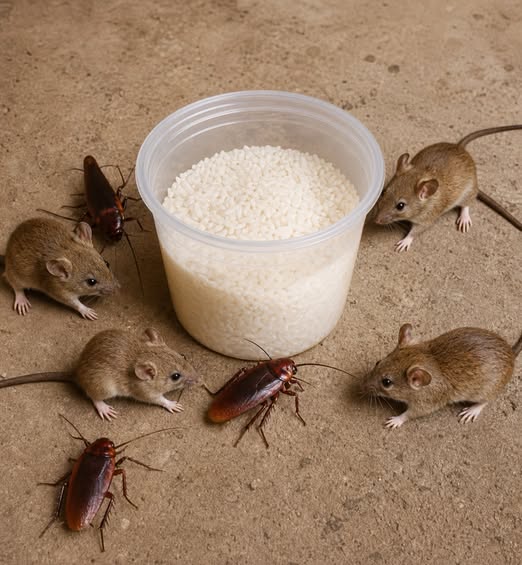
Your home may already contain something you’ve been overlooking—a simple pantry staple that has been sitting in your kitchen for years. No expensive equipment. No complicated process. Just an ordinary ingredient that has suddenly become the center of attention for people searching for gentler ways to deal with unwanted pests. Parents, pet owners, and homeowners are increasingly interested in methods that don’t immediately involve filling their homes with strong chemical odors or reaching for the most aggressive product on the shelf.
For years, pest control has been associated with harsh smells, chemical sprays, sticky traps, and expensive professional treatments. The moment someone notices a cockroach in the kitchen or hears scratching behind a wall, the instinct is often to reach for something powerful. But there is another approach worth considering: making the home less attractive to pests in the first place.
Rice is sometimes suggested as part of these homemade pest-control methods, often combined with strongly scented household ingredients. The idea is that certain smells may discourage pests from lingering in particular areas. But it is important not to confuse a homemade deterrent with a proven extermination method. Rice itself is **not a reliable way to eliminate rats or cockroaches**, and serious infestations require a more dependable approach.
Still, the broader idea behind these methods is useful.
Pests are attracted to homes because homes provide what they need: food, water, warmth, shelter, and hiding places. If those resources are easy to access, even the strongest-smelling household remedy is unlikely to solve the underlying problem. A cleaner kitchen, sealed food containers, covered garbage, dry sinks, and properly sealed gaps can often do more to discourage pests than a bowl of scented ingredients sitting in the corner.
Think about what a rat or cockroach is looking for.
A few crumbs beneath an appliance can become a food source. An open bag of pet food can provide an easy meal. A leaking pipe can provide water. A small crack beneath a cabinet can become a protected entrance. What looks insignificant to us can be an entire support system for a pest population.
That is why prevention is so important.
Instead of thinking only about how to kill pests after they appear, homeowners can also think about how to make their homes less welcoming before an infestation develops. Natural scents may have some value as temporary deterrents in certain circumstances, but they should be viewed as one small part of a larger strategy rather than a magic solution.
And there is another reason people are drawn to these gentler approaches.
Nobody wants to spray harsh chemicals around a kitchen where food is prepared. Parents may worry about children touching treated surfaces. Pet owners may wonder whether their animals could come into contact with something dangerous. Even adults without children or pets may simply prefer to minimize unnecessary chemical exposure in their living spaces.
That doesn’t mean every “natural” remedy is automatically safe, either. Natural substances can still irritate skin, harm pets, contaminate food, or become dangerous when mixed incorrectly. **Natural does not automatically mean harmless.** Any household ingredient used for pest control should be kept away from food, children, and animals unless its safety is well established.
For rats especially, a homemade rice mixture should never be treated as a substitute for proper control. Rats can carry pathogens, damage electrical wiring, contaminate food, and reproduce quickly. If you are seeing repeated signs of rats—droppings, gnaw marks, scratching sounds, or nesting material—the priority should be finding and sealing entry points and using an appropriate, effective control method.
Cockroaches require a similarly practical approach. Removing food and water sources, cleaning hidden areas, reducing clutter, and sealing cracks can make a significant difference. If the infestation is persistent, professional pest management may be necessary.
So perhaps the real “secret weapon” isn’t a single ingredient at all.
It’s changing the environment.
When food isn’t readily available, water isn’t constantly accessible, garbage is sealed, and entry points are blocked, your home becomes much less attractive to unwanted visitors. A simple pantry ingredient might play a small supporting role, but good household habits form the real foundation.
And there is something satisfying about that philosophy.
You don’t have to turn your home into a chemical battlefield. You don’t have to panic at the first sight of a bug. And you don’t have to believe every viral household hack promising an instant solution.
Sometimes the smartest strategy is surprisingly ordinary: **clean, seal, remove food sources, reduce hiding places, and deal with the underlying problem.**
Rice may already be sitting in your kitchen cabinet, but the most powerful pest-control tool in your home may actually be something much simpler—your ability to make the environment difficult for pests to live in.
Safety, cleanliness, and environmental responsibility don’t have to compete with one another.
They can exist under the same roof.