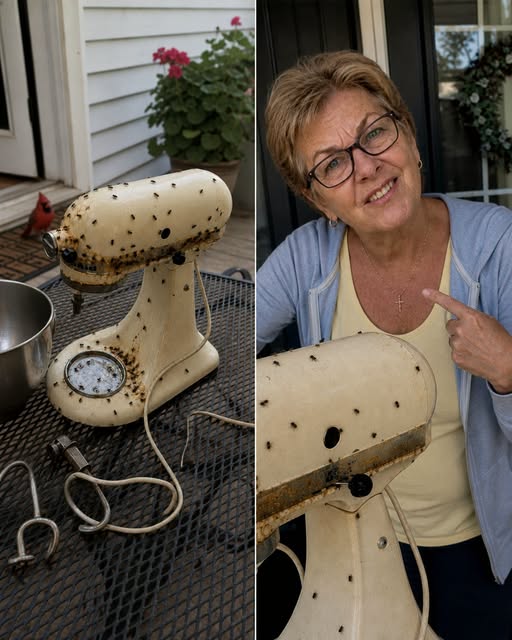
I thought my neighbor had simply ruined my things. I never expected her to break the one object that still sounded like my mother’s voice. A muddy ladder, a dented pan, a missing lid—I swallowed it all. Every time something came back damaged, I told myself it wasn’t worth the argument. I convinced myself that being understanding was easier than demanding an explanation. But when she left my dead, filthy heirloom mixer on my porch and laughed off the damage, something inside me finally snapped.
That mixer was different.
It wasn’t just another kitchen appliance sitting in a cabinet. It belonged to my mother, and the sound of its motor had been part of my childhood. I could remember standing nearby while she baked, listening to that familiar hum as she mixed batter and frosting. After she was gone, the mixer became one of the small things that made the past feel close. It was old, imperfect, and probably worth far less financially than many of the things in my kitchen.
But emotionally, it was priceless.
I had spent years teaching Denise that my belongings were optional, that my kindness came with no limits and no consequences. She borrowed things because she knew I would probably say yes. And when those things came back dirty, scratched, missing pieces, or simply not in the condition I had given them to her, I usually swallowed my frustration.
I told myself that good neighbors helped each other.
I told myself that making a big deal out of small things would create unnecessary tension.
Most importantly, I kept telling myself that eventually she would understand.
She didn’t.
Every small incident added another layer of resentment. The muddy ladder could be cleaned. The dented pan could still be used. The missing lid could probably be replaced. Each individual problem seemed too insignificant to justify a confrontation, so I kept letting them go.
But the pattern was becoming impossible to ignore.
Then came my mother’s mixer.
When it came back crusted with dried frosting, covered in grime, and with a burned-out motor, it wasn’t simply an appliance that had broken. Something much deeper had broken with it. I realized I wasn’t angry because Denise had damaged an old mixer.
I was angry because she had treated something deeply meaningful to me as though it meant nothing.
And I finally understood that my silence had helped create the situation.
For years, I had confused kindness with unlimited access. I thought being generous meant never saying no. I thought setting rules would make me difficult or selfish. Instead, all I had done was teach people that my generosity had no boundaries.
The repair bill gave me proof.
The damage was no longer just an uncomfortable feeling I could dismiss. There was a concrete cost attached to it. The lending agreement I created afterward gave me something I had never allowed myself to have before: a spine.
I started listing every borrowed item.
I documented what it was, what condition it was in, and what it would cost to replace or repair. I assigned dollar values and attached a security deposit. Suddenly, borrowing my belongings wasn’t based on a vague promise to “take care of them.” There were expectations, responsibilities, and consequences.
Denise didn’t like it.
She called the new rules petty.
She complained that I was making everything too complicated and treating simple neighborly favors like business transactions. For a moment, the old version of me wanted to apologize. I almost wondered whether I had gone too far.
Then I looked at my mother’s mixer.
And I realized I wasn’t being petty.
I was finally taking myself seriously.
The rules weren’t designed to punish Denise. They were designed to make responsibility visible. If someone borrowed something, they needed to understand that the object belonged to another person and might have value beyond its price tag.
Eventually, Denise paid for the damage.
She returned everything she had borrowed spotless and in good condition. And, after enough time had passed for the anger to settle, she eventually apologized.
The apology didn’t magically erase what happened, but it mattered.
More importantly, something in me had changed.
I no longer felt guilty for saying no. I no longer believed that kindness required me to tolerate disrespect. And I stopped thinking that boundaries were a sign that I had become less generous.
My mother’s mixer was repaired.
When I turned it on again, the old motor came back to life with that familiar hum. It wasn’t perfect. It still looked old. It carried scratches and signs of years of use. But when it began running in my kitchen again, I felt something I hadn’t expected.
It sounded like home.
It sounded like my mother.
And suddenly, the entire experience made sense.
The mixer had forced me to confront something I had avoided for years: generosity without boundaries can eventually turn into resentment. You can give and give until the thing you once offered freely becomes something you secretly regret offering at all.
That isn’t kindness.
That is quiet bitterness wearing the mask of kindness.
I had spent years believing that saying no would damage relationships. Instead, refusing to set boundaries had slowly damaged my relationship with myself. Every time I accepted another damaged item, every time I swallowed another irritation, I was silently telling myself that my belongings—and my feelings about them—didn’t matter enough to protect.
I finally decided they did.
In the end, Denise paid for the damage. She returned everything spotless. She apologized. And I learned a lesson that had taken years, several ruined belongings, and one deeply sentimental mixer to teach me.
Boundaries don’t kill generosity.
They protect it.
They allow you to keep helping people without secretly resenting them. They make kindness a choice rather than an obligation. And they remind others that generosity should never be confused with permission to be careless.
My mother’s mixer now hums in my kitchen again, old and steady.
Every time I hear it, I remember my mother.
But I also remember the lesson.
Being kind does not mean allowing people to take whatever they want from you.
Sometimes the kindest thing you can do—for yourself and everyone around you—is finally say, “This matters to me, and I need you to treat it that way.”