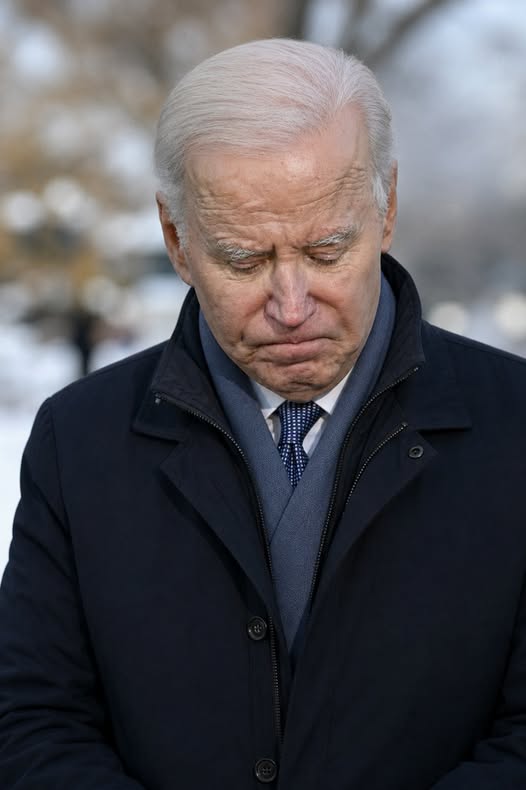
The alert spread like wildfire. A “critical condition” scare involving a former president was enough to send an already anxious nation into a frenzy. Within minutes, timelines exploded, screenshots began circulating, and speculation spread faster than anyone could verify it. People who had never seen an official statement were suddenly repeating claims as if they were confirmed facts.
Was Joe Biden really rushed to the hospital? Was there an actual medical emergency? Or was the country once again watching a rumor transform into a national crisis before reality had even caught up?
When the name involved is a former president, even the smallest whisper can become a political earthquake. A vague post can be shared thousands of times before anyone stops to ask where it came from. An anonymous account can suddenly become the source for millions of people simply because its claim sounds frightening enough to believe.
That is why moments like this demand something increasingly rare: restraint.
A genuine medical emergency involving a former president would normally generate confirmation or denial from official representatives and reporting from major, reputable news organizations. Until that happens, screenshots without context, anonymous accounts, and unnamed “sources” should not be treated as proof.
They are claims.
Nothing more.
The temptation to share first and verify later is powerful, especially when the story involves someone as recognizable and politically significant as Biden. People want to know immediately. They want certainty. They want to feel as though they are ahead of everyone else.
But that urgency is exactly what misinformation exploits.
A dramatic headline doesn’t become more credible because thousands of people are repeating it. A viral post isn’t evidence simply because it has millions of views. And a photograph, especially one taken out of context or recycled from an earlier event, can create an entirely false impression within seconds.
The deeper danger isn’t just one inaccurate headline.
It is what repeated misinformation does to public trust.
Every time an unverified medical scare becomes a viral event, people become more suspicious of everything that follows. When the claim is eventually corrected, some people believe the correction. Others decide the correction is itself part of a cover-up. Eventually, the public becomes trapped between competing narratives, neither of which has been properly established.
That is how information chaos grows.
And it doesn’t only affect politicians.
It affects families watching the news.
It affects journalists trying to separate fact from speculation.
It affects voters trying to understand the people who may influence their country.
It affects anyone who relies on the internet to understand what is happening beyond their own lives.
The responsible response is surprisingly simple.
Pause.
Check the source.
Look for confirmation.
Compare multiple reputable reports.
Wait for official information when the situation involves something as serious as a person’s health.
And if the evidence isn’t there, be willing to say, “We don’t know yet.”
That sentence can feel unsatisfying.
It doesn’t generate clicks.
It doesn’t make an exciting post.
It doesn’t provide the instant certainty people crave.
But uncertainty is better than a confident lie.
In an era when misinformation can travel around the world before journalists have time to verify a single sentence, patience has become a form of responsibility.
The next viral claim will almost certainly arrive.
There will be another screenshot.
Another anonymous account.
Another supposedly urgent warning.
Another headline designed to make people react before they think.
The challenge is not to become faster at believing.
It’s to become better at verifying.
Because responsible citizens—and responsible journalists—must follow a simple discipline:
**Wait. Verify. Then decide what to believe.**
In the noise of speculation, fact-checking can feel slow and boring.
But that quiet work matters.
It is the difference between information and rumor, between awareness and panic, and between a public sphere guided by evidence and one controlled by fear, clicks, and manufactured chaos.