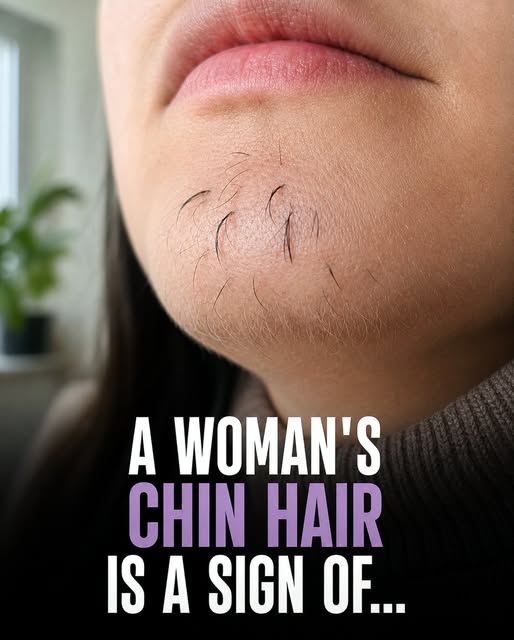
Some women brush it off.
Others panic in silence.
And a few stubborn hairs appearing on the chin can feel like a tiny betrayal from your own body. You look in the mirror, notice something that wasn’t there before, and suddenly start wondering whether it means something more serious is happening beneath the surface.
Why now?
Why there?
And why does it seem darker or thicker than the hair you’ve always had?
But before assuming the worst, it’s important to understand that a few stray chin hairs are surprisingly common. What looks like a small cosmetic change can simply be the result of normal hormonal shifts, genetics, or the natural changes that happen as the body moves through different stages of life.
When hormones shift, your skin and hair can sometimes speak first.
You may notice new facial hair.
A change in acne.
Subtle changes in weight.
Different patterns of hair growth.
Or even changes in the way your scalp hair looks and feels.
Those stray chin hairs are often just a normal response to subtle hormonal changes, especially with age, genetics, or life stages such as perimenopause and menopause. As the balance of hormones changes over time, certain hair follicles can become more sensitive to androgens.
Androgens are often described as “male” hormones, but women naturally produce them too. Everyone has a combination of different hormones, and the balance between them can influence skin, hair growth, energy, metabolism, and many other functions.
When androgen activity affects certain facial hair follicles, those follicles may begin producing strands that are darker, thicker, or coarser than the fine hair surrounding them.
That’s why one day you may notice a single stubborn hair that seems completely out of place.
And then, perhaps weeks or months later, you notice another.
For many women, that’s all it is.
A normal change.
A few hairs that can be managed with tweezers, a quick wax, shaving, or a regular threading appointment.
There doesn’t have to be a deeper medical explanation every time.
Genetics can play a significant role, too. Some women are simply more likely to develop noticeable facial hair than others, and family patterns can influence how hair follicles respond to hormones.
Age matters as well.
The body doesn’t remain hormonally identical throughout adulthood. Hormone levels and sensitivity can shift with time, and those changes can become particularly noticeable around perimenopause and menopause.
So if you suddenly discover one or two coarse hairs on your chin, it doesn’t automatically mean something is wrong.
But there is an important distinction between a few isolated hairs and a sudden, significant change.
When chin or facial hair increases rapidly, especially when it appears alongside other symptoms, it may be worth discussing with a healthcare professional.
For example, irregular or absent menstrual periods can sometimes point toward an underlying hormonal imbalance. Rapid or unexplained weight gain, severe or worsening acne, increased facial or body hair, or noticeable thinning of the hair on the scalp can also provide important clues.
One possible cause is polycystic ovary syndrome, commonly known as PCOS, although it is certainly not the only explanation.
Other hormonal conditions or changes can also affect hair growth.
The important thing is not to diagnose yourself based on one symptom.
A chin hair by itself usually doesn’t tell you enough.
Your overall pattern matters much more.
A healthcare professional can look at your medical history, menstrual pattern, medications, family history, other symptoms, and the timing of the changes. Depending on the situation, they may recommend an examination or laboratory testing to help determine whether hormones are playing a role.
That can turn an uncomfortable mystery into something much easier to understand.
And if treatment is needed, there are options.
For someone dealing primarily with unwanted facial hair, temporary methods such as shaving, tweezing, waxing, or threading may be perfectly reasonable.
Other approaches can target hair growth more directly.
Topical treatments may slow the growth of certain facial hairs.
Some hormone-regulating medications may be appropriate for particular underlying conditions.
Laser hair removal can reduce hair growth over time for many people, while electrolysis can provide another option for longer-term hair removal.
The best choice depends on the individual, the cause of the hair growth, skin and hair characteristics, and medical history.
But perhaps the most important change is psychological.
Understanding what is happening beneath the surface can turn embarrassment into informed action.
Instead of staring at the mirror and wondering whether your body is suddenly “betraying” you, you can recognize that bodies change. Hormones change. Hair follicles respond differently over time. And sometimes something that feels alarming is simply another variation of normal biology.
At the same time, paying attention to changes is not something to be ashamed of.
Your body communicates through patterns.
If something changes quickly, becomes unusually pronounced, or appears alongside several other symptoms, noticing it is useful. You don’t have to panic, but you also don’t have to ignore it.
Think of the change as information.
A few stray hairs may simply mean you need a pair of tweezers.
A sudden increase accompanied by other hormonal symptoms may mean it’s time to ask questions.
Either way, knowledge gives you more control than fear does.
And there is no reason to feel embarrassed about bringing the subject up with a healthcare professional. Facial hair is a common concern, and doctors and other qualified clinicians encounter questions like this regularly.
What feels intensely personal to you may be a completely ordinary conversation for them.
The goal isn’t to achieve some impossible standard of perfectly smooth skin.
The goal is to understand your body well enough to recognize what is normal for you and when something has genuinely changed.
Because one stubborn chin hair doesn’t define your health.
It doesn’t define your femininity.
And it certainly doesn’t mean your body is working against you.
Sometimes, it’s simply a hair follicle responding to the hormones and genetics that make you who you are.
And when there is a bigger pattern behind it, recognizing that pattern can help you get the right information and support sooner.
So the next time you notice that unexpected hair in the mirror, take a breath before you panic.
Look at the bigger picture.
Notice whether anything else has changed.
And remember that understanding your body is far more powerful than being embarrassed by it.
What begins as a tiny detail on your chin can sometimes be nothing more than a normal part of getting older.
And when it does signal something worth investigating, the answer isn’t fear.
It’s information, professional guidance, and the confidence to take care of yourself.