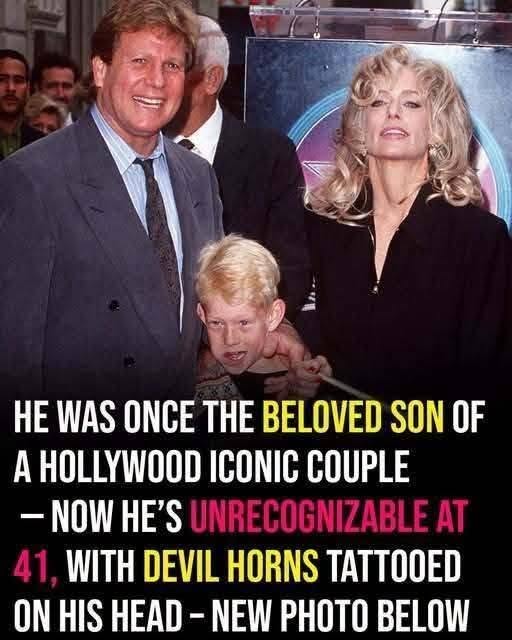
Redmond O’Neal, the only child of actors Farrah Fawcett and Ryan O’Neal, has lived a painful public story shaped by addiction, legal trouble, mental illness, and repeated attempts at recovery. Recent images shocked people who remembered him as the young son of Hollywood stars, but appearance alone cannot explain the decades of struggle behind it.
Farrah Fawcett became an international icon through Charlie’s Angels, film, television, and an image reproduced across popular culture. Behind the glamour, friends described a mother deeply concerned about her son and determined to help him find stability.
Redmond’s difficulties grew during adolescence and adulthood. Substance use, arrests, rehabilitation, and psychiatric evaluation became recurring parts of his life. Wealth and famous parents provided access to treatment but could not produce recovery on his behalf.
Fawcett encouraged programs, offered emotional support, and continued hoping that one attempt would finally take hold. Addiction affects family systems as well as individuals. Relatives move between rescue, boundaries, fear, anger, and the belief that the right intervention might change everything.
Her own cancer diagnosis made the situation more painful. As her health declined, she reportedly worried about what would happen to Redmond without her. A mother facing death was also confronting the limit of love: it can remain unconditional while being unable to control another person’s illness or behavior.
Redmond was allowed to visit her while in custody, arriving under restraint. The image of a son coming to his mother’s deathbed in shackles became one of the most devastating moments in the family’s public history. It joined private grief with consequences visible to the world.
After Fawcett died in 2009, his problems continued. Further arrests and court proceedings kept his name in headlines, often reducing a complicated person to a booking photograph or shocking detail.
Later images showed extensive facial tattoos and a dramatically altered appearance. Online reactions ranged from ridicule to sorrow. Tattoos do not diagnose mental illness or prove dangerousness, but the transformation reminded viewers of years in which Redmond had moved farther from the stable life his mother wanted.
His story should not be used to claim that addiction is inevitable or that recovery is impossible. People recover after repeated setbacks, and treatment can include medical care, therapy, medication, stable housing, peer support, and long term follow up. The correct plan depends on the individual.
It also should not be framed as proof that Fawcett failed as a mother. Parents can provide resources, consequences, and love, but they cannot make treatment decisions for an adult indefinitely. Blame oversimplifies an illness influenced by trauma, mental health, environment, and personal choice.
The fascination with a celebrity child can obscure the human reality. Redmond is not merely a tragic extension of famous parents. He is a person whose actions had consequences and whose health needs require seriousness rather than entertainment.
Farrah Fawcett’s unending concern remains one of the most painful parts of the story. She could not guarantee the future she wanted for her son, yet she did not stop loving him. That distinction—between love and control—is what makes the family’s experience recognizable far beyond Hollywood.
Redmond’s history also shows how fascination with a famous family can obscure the realities of addiction and mental-health care. Recovery is rarely one dramatic turning point. It may require stable housing, medical treatment, legal supervision, relapse prevention and relationships strong enough to maintain boundaries. Love matters, but love alone cannot replace sustained professional support.
Public compassion should therefore avoid both condemnation and romanticization. Redmond’s actions had consequences, while his illnesses required care. Holding those truths together creates a more honest picture than treating him only as a scandal attached to famous parents.