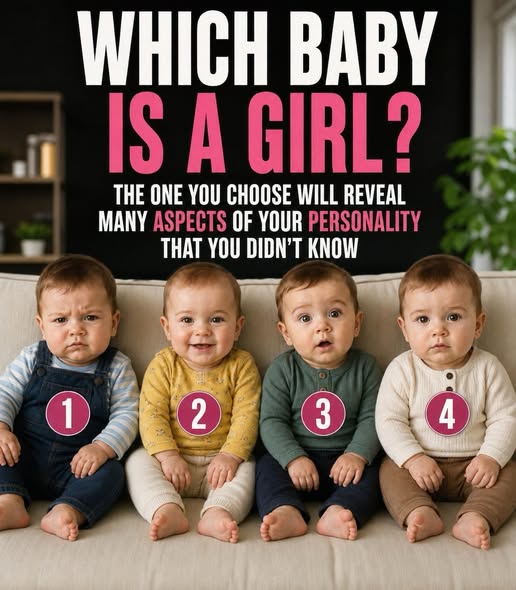
A single photo. Four babies. One impossible question.
Which one is the girl?
Millions tap their answer in seconds, then hold their breath as a glossy “personality reading” appears. It feels eerily accurate, almost intimate, as if a tiny detail in a baby’s expression could somehow reveal something hidden about who they are. Friends argue, compare, defend their choices, and sometimes become surprisingly confident that they have spotted the answer. Yet nothing in the image can prove gender, reveal a child’s future personality, or diagnose character. The real story isn’t about the babies at all. It’s about the human mind, and how quickly it turns a few visual details into a complete story.
What this viral baby test truly exposes is not secret wisdom about gender, but how quickly we build stories from almost nothing. Faced with four nearly indistinguishable infants, people instinctively search for clues. They lean on color cues, softness, calm expressions, hairstyles, facial features, or a hint of delicacy they’ve been taught to associate with girls. Even when those clues have no reliable connection to gender, the brain wants to find a pattern. The moment someone commits to a choice, the quiz rewards them with warm, flattering traits—kind, intuitive, emotionally balanced, compassionate, thoughtful, and perceptive. The descriptions sound personal, but they are broad enough that nearly anyone can find something familiar in them. Suddenly, a random choice feels like evidence of deep intuition.
This is the Barnum effect at work, amplified by confirmation bias and the incredible speed of social media. Once people are told a particular description supposedly matches them, they naturally remember the parts that feel accurate and overlook the parts that do not. A simple guessing game can therefore create the illusion that the image revealed something meaningful about the person looking at it. The image feels playful and harmless, but underneath the entertainment, it quietly reveals how fast we judge and how strongly we cling to those judgments once they have been formed.
And perhaps that is what makes the test more interesting than the answer itself. Its real value is not in labeling personalities, predicting behavior, or deciding which baby “looks” like a girl. It is in sparking conversations about perception and bias. What did you see? Which detail caught your attention first? Why did you think that detail meant “girl”? Would you have made the same choice if the colors or framing were different? And where else, in real life, are those same snap assumptions steering you without your consent? Sometimes the most revealing part of a personality test isn’t what it tells us about the picture—it’s what our immediate reaction reveals about ourselves.