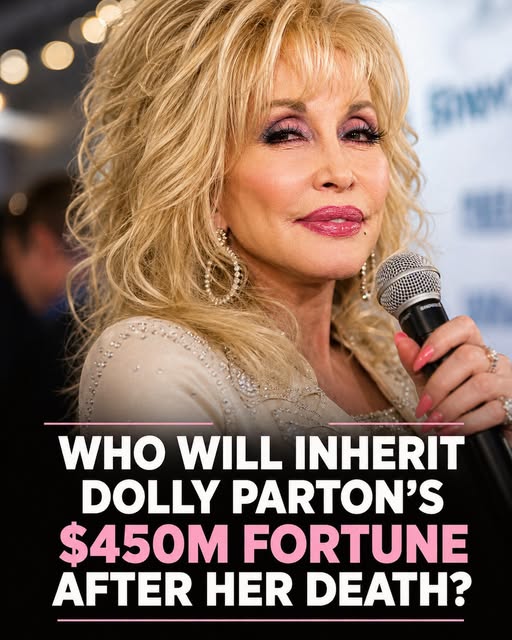
Dolly Parton is gone, and almost immediately, attention has turned from the music to the money.
For more than six decades, she built an extraordinary empire from almost nothing. Songs became publishing rights. Performances became businesses. Her name became attached to Dollywood, books, merchandise, film, television, and countless other ventures.
Now that empire has entered a new chapter.
Dolly died at 80 on August 25, 2026, leaving behind an estate whose full details have not yet been made public. Forbes had estimated her net worth at approximately **$450 million**, with a major portion of that wealth tied to her stake in Dollywood and a songwriting catalog Forbes valued at roughly $120 million in 2025.
And that immediately raises the question everyone wants answered:
Who gets it?
The obvious answer might once have been her husband.
But Carl Dean died in March 2025 after nearly 60 years of marriage. The couple famously never had children, leaving no direct descendants to automatically step into the role many people would expect.
That doesn’t mean Dolly’s fortune is suddenly without a destination.
It means the destination may be considerably more complicated.
Parton’s family remains large. She grew up as one of 12 children, and her extended family includes siblings, nieces, nephews, grandnieces, and grandnephews. But exactly which relatives, if any, will benefit from her estate cannot be known until the relevant estate documents become available.
And there is another possibility that feels particularly consistent with Dolly herself.
Charity.
For decades, philanthropy was not something she added to her career after becoming wealthy. It became part of the career itself.
Through the Dolly Parton Foundation and the Imagination Library, she helped put hundreds of millions of books into children’s hands. She also supported medical research, disaster relief, education, and other causes. Forbes reported that her Imagination Library had distributed more than 300 million books across five countries.
So it would not be surprising if charitable organizations eventually become major beneficiaries of her estate.
But right now, that remains speculation.
What is known is that Dolly thought seriously about what would happen after her death.
She had publicly discussed estate planning years before she died. In a 2020 interview, she explained that she was working with an estate lawyer and said she did not want to leave behind the kind of confusion that had surrounded the estates of other famous musicians. Her concern was that her family should not be forced into years of fighting over what she had built.
That statement may prove to be one of the most important pieces of the puzzle.
Because Dolly wasn’t simply someone who accumulated wealth and assumed the rest would take care of itself.
She was a businesswoman.
She understood intellectual property.
She understood contracts.
She understood the value of her name.
And she understood that a fortune built over a lifetime could become a source of conflict if there was no clear plan for what happened afterward.
Her music catalog alone represents an enormous asset.
With more than 3,000 songs credited to her, the rights associated with her songwriting could continue generating income for decades.
Then there is Dollywood.
The theme park became one of the most visible symbols of the empire Dolly built. Her stake in the Dollywood Company was a major component of the fortune Forbes estimated before her death.
And unlike a bank account, an empire like this doesn’t simply disappear when its founder dies.
The businesses continue.
The music continues earning royalties.
The intellectual property continues generating value.
The brand continues operating.
The charitable organizations continue their work.
In other words, Dolly’s estate is not just about dividing up a pile of money.
It is about deciding what happens to an entire ecosystem she spent decades creating.
There is also a fascinating piece of history involving Carl Dean’s own estate.
According to reporting cited by Parade and other outlets, Dean’s 2013 will named Dolly as the primary beneficiary and placed his estate into a trust in her name, while also specifying certain personal items for members of his family.
That means Dolly’s estate planning was not happening in isolation.
The couple had already taken steps to organize what would happen to their possessions.
And Dolly had years to think about what should happen to hers.
Still, the public has not been given the complete picture.
Her will has not been made public as of the latest reporting, and no definitive list of beneficiaries has been announced.
That uncertainty is exactly what is feeding the speculation.
Some people expect relatives to inherit significant portions.
Others believe Dolly may direct substantial wealth toward the charitable causes that defined her later life.
Still others wonder whether carefully structured trusts will keep parts of her empire operating largely as they did while she was alive.
The truth is that nobody outside the people handling her estate can say with certainty yet.
And perhaps that is exactly how Dolly would have wanted it.
She spent her life giving the public enormous amounts of herself while keeping certain parts of her private world firmly protected.
Her marriage was private.
Her home was private.
Her finances were carefully managed.
And her estate planning appears to have been treated as another matter that belonged behind closed doors.
What is already clear, however, is that Dolly’s legacy cannot be reduced to the size of her fortune.
She gave away enormous amounts while she was alive.
She built institutions designed to keep giving after she was gone.
She created programs that could continue helping children she would never meet.
She created music that will continue earning money long after the original recordings are gone.
She created Dollywood as a place where millions of people could continue experiencing something connected to the world she came from.
That may be the most important part of the inheritance.
Dolly Parton did not simply leave money behind.
She left machines for doing good.
Books will continue arriving.
Music will continue playing.
Businesses will continue operating.
People will continue visiting Dollywood.
And somewhere, a child will open a book that exists because Dolly once believed every child deserved the chance to dream.
The legal documents will eventually reveal who receives what.
There may be relatives.
There may be trusts.
There may be charities.
There may be complicated arrangements that the public never fully understands.
But the larger inheritance is already obvious.
Dolly spent her lifetime turning success into something that could reach beyond herself.
Now her estate has to determine how that work continues without her.
The money trail may become a legal story.
The trusts may become a financial story.
The beneficiaries may become a family story.
But the legacy is something else entirely.
That part was already settled before she died.
Dolly Parton built something meant to outlive Dolly Parton.
And now the world is waiting to see exactly how far it will reach.