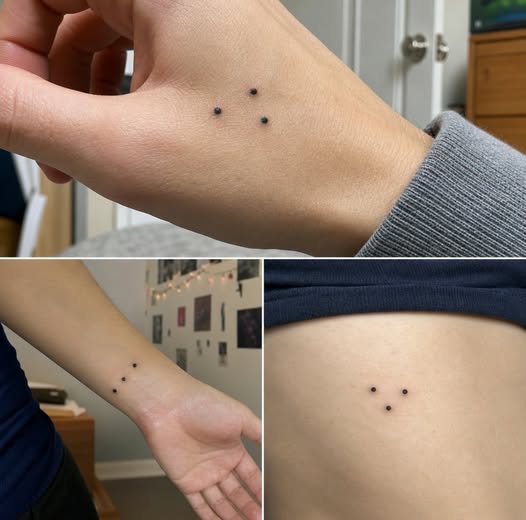
A tiny triangle of ink.
Three dots.
Nothing more.
Yet those three little marks can carry an enormous amount of meaning, depending on who wears them, where they live, and why they chose them.
To one person, they may look like a warning.
To another, they may represent survival.
And to someone else, they may simply be a private reminder of a chapter in their life that nobody else knows anything about.
For decades, three-dot tattoos have been surrounded by rumors, stereotypes, and assumptions.
People see the symbol and immediately try to tell a story about the person wearing it.
Gang member.
Former prisoner.
Troublemaker.
Someone living on the edge.
Sometimes those associations do exist.
But they are not universal.
And that distinction matters.
### The meaning people know best
One of the most commonly discussed interpretations of the three-dot tattoo is the Spanish phrase **“mi vida loca,”** meaning “my crazy life.”
The symbol has been associated in some contexts with people living on the margins of society, particularly within certain prison and gang cultures.
But even there, meaning can vary considerably.
There isn’t one universal rulebook that says every three-dot tattoo means the same thing.
The placement matters.
The surrounding tattoos may matter.
The person’s cultural background may matter.
And most importantly, the person’s own reason for getting it matters.
That’s something outsiders often forget.
A symbol can travel from one community into another and acquire completely different meanings along the way.
### Prison symbolism isn’t the whole story
Because three-dot tattoos have appeared in prison and gang-related contexts, many people automatically assume the wearer has a criminal past.
That assumption can be completely wrong.
Someone may have chosen the design because they liked its appearance.
Someone else may have connected it to a personal philosophy.
Another person may have used it as a symbol of family or faith.
Someone else may have gotten it during a difficult period of their life as a reminder that they survived.
The same three dots can therefore tell completely different stories.
Ink doesn’t come with a universal translation.
### Sometimes the meaning is deeply personal
Tattoos are often used to mark experiences that are difficult to explain.
A person may choose a small symbol because they don’t want the world to know everything behind it.
Three dots can represent a turning point.
A loss.
A promise.
A friendship.
A personal struggle.
A new beginning.
Or simply a reminder of a period the person never wants to forget.
The tattoo may be visible.
The story behind it may not be.
And that’s where assumptions become dangerous.
You can see the ink.
You cannot see the memory attached to it.
### Context changes everything
Imagine seeing three dots tattooed near someone’s hand.
Without context, you have almost no reliable information.
You don’t know where they got it.
You don’t know when they got it.
You don’t know who influenced them.
You don’t know what it means.
You don’t know whether the person has ever been involved in anything criminal.
And you certainly don’t know what kind of person they are.
Yet people often make all of those judgments within seconds.
That’s the problem with symbolic tattoos.
They can become stereotypes faster than they become stories.
The symbol gets recognized.
The stereotype follows.
And the actual person disappears behind it.
### Even the location can change perceptions
The placement of a tattoo can influence how people interpret it.
A design on the hand or near the face is highly visible and therefore more likely to attract attention.
The same design somewhere covered by clothing may go unnoticed for years.
But visibility doesn’t automatically make the meaning more serious.
It simply makes the symbol easier for strangers to see.
And once people see it, they may begin constructing a story.
That story may have nothing to do with reality.
### Three dots aren’t a universal gang code
This is perhaps the most important point.
There is no single universal meaning of a three-dot tattoo.
Some people associate it with gangs.
Some associate it with prison culture.
Some associate it with “mi vida loca.”
Others use the symbol for entirely personal reasons.
The design can also appear in different cultural contexts where its significance isn’t connected to crime at all.
So if you see someone with three dots tattooed on their body, you cannot reliably determine their character from that symbol alone.
You don’t know their history.
You don’t know their intentions.
And you don’t know their future.
A tattoo is evidence that someone chose to put ink on their skin.
It is not evidence of who they are as a human being.
### Why the stereotype survives
The stereotype is powerful because it has been reinforced for decades through movies, television, news coverage, and popular culture.
Audiences repeatedly see certain tattoo symbols associated with criminals or dangerous characters.
Eventually, the association becomes automatic.
Three dots appear.
People immediately think they know the story.
But fiction often compresses complicated cultural symbols into simple visual shortcuts.
Real life is much messier.
People don’t fit neatly into the roles created for them on screen.
And tattoos rarely come with the convenient explanations that movies provide.
### A stranger’s tattoo cannot tell you their character
This is the bigger lesson.
We often judge people using tiny pieces of information.
Clothing.
Hair.
Accent.
Tattoos.
Piercings.
The neighborhood someone lives in.
The music they listen to.
The way they speak.
We take one visible detail and build an entire personality around it.
But human beings are far more complicated than that.
A person can have a tattoo associated with a particular culture without participating in every aspect of that culture.
A person can have a symbol associated with criminality without ever committing a crime.
And someone who appears completely ordinary may carry a history you could never guess.
You simply cannot know from a few marks on someone’s skin.
### The story belongs to the person wearing it
That may be the most honest way to look at tattoos.
The meaning belongs first to the person who chose them.
If they want to explain it, they can.
If they don’t, they don’t owe anyone an explanation.
Three tiny dots may represent a complicated life.
Or they may represent almost nothing at all.
Maybe the person simply liked the design.
Maybe they got it because a friend had one.
Maybe it marks a moment that changed their life.
Maybe it means something that cannot easily be translated into words.
And sometimes the person wearing the tattoo is the only one who truly knows.
So the next time you see three small dots arranged together, resist the urge to immediately create a story.
Don’t assume criminality.
Don’t assume gang membership.
Don’t assume prison.
Don’t assume innocence either.
Simply recognize what you actually know:
Someone chose three dots.
Everything else is context.
And if you ever genuinely need to know what they mean, the only reliable answer is the one the person wearing them chooses to give.
Because three dots may be tiny.
But the story behind them can be an entire life.