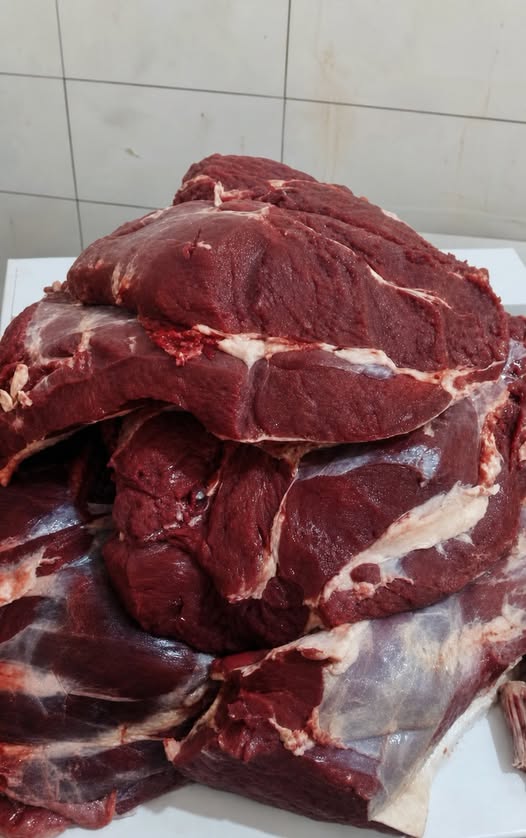
That bright red steak in the display case might be lying to you.
It looks perfect.
It looks fresh.
It looks safe.
But the color that shoppers instinctively trust may be one of the least reliable clues in the entire store.
Under bright supermarket lights, behind plastic wrap, and surrounded by carefully designed packaging, meat can appear newer and more appealing than it really is. The reddest package may grab your attention first, but bright color alone cannot tell you whether the meat is safe, fresh, or worth buying.
The reason is simple:
**Meat changes color because of chemistry.**
Fresh beef exposed to oxygen often develops the familiar bright cherry-red appearance that shoppers associate with freshness. That color comes largely from the interaction between oxygen and myoglobin, a protein naturally found in muscle tissue.
But remove much of that oxygen, and the same beef can look completely different.
Vacuum-sealed beef, for example, may appear dark purple or almost burgundy when you first open the package. That does not automatically mean the meat has spoiled. Once exposed to oxygen, it can gradually become red again.
In other words, the same piece of beef can look dramatically different depending on how much oxygen is around it.
That alone should make you think twice before judging meat by color.
A steak sitting in a traditional tray may look bright red because its surface has been exposed to oxygen.
Another steak sealed tightly in plastic may appear darker because oxygen has been limited.
Neither appearance, by itself, tells the entire story.
And supermarkets know that appearance matters.
Lighting can influence what you see.
Packaging can influence what you notice.
Labels can influence what you believe.
Words like “premium,” “natural,” “farm raised,” or other marketing language can create an impression of quality that has little to do with whether the meat is actually safer to eat.
The smartest shopper therefore looks beyond the color.
Start with the package itself.
Check whether the seal is intact.
Look for leaks.
Look for excessive liquid that has escaped from the package.
Pay attention to swelling or unusual bulging.
Make sure the meat has been kept properly chilled and that the package has not been sitting in a warm environment.
The package should look like it has been handled and stored appropriately.
But even those details are not a guarantee of safety.
The most important thing to understand is that **you cannot see dangerous bacteria simply by looking at meat**.
A piece of beef can look attractive and still contain harmful microorganisms.
And a piece of meat that looks darker than expected is not automatically dangerous.
That is why appearance should never be your only test.
When you get the meat home, keep it refrigerated and handle it carefully.
Avoid leaving it sitting on the counter for long periods.
Prevent raw juices from coming into contact with foods that will be eaten without cooking.
Wash hands, utensils, and surfaces appropriately after handling raw meat.
And when you cook it, use a food thermometer rather than relying entirely on color.
That last point matters because visual cues can be misleading in both directions.
A steak can appear cooked on the outside while still being undercooked internally.
Another piece can lose its pink color before it reaches the temperature you actually need.
A thermometer gives you information that your eyes simply cannot.
The same principle applies when evaluating meat after opening the package.
Smell and texture can provide useful clues about spoilage, but they are not perfect safety tests either.
If something smells distinctly unpleasant, feels unusually slimy, or looks otherwise abnormal, that is a good reason to stop and reconsider.
But the absence of a bad smell does not prove that dangerous bacteria are absent.
That is one of the biggest misconceptions about food safety.
People often assume that spoiled food will always announce itself.
Sometimes it does.
Sometimes it doesn’t.
Certain harmful bacteria can be present without creating an obvious smell, taste, or visual change.
That is why safe storage and proper cooking matter far more than trying to become an expert at judging meat by appearance.
There is another reason shoppers can be fooled by color.
The surface of meat is constantly interacting with its environment.
Oxygen levels change.
Packaging changes.
Temperature changes.
Lighting changes.
Even the position of the package in the display case can affect how it looks to you.
A steak underneath bright overhead lighting may appear dramatically more appealing than the same steak under ordinary kitchen lighting.
That doesn’t mean the store is deliberately deceiving you.
It means your eyes are responding to conditions that have very little to do with microbiological safety.
Color is presentation.
Safety is a process.
That distinction is important.
A bright red steak is not necessarily better.
A darker steak is not necessarily worse.
A vacuum-sealed steak that looks purple can be perfectly normal.
And a beautifully red steak cannot promise that it is free from harmful bacteria.
So the next time you stand in front of the meat case, don’t automatically reach for the reddest package.
Slow down.
Read the label.
Check the date and storage information.
Inspect the packaging.
Make sure it is properly chilled.
Think about how you will transport and store it.
And when you cook it, use a thermometer.
The goal isn’t to become afraid of buying meat.
It’s to stop letting appearance make the decision for you.
Because the brightest steak isn’t necessarily the freshest.
The darkest steak isn’t necessarily spoiled.
And the prettiest package isn’t necessarily the safest.
The smartest shopper understands that meat is more complicated than it looks.
The color is chemistry.
The packaging is presentation.
The label provides information.
The thermometer provides a measurable cooking check.
And the safest approach is to consider all of those details together rather than trusting one visual clue.
So next time that perfect red steak catches your eye, remember:
**Your eyes can tell you what the meat looks like.**
They cannot tell you everything you need to know about whether it is safe.