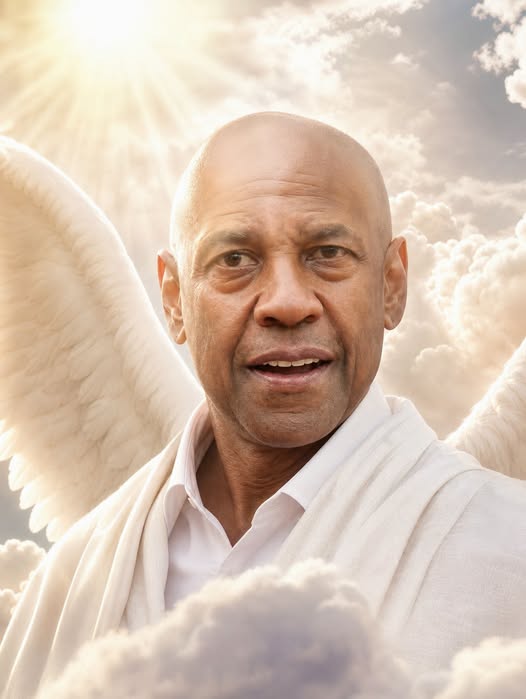
He didn’t just play heroes and villains.
He made them feel terrifyingly real.
For decades, Denzel Washington has walked into stories and somehow made the characters feel as though they existed long before the cameras arrived—and would continue living after the credits rolled.
He could play a man of extraordinary principle, a deeply wounded soul, a dangerous criminal, a charismatic liar, or someone quietly fighting to hold himself together.
Whatever the role, he rarely seemed to be simply performing it.
He inhabited it.
That is what separates Denzel Washington from so many great actors.
His performances are not built entirely around dramatic speeches or obvious displays of emotion. Often, the most powerful moments happen when he says almost nothing.
A glance.
A pause.
A slight change in his expression.
The way he sits in a chair.
The way he walks into a room.
The way his voice changes when someone touches a subject he would rather avoid.
Those details create the feeling that there is an entire history happening beneath the dialogue.
And audiences can sense it.
Washington’s career has stretched across decades and genres, but one quality has remained remarkably consistent: he understands that strength is most compelling when vulnerability exists underneath it.
That tension has defined some of his most unforgettable characters.
As Malcolm X, he portrayed a man undergoing an extraordinary transformation, moving through anger, conviction, identity, and spiritual awakening. The performance did more than recreate a historical figure. It brought the emotional force of Malcolm X’s journey to a new generation of viewers.
Washington didn’t make him feel like a distant figure from a history book.
He made him feel alive.
He made audiences feel the intelligence behind the words, the anger behind the conviction, and the evolution of a man whose worldview was constantly changing.
Then there were characters who were almost the complete opposite.
In *Training Day*, Washington played Alonzo Harris, a corrupt detective whose charm was as dangerous as his authority.
Alonzo could smile while threatening someone.
He could make corruption sound like wisdom.
He could turn confidence into intimidation without ever raising his voice.
That performance was frightening precisely because the character was not presented as a simple monster.
He was intelligent.
Funny.
Charismatic.
Manipulative.
And completely comfortable with his own moral corruption.
Washington understood that the most dangerous people are not always the ones who look dangerous.
Sometimes they are the ones who make you feel safe first.
That ability to move between moral extremes became one of the defining strengths of his career.
He could portray people audiences admired.
He could portray people audiences feared.
And sometimes, he played characters who were both.
In *Philadelphia*, his performance as a lawyer confronting prejudice placed him in a story about discrimination, fear, friendship, and human dignity.
The character’s strength came not from being invulnerable, but from being forced to confront ideas that challenged him.
Again, Washington found the human conflict underneath the plot.
That became a pattern throughout his career.
He rarely played characters who were simply good or evil.
His people were complicated.
They carried wounds.
They made mistakes.
They had contradictions.
They wanted things.
They feared things.
They sometimes made terrible decisions while believing they were doing the right thing.
That complexity is part of why audiences continue returning to his films.
A great performance does not simply tell you what a character is feeling.
It makes you wonder what they are feeling.
It gives the audience room to interpret.
And Washington is particularly powerful in those spaces between words.
He can stand completely still and somehow create tension.
He can look at another character and make the audience wonder whether he is about to forgive them, threaten them, or walk away.
That control has become one of his trademarks.
His performances also helped change perceptions of what a leading man could look like.
For Black actors in particular, Washington’s career represented something enormous.
He did not become successful by limiting himself to one kind of character.
He played historical figures.
Professionals.
Soldiers.
Detectives.
Lawyers.
Fathers.
Criminals.
Mentors.
Men struggling with addiction, anger, grief, ambition, morality, and power.
He demonstrated that Black leading men could occupy the full range of human experience on screen.
They could be heroic without being perfect.
Powerful without being emotionless.
Vulnerable without losing their strength.
Dangerous without becoming caricatures.
Intelligent without needing to explain their intelligence.
That breadth mattered.
It expanded possibilities not only for Washington himself, but for generations of actors who followed.
And perhaps the most impressive part is that his greatest performances do not feel trapped inside their time.
A movie may age.
A hairstyle may become dated.
Technology may look old-fashioned.
But a genuinely human performance can remain powerful.
That is why new audiences continue discovering Washington’s work.
Someone who watches *Malcolm X* decades after its release can still feel the intensity.
Someone watching *Training Day* for the first time can still understand why Alonzo is so unsettling.
Someone encountering another performance from his long filmography can still experience that same sensation:
This person feels real.
That is the ultimate compliment an actor can receive.
Not that they looked convincing.
Not that they memorized their lines.
But that, for a while, you forgot you were watching an actor.
You believed you were watching a human being living through something.
Washington has built an entire career around that feeling.
His legacy is therefore bigger than any single role.
It is a gallery of people.
Some wounded.
Some ambitious.
Some compassionate.
Some dangerous.
Some lost.
Some searching for redemption.
Some who never find it.
Together, they form one of the most remarkable collections of character work in modern American cinema.
And there is another reason his work continues to matter.
He understands the power of restraint.
In an era when performances can sometimes become louder and more exaggerated in an attempt to attract attention, Washington can do the opposite.
He can lower his voice.
Slow down.
Let silence sit.
Trust the audience.
That confidence is rare.
He does not always need to tell you what a character is thinking.
He lets you feel that something is happening beneath the surface.
And sometimes, that is more powerful than any speech.
Decades into his career, Denzel Washington has become more than a movie star.
He has become a reference point.
When people talk about screen presence, intensity, emotional intelligence, or the ability to command a scene without shouting, his name naturally enters the conversation.
But perhaps the simplest way to understand his legacy is this:
He never treated his characters like costumes.
He treated them like lives.
And that is why they remain with us.
Long after the box-office numbers disappear.
Long after the premieres are forgotten.
Long after a particular movie leaves the headlines.
The characters remain.
Malcolm X remains.
Alonzo remains.
And the countless other men Washington has brought to life continue waiting on screens for another generation to discover them.
The remarkable thing is that when they appear, they rarely feel like performances from the past.
They feel immediate.
Human.
Alive.
That is not simply stardom.
That is the rare ability to make audiences believe, for a few unforgettable hours, that they are not watching someone pretend to be another person.
They are watching a life unfold.