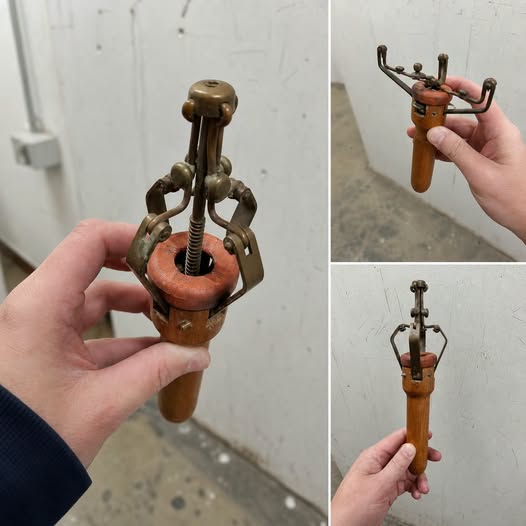
A strange wooden-handled device lay buried beneath decades of dust in an old barn.
No label.
No instructions.
No obvious purpose.
To anyone who found it today, it might look like an oddly shaped piece of farm equipment that had long ago lost its meaning.
But this humble tool once performed a surprisingly important job.
It helped protect a cow from daily injury.
The device was known as an **“Écarteur de tétine de trayeuse,”** or a **teat cup liner expander**. Its purpose was closely connected to the early development of mechanical milking, when farms were making the difficult transition from traditional hand-milking to machines.
That transition promised speed and efficiency.
But early machines were not perfect.
One of their most important components was the rubber liner inside the metal teat cup. The liner formed the soft connection between the machine and the animal, allowing milk to be drawn without exposing the teat directly to hard metal.
The problem was that early rubber liners were often simple tubes.
They had to be inserted manually into the stainless-steel cups, and the edges needed to be carefully shaped.
If the rubber was not properly flared, the edge could remain too sharp or uneven.
During repeated milking, that small imperfection could cause pinching, cuts, irritation, or other injuries to the sensitive skin.
For the farmer, it might have looked like a tiny mechanical detail.
For the animal, it could mean pain every time the machine was used.
That is where the strange wooden-handled tool came in.
Its design was simple, but precise.
The wooden handle provided a comfortable grip while metal jaws or working surfaces were used to expand and shape the edge of the rubber liner.
Instead of forcing tired fingers to manipulate cold, stubborn rubber, the farmer could use the tool to create a smoother, rounded lip.
That small adjustment made the liner fit more safely.
The edge could sit against the animal’s skin without producing the same sharp contact that an improperly prepared liner might cause.
It was not glamorous technology.
It did not make headlines.
It was not the kind of invention that transformed a farm overnight.
But it solved a very specific problem.
And on a working dairy farm, small problems matter.
A damaged liner could affect the comfort of an animal, the quality of milking, and the daily routine of the people operating the equipment.
The expander therefore became one of those tools whose importance was measured not by how impressive it looked, but by how many problems it quietly prevented.
The timing of its existence is what makes it especially interesting.
Mechanical milking was changing agriculture.
Machines could do work that previously required hours of manual labor, allowing farmers to handle larger herds and make milking more efficient.
But every new machine introduced new challenges.
Farmers had to learn how to maintain equipment.
Rubber components had to be cleaned.
Metal parts had to be inspected.
Linings had to be replaced or prepared correctly.
Hygiene became increasingly important because equipment came into direct contact with milk and animals.
After each milking, components could be removed, cleaned, and sanitized before being used again.
The teat cup liner expander belonged to this world of careful maintenance.
It was a tool for preparing the equipment before it went back to work.
And then technology moved forward again.
Manufacturing techniques improved.
Factories became capable of producing rubber liners in more consistent shapes, with edges that were already molded into the correct form.
The farmer no longer needed to spend time manually expanding the liner.
The little tool that had once been useful suddenly became unnecessary.
Its disappearance was almost invisible.
There was no dramatic announcement.
No final day when someone declared that the expander was obsolete.
It simply stopped being needed.
New liners arrived from factories already shaped correctly.
Farmers used them.
The old tools were pushed into drawers, workshops, barns, and storage sheds.
Some were eventually thrown away.
Others were forgotten.
Decades passed.
And eventually, someone might discover one beneath a layer of dust and wonder what on earth it had been designed to do.
That is what makes objects like this so fascinating.
Modern technology often hides the problems that earlier generations had to solve manually.
Today, a perfectly molded rubber component seems ordinary.
We don’t think about the manufacturing precision required to create it.
We don’t think about the old tools that existed because those manufacturing processes were not yet available.
We simply see the finished product.
But behind every modern convenience is often a collection of forgotten inventions.
Tools that existed for a specific problem.
Tools that were important for a few decades.
And tools that disappeared as soon as technology found a better way.
The teat cup liner expander was one of them.
Its purpose may sound insignificant compared with tractors, engines, or modern milking systems.
Yet its purpose was remarkably practical.
It helped turn an awkward piece of rubber into something safer and more comfortable for the animal.
It represented a period when farmers were learning how to make machines work alongside living creatures.
The tool also tells us something about how progress really happens.
Innovation isn’t always about creating something completely new.
Sometimes it is about solving one small problem at a time.
A rough edge.
A painful pinch.
A poorly fitting component.
A task that takes too long.
Someone notices the problem.
Someone creates a solution.
And for a while, that solution becomes part of everyday life.
Until another invention makes it unnecessary.
Then the tool disappears.
Years later, someone finds it again.
The wooden handle is worn.
The metal is aged.
The original context is gone.
And without knowing its history, it looks almost meaningless.
But it once stood between a machine and an animal’s skin.
It helped prevent small injuries that could otherwise happen again and again.
Eventually, better manufacturing made the tool unnecessary.
That is why the mysterious object in the dusty barn was more than an old piece of farm equipment.
It was a surviving fragment of a technological transition.
A reminder of the period when dairy farming was changing rapidly and farmers were learning, through trial and error, how to make machines safer, cleaner, and more practical.
Today, most people would probably walk past it without recognizing its purpose.
But hidden inside its strange shape is a story about progress.
About problems that once seemed unavoidable.
About the quiet tools created to solve them.
And about how quickly even useful inventions can disappear when the world finds a better way.
The little wooden-handled device didn’t change history by itself.
It simply made one difficult task a little safer.
And sometimes, that is exactly what good technology is supposed to do.