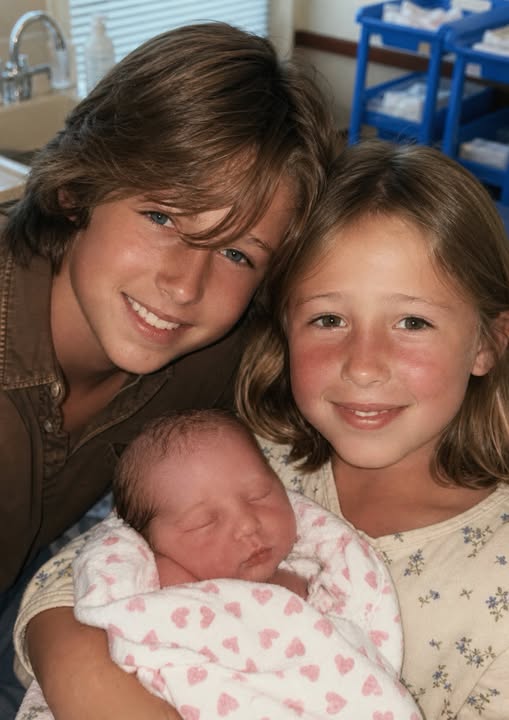
A child became a mother, and the whole country gasped.
In North London, the story of a 12-year-old girl and her 13-year-old boyfriend becoming parents has captured widespread attention, not simply because of the age involved, but because of everything those numbers represent.
Two children are suddenly facing responsibilities normally associated with adulthood.
A newborn needs constant care.
There are feeding schedules, sleepless nights, medical appointments, financial concerns, education, and countless decisions that adults often spend years preparing to handle.
For two young teenagers, that reality can be overwhelming.
Behind the headlines is a girl who is still, in many ways, a child herself.
She may still want to sit in a classroom with friends.
She may still have subjects she enjoys, teachers she trusts, and dreams that have nothing to do with diapers or midnight feedings.
The arrival of a baby does not erase those dreams.
If anything, protecting them becomes more important.
Her baby was reportedly born healthy, something that provided a moment of relief amid an otherwise deeply complicated situation.
But a healthy birth does not make the circumstances simple.
The weeks and months that follow can be just as challenging as pregnancy itself.
A newborn requires attention around the clock, while a young mother still needs education, emotional support, healthcare, and the opportunity to continue developing into the person she is supposed to become.
Her 13-year-old boyfriend has described their relationship as true love.
Their families have expressed support and spoken about commitment, responsibility, and hope for the future.
Those feelings may be genuine.
But love alone cannot remove the realities facing two children who have suddenly entered a world of adult responsibilities.
They will need help.
Not just encouragement, but practical support.
They will need adults willing to protect their wellbeing while helping them understand what parenthood actually requires.
They will need access to education.
They will need medical and emotional care.
They will need guidance with the everyday responsibilities of raising a child.
And they will need space to continue being young people themselves.
That last part can easily be forgotten.
When a teenager becomes a parent, society often begins treating them as an adult immediately.
The language changes.
The expectations change.
People start asking whether they are responsible enough, mature enough, or capable enough.
But becoming a parent does not magically accelerate every other part of development.
A 12-year-old does not suddenly acquire decades of life experience simply because she has a baby.
A 13-year-old does not automatically know how to navigate relationships, finances, education, employment, housing, or long-term family responsibilities.
They are still learning.
They still need adults.
And the child they are raising needs them to have that support.
That is why judgment is unlikely to help.
It is easy for strangers to look at a headline and decide who is responsible.
It is much harder to understand the circumstances that led there.
There may be questions about family support, education, safeguarding, social pressures, and the environment surrounding the young couple. Those questions are important, but they should be approached carefully and through verified facts rather than speculation.
The priority now should be the wellbeing of everyone involved—especially the baby and the two young parents.
The families’ support can make an enormous difference.
So can schools, healthcare professionals, social services, and other trusted adults.
A young parent should not be forced to choose between caring for a baby and having an education if meaningful support can make both possible.
The girl should still have the opportunity to learn.
The boy should still have the opportunity to grow.
And their child should have the chance to grow up in an environment that is safe, stable, and supported.
There is also something important to remember about the language surrounding this story.
Calling them Britain’s “youngest parents” may attract attention, but records are not the most important part of their lives.
They are not statistics.
They are not a headline.
They are two young people who now have a responsibility far larger than their years suggest.
And there is a baby at the center of the story who had no say in any of it.
That baby deserves stability.
The parents deserve guidance.
And the families deserve support rather than an endless cycle of public judgment.
The future will not be determined by one headline.
It will be determined by what happens next.
Whether the young parents remain connected to education.
Whether they receive appropriate healthcare.
Whether adults around them provide consistent support.
Whether the baby grows up surrounded by safety and stability.
And whether the two teenagers are allowed to continue developing as individuals while learning how to become parents.
This is not a fairy tale.
It is not a simple story of teenage romance.
And it should not be reduced to a morality lesson.
It is a complicated situation involving childhood, responsibility, family, safeguarding, love, and a newborn life.
The most compassionate response is not to pretend that everything will be easy.
It is to acknowledge how difficult it may be while making sure these children are not left to face it alone.
Because two children have suddenly been asked to carry an adult responsibility.
They should not have to carry it without adults beside them.
The baby deserves a future.
The young mother deserves an education and the chance to grow.
The young father deserves guidance and support.
And all of them deserve the opportunity to move beyond the shock of a headline and build something safer, steadier, and more hopeful.
Childhood may have collided with adulthood far too soon.
But with the right support, that does not have to mean the end of childhood altogether.
It means the adults around them must work harder to protect it.