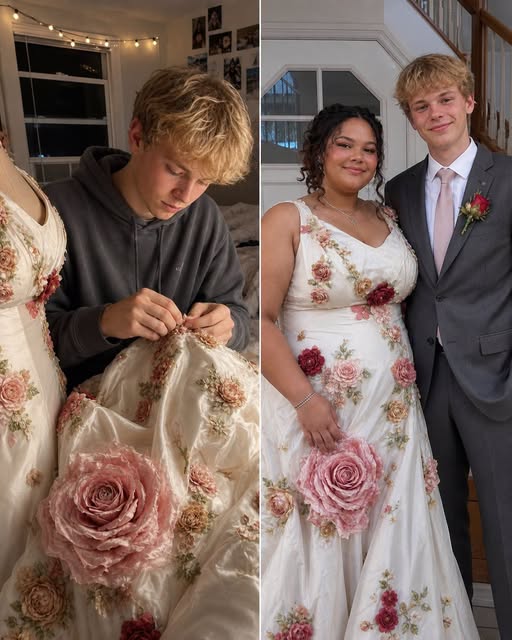
The first insult was sewn into a rose.
The second was stitched into a confession.
By the time the third appeared, the entire gym had fallen silent.
Hazel thought she was simply wearing a dress.
She didn’t know she was carrying years of cruelty across her shoulders.
She didn’t know that every flower, every thread, and every carefully embroidered word represented something someone had once said to make her feel small.
And she certainly didn’t know that by the time she reached the center of that gym, those same words would no longer have the power they once did.
The dress had been created by Eli.
To anyone looking at it from a distance, it was beautiful.
Delicate fabric.
Intricate stitching.
Flowers blooming across the gown.
But every detail had a meaning.
Eli had taken the words that had wounded Hazel and transformed them into something she could wear without shame.
The insults were no longer weapons.
They were part of the design.
Part of the story.
Part of something that Hazel had survived.
For years, Hazel had learned what it felt like to become invisible.
She had been mocked by classmates.
She had heard cruel comments about the way she looked, the way she dressed, and the way she carried herself.
Some words were thrown casually, followed by laughter.
Others stayed with her long after the people who said them had forgotten.
That is the cruelty of bullying.
The person who delivers the insult may remember it for seconds.
The person receiving it can carry it for years.
Hazel began withdrawing.
She spent more time alone.
She avoided attention.
Eventually, hiding felt safer than being seen.
Her room became a place where she could escape the eyes of everyone who had made her feel inadequate.
But there was another layer to her pain.
Grief had already changed her life.
The absence of someone she loved deeply had left an emptiness that bullying only made heavier.
When grief and cruelty collide, silence can become overwhelming.
You stop wanting people to ask questions.
You stop wanting people to look too closely.
You begin believing that perhaps disappearing would be easier than explaining how much you hurt.
That was the Hazel Eli knew.
And he refused to accept that this was how her story would end.
So he made the dress.
Not as a costume.
Not as a joke.
As a statement.
He gathered the words that had been used against Hazel and gave them a different purpose.
Instead of hiding them, he placed them where everyone could see them.
The cruelest words became embroidery.
The insults became petals.
The things that had once made Hazel cry became part of something extraordinary.
When Hazel finally walked into the gym, she didn’t immediately understand what everyone was seeing.
She only knew that the room felt different.
People were staring.
But this time, the staring was not accompanied by laughter.
There were no whispers.
No cruel jokes.
No one looking for an opportunity to make her feel smaller.
They were simply watching.
And then they began recognizing the words.
One after another.
The insults they remembered.
The phrases they had heard.
The comments that had once been used to hurt Hazel were now visible across the dress.
The gym became painfully quiet.
Some of the students who had once laughed at Hazel lowered their eyes.
Others looked away.
A few began crying.
Because it is different when cruelty is reflected back at you.
It is easy to say something cruel when the person you’re hurting is alone.
It is much harder to face the consequences when everyone is forced to see what those words became.
Hazel kept walking.
She could have stopped.
She could have turned around.
She could have run back to the safety of the room where she had spent so many days hiding.
But she didn’t.
She walked toward the center of the gym.
And with every step, something changed.
The girl who had once believed she needed to disappear was suddenly the person nobody could look away from.
Her tears came.
But they were not the same tears she had cried alone.
They were not tears of humiliation.
They were tears of release.
For years, she had carried those words as evidence that something was wrong with her.
Now she could finally see them for what they were.
Evidence of what other people had chosen to do.
Not evidence of who she was.
That distinction changed everything.
Eli stood nearby, watching quietly.
He hadn’t created the dress to make Hazel famous.
He had created it because he wanted her to understand something she had forgotten.
She was worth defending.
She was worth celebrating.
And she deserved to be seen.
There was another memory woven into the moment too.
Mason’s remembered promise.
Something he had once said or done that Hazel had carried with her, even after grief had made everything else feel distant.
His memory became another thread in the story.
Then there was Hazel’s mother.
She had watched her daughter struggle.
She had seen the way grief and bullying had changed the person Hazel used to be.
And despite everything, she continued hoping.
Continued encouraging.
Continued believing that one day her daughter would find her way back to herself.
That day did not erase the pain.
It did not undo the bullying.
It did not bring back the person Hazel had lost.
Healing rarely works that way.
It is not a switch.
It is not one perfect afternoon after which everything becomes easy.
But something shifted.
Hazel had finally stood in the center of the room instead of hiding from it.
She had allowed herself to be seen.
And perhaps that was the first real victory.
The dress did not make her wounds disappear.
It gave them somewhere to go.
Every embroidered word represented something that had once been used to diminish her.
Now those same words were surrounded by beauty.
Flowers grew around them.
Fabric held them.
And Hazel carried them without allowing them to define her.
That was Eli’s quiet genius.
He didn’t pretend the cruelty hadn’t happened.
He transformed it.
He took the evidence of Hazel’s pain and turned it into proof of her survival.
The classmates who had once mocked her were forced to confront something uncomfortable.
Hazel had not remained the person they tried to create with their words.
She had survived them.
She had grown beyond them.
And now she was standing in front of everyone wearing their cruelty as art.
The gym eventually began to breathe again.
People moved.
Some apologized.
Some cried.
Others simply stood in silence, perhaps realizing for the first time how much damage words can cause.
Nothing was magically repaired that afternoon.
Trust would take time.
Forgiveness, if it ever came, would take even longer.
The grief inside Hazel’s family would not simply disappear.
But the atmosphere had changed.
The house where sadness had once seemed to occupy every room suddenly felt a little lighter.
Not because everything was fixed.
Because hope had returned.
Hazel was no longer hiding.
She was still grieving.
Still healing.
Still carrying scars.
But she was also standing.
And sometimes standing is the beginning of everything.
The dress became more than clothing.
It became a record of what Hazel had survived.
A memorial to the words that had hurt her.
A tribute to the people who loved her.
And a declaration that cruelty does not get the final word.
Eli didn’t just make Hazel a beautiful dress.
He gave her a way to look directly at everything that had tried to break her and say:
You happened to me.
But you did not become me.
And when Hazel finally walked out of that gym, the words were still stitched into the fabric.
But they no longer belonged to the people who had spoken them.
They belonged to her.
And she was finally free to decide what they meant.