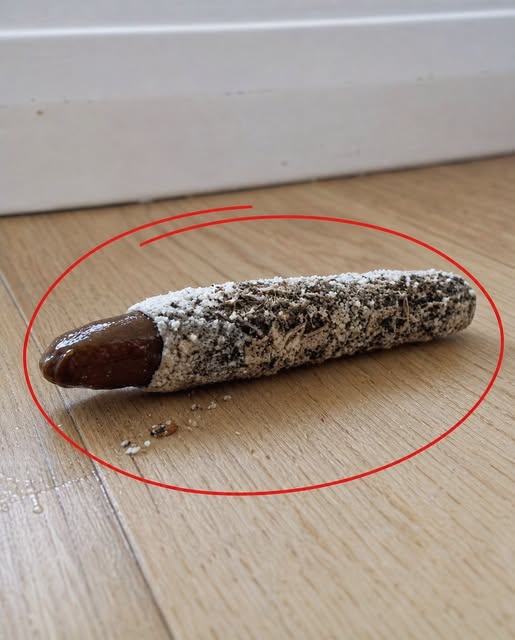
It looked wrong from the start. Not dangerous. Worse—intentional. A dull, dusty tube on the floor that felt like it was watching me as much as I was staring at it. The longer I looked, the more it stopped being trash and started feeling like a message. A quiet, crawling, perfectly constructed little object had somehow appeared in a place I thought I knew completely, and the realization made me uneasy. It seemed too carefully shaped to be random, yet too strange to immediately identify.
At first, the discovery felt like a violation, as if something secret had slipped past my attention and settled quietly into my home. I kept wondering how long it had been there and how many times I might have walked past it without noticing. The little tube was so ordinary in color and texture that it could easily have been mistaken for dust, lint, or a piece of debris. Yet once I actually stopped and examined it, the shape seemed deliberate.
That was what bothered me most.
It wasn’t simply that there was something unfamiliar on the floor. It was that the object seemed constructed. Its surface appeared layered, almost assembled piece by piece, as though something had carefully selected the material and wrapped itself inside. The more closely I looked, the less it resembled household debris and the more it resembled a tiny piece of architecture.
I found myself imagining all sorts of possibilities. Could it have come from an insect? Was it some strange plant material? Had something been dragged inside from outdoors? The lack of an obvious answer made the discovery feel more mysterious than it probably deserved to be.
Then I learned what it was.
The little tube was the portable shelter of a case-bearing moth larva.
Suddenly, the mystery became biology.
The larva had gathered fibers, lint, dust, and other tiny pieces of material from its surroundings and transformed them into a protective case. What I had dismissed as meaningless scraps were, to the creature, building supplies. Every tiny fiber had a purpose. Every layer offered protection.
Learning that didn’t completely erase the unease.
Instead, it transformed it into something more complicated: respect.
The object that had initially seemed threatening was actually evidence of an incredibly practical survival strategy. The larva wasn’t trying to invade my space in some sinister way. It was simply doing what countless creatures have evolved to do—finding whatever materials are available and turning them into protection.
What fascinated me was how perfectly the creature had disappeared into its environment.
Its case wasn’t bright.
It wasn’t designed to attract attention.
It didn’t announce itself.
It blended in.
That camouflage had probably been one of its greatest advantages. While I was staring directly at it, I realized that the creature had essentially accomplished something humans spend enormous effort trying to achieve: it had made itself almost invisible.
And it had done so using the things I barely noticed.
Lint.
Dust.
Fibers.
Tiny scraps.
The things I would normally sweep away without thinking had become armor and identity.
That realization changed the way I looked at the floor around me.
Suddenly, every corner seemed capable of containing something I had overlooked. The space beneath furniture, the edges of walls, the places where dust quietly accumulates—these weren’t necessarily empty spaces. They could be miniature habitats, filled with organisms carrying on lives that rarely intersect with ours.
I began thinking about how casually I move through my own home.
I assume I know what is there because I recognize the large things. Furniture, walls, windows, appliances, objects I deliberately placed. But there is another layer of life operating at a scale I rarely pay attention to.
It exists beneath my attention.
The moth larva had made that invisible world impossible to ignore.
There was something almost poetic about the material it had chosen. Humans often treat lint and dust as signs of disorder. We remove them, throw them away, and rarely consider where they came from. To the larva, those same materials were valuable resources.
What looked like waste had become shelter.
What looked insignificant had become protection.
What looked like debris had become a home.
The creature didn’t need a sophisticated structure. It didn’t need tools or manufactured materials. It simply used what was available.
And somehow, that was enough.
The case also represented something more than survival. It was part of the larva’s identity. It carried the environment around it, turning pieces of its surroundings into something uniquely its own. The creature was protected by a structure built from the very world it inhabited.
The more I thought about that, the less strange the little tube seemed.
It was no longer a message.
It was a lesson.
A reminder that nature doesn’t always announce itself with dramatic colors, loud sounds, or enormous movements. Sometimes it works quietly, almost invisibly, in the corners we never bother to inspect.
A creature can survive inside something we would normally sweep away.
A tiny organism can transform scraps into armor.
A seemingly meaningless collection of fibers can become a carefully constructed shelter.
And a person can walk past all of it without ever realizing that an entire process of life is happening directly beneath their feet.
The discovery also made me reconsider what “control” means inside my own space. I had initially felt disturbed because something had existed there without my noticing. But perhaps that assumption—that I should notice everything—was the real illusion.
No human being sees everything.
We simply notice what our minds have decided is worth noticing.
The moth larva had been living outside that attention.
It didn’t need me to understand it.
It didn’t need permission.
It simply needed material, protection, and time.
And it found all three.
Instead of a threat, it became a quiet teacher, reminding me that life persists in the margins. It reminded me that survival doesn’t always look dramatic and that intelligence in nature can appear in forms so small we almost mistake them for dirt.
That dusty little tube no longer looked like something watching me.
It looked like something surviving.
And perhaps that is why the discovery stayed with me.
Because hidden inside something I had almost thrown away was a tiny example of adaptation, patience, and ingenuity.
The creature had taken the forgettable scraps of my environment and turned them into safety.
It had built a home from what I didn’t value.
And for a moment, standing there and looking at that almost invisible shelter, I understood that the world around us is far more alive than we usually bother to see.