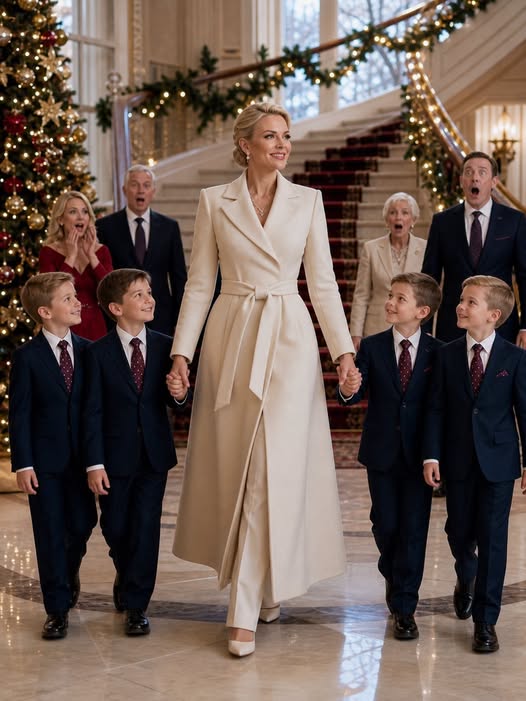
The truth walked up his driveway in four small coats. For eight years, Ethan Caldwell was certain his ex-wife had invented a pregnancy to stop their divorce. He built a new life, a new engagement, and a future carefully designed without her. He convinced himself that leaving was the only way forward. Then, on one frozen Christmas Eve, an aircraft landed, a woman stepped out, and behind her came four boys who looked so remarkably alike that the world Ethan had built around his certainty began to collapse in a matter of seconds.
Grace’s choice to accept that invitation was never about revenge. It was about four boys who deserved to know where half of their story began. For years, she had carried the weight of raising them while Ethan remained convinced that none of it was real. She could have kept the distance permanent. Instead, she decided that her sons deserved the opportunity to meet the father whose absence had shaped so much of their childhood.
She arrived prepared for awkward silences, judgment, and disbelief, but she was not prepared for the expression on Ethan’s parents’ faces when the four boys stepped through the door. The tension changed almost immediately when the children quietly said, “Merry Christmas.” Ethan’s parents stared at the nearly identical grandsons they had never known existed, trying to understand how eight years of their family history had happened without them.
For Ethan, the sight was almost impossible to process. He had spent years believing Grace had manipulated the situation and that the pregnancy story had been nothing more than an attempt to keep him from moving on. He had built arguments around that belief until they became part of his identity. Now four living, breathing children were standing in front of him, carrying pieces of his own face and mannerisms.
The dinner that followed was messy, emotional, and painfully honest. There were questions nobody knew how to answer and silences that seemed to stretch forever. Grace didn’t dramatize the past or turn the evening into a courtroom. She simply laid it out. She explained what had happened, what she had endured, and why she had made the choices she did. For once, Ethan had no argument that could make the evidence disappear.
He finally understood that his certainty had cost him eight unrepeatable years.
There would be no way to recover the birthdays he had missed, the first days of school, the childhood illnesses, the small victories, or the nights when his sons had asked questions he wasn’t there to answer. Those moments had already happened. They could not be replayed or replaced. The realization was painful precisely because there was nobody else to blame for the years he had chosen to walk away from.
The boys, meanwhile, had their own complicated feelings. They were old enough to understand that something important had been missing from their lives, but still young enough to wonder what having a father might actually mean. They didn’t arrive expecting an instant relationship. They arrived with curiosity, uncertainty, and the cautious hope that the man standing across the room might eventually become someone they could trust.
Ethan’s parents struggled with their own emotions. They were overjoyed to finally meet their grandchildren, but their happiness was mixed with grief over everything they had missed. They wondered how many Christmas mornings had passed without them, how many photographs existed that they had never seen, and how different their family might have looked if the truth had been known years earlier.
Grace understood that forgiveness could not be demanded from anyone. She also understood that protecting her sons did not have to mean keeping the door permanently closed. She had spent years making decisions for four children who depended on her, and now she had to decide whether allowing Ethan into their lives would help them or hurt them.
The answer could not come from promises alone.
What came after that Christmas wasn’t a miracle reunion or an instant transformation. It was slow, deliberate work. Ethan had to learn his sons as individual people rather than simply as the children he had missed. He learned their birthdays, their fears, their favorite foods, the things that made them laugh, and the subjects they could talk about for hours.
He discovered that four boys who looked remarkably alike could have completely different personalities. One might be quiet and thoughtful, another endlessly curious, another competitive, and another constantly making jokes. They weren’t simply “the twins” or “the four boys.” They were four separate people who had spent eight years becoming themselves.
The boys also had to learn Ethan. They had to decide whether his presence was something they could trust. They had every reason to be cautious. A father appearing after eight years is not the same as a father who has been there all along. Ethan could not demand that they instantly call him family. He could only demonstrate, day after day, that he intended to remain.
Grace watched the process carefully. She knew that rebuilding a relationship could be beautiful, but she also knew that children needed consistency more than dramatic promises. She refused to make the boys responsible for repairing the adults’ mistakes. Their job was simply to be children and decide, at their own pace, what place Ethan would eventually have in their lives.
Over time, the awkwardness began to soften. Conversations became easier. Ethan stopped trying to explain the past and started paying attention to the present. He learned that showing up for ordinary moments mattered more than making grand declarations. A school event, a meal, a phone call, or helping with homework could mean more than any apology.
The boys learned something equally difficult: forgiveness doesn’t erase hurt. It doesn’t pretend the missing years never happened or make every painful memory disappear. Instead, forgiveness can create room for something new without denying what came before.
Grace learned that she could protect her sons and still open the door to their father. She didn’t have to choose between shielding them and allowing them to discover the relationship for themselves. She could set boundaries, remain involved, and still let the boys decide what they wanted their connection with Ethan to become.
That first Christmas didn’t fix the past.
It couldn’t.
But it quietly rewrote their future. What began with four small coats walking up a driveway became the first step toward a family learning how to exist together after years of separation. There were still difficult conversations ahead, and there would undoubtedly be moments when old wounds resurfaced. But for the first time, nobody was pretending the story had only one side.
Ethan had lost eight years because he believed he already knew the truth. Now he understood something far more painful and far more valuable: certainty can sometimes be the very thing that keeps a person from seeing what is standing directly in front of them.
And on that frozen Christmas Eve, the truth did not arrive with an accusation.
It arrived with four children saying, “Merry Christmas.”