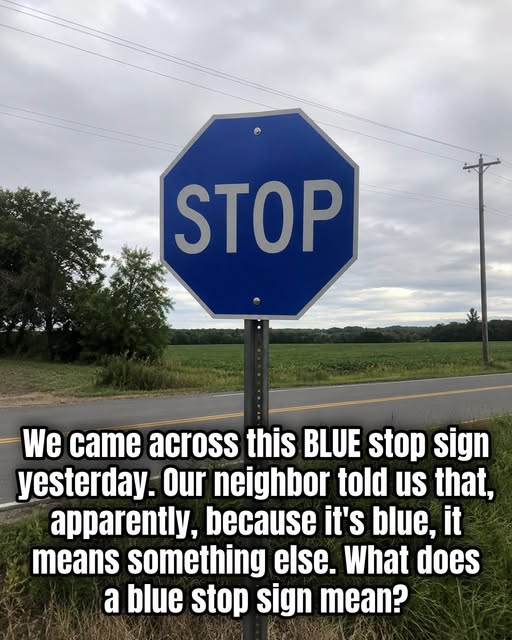
A blue stop sign can feel like a glitch in reality. Your brain immediately screams “wrong,” yet your eyes insist that the unusual sign is standing there, clearly telling you to stop. For generations, drivers have been trained to recognize the familiar red octagon with white lettering almost instantly, so seeing the same shape in blue can create a strange moment of uncertainty. Is it legal? Is it a prank? Is it a private-road sign? Or could it be a warning that you have entered an area where ordinary traffic rules work differently? The truth is more complicated than the viral mystery suggests.
That sudden jolt of confusion is exactly what makes blue stop signs so fascinating. Drivers do not normally have to consciously think about what a red stop sign means. The shape, color, and word have become deeply connected in our visual memory. You can spot one from a distance and immediately understand what action is expected.
A blue version disrupts that automatic reaction.
The octagonal shape still tells your brain that the sign is important. The word “STOP” may still be clearly visible. But the color doesn’t match what you have been conditioned to expect. For a fraction of a second, your brain has to reconcile two conflicting signals: everything about the sign says “stop,” while one of its most recognizable features says “this is unusual.”
On a busy road, that moment of hesitation matters.
Drivers make decisions quickly, especially at intersections, parking areas, private entrances, and places where pedestrians may be present. Anything that creates uncertainty can potentially increase the risk of a mistake. That is one reason traffic signs are generally designed around consistency and recognizability rather than simply looking interesting.
So where do these strange blue stop signs come from?
In many cases, they are found on private property rather than on ordinary public roads. Gated communities, private developments, business campuses, parking facilities, resorts, apartment complexes, and other privately controlled areas may use signs that differ from standard public-road traffic signs.
The important distinction is that not every sign you encounter on private property has exactly the same legal status as a traffic-control device installed by a government transportation authority.
That does not mean a blue stop sign should simply be ignored.
Far from it.
If you encounter one while driving, the safest response is still to stop and assess the situation carefully. Even if the sign is not a standard government traffic sign, it may have been placed at a location where vehicles and pedestrians cross or where another vehicle could enter your path.
A private parking lot can still have dangerous intersections.
A gated community can still have children crossing the road.
A corporate campus can still have cars moving in several directions.
A resort can still have pedestrians stepping unexpectedly into traffic.
The physical risk does not disappear simply because the sign is unusual.
This is where some online explanations become misleading. Viral posts sometimes claim that blue stop signs are universally illegal, universally meaningless, or proof that a driver has somehow entered a strange legal loophole. Traffic regulations don’t work that simply. The legal status of a sign can depend on the jurisdiction, the type of roadway, and who controls the property.
Standard traffic-control devices on public roads generally follow established design standards, including standardized colors and shapes. The U.S. Department of Transportation’s Manual on Uniform Traffic Control Devices establishes national standards and guidance for traffic signs and pavement markings used on roads open to public travel.
That is why a blue stop sign standing on an ordinary public street would be unusual and worth questioning.
But private property can be a different environment.
Property owners sometimes install signs to control traffic flow, communicate expectations, or reduce confusion within a development. A sign may resemble an official traffic device while not being part of the standard system used on public roads.
Even then, drivers should not assume that an unusual sign has no consequences.
Imagine approaching a blue stop sign at the exit of a private parking area. You could decide that it “isn’t real” and continue without stopping. At the same moment, another driver coming from the opposite direction may be obeying it. A pedestrian may also assume that vehicles will stop.
Suddenly, the question isn’t about whether the sign looks officially familiar.
It’s about whether failing to stop creates danger.
That’s why caution is the better response.
Come to a complete stop.
Look in every direction.
Check for pedestrians, bicycles, and approaching vehicles.
Then proceed only when it is safe and permitted.
The few seconds spent doing that are insignificant compared with the consequences of assuming that an unfamiliar sign can be ignored.
There is another reason these signs attract so much attention: they challenge the way people learn visual rules. Humans are remarkably dependent on familiar patterns. Once we learn that red octagon equals stop, we begin recognizing the pattern almost automatically.
Change the color, and suddenly the familiar becomes strange.
It is similar to seeing a traffic light with an unexpected color arrangement. Even if you intellectually understand what the light is supposed to mean, the visual mismatch can slow your reaction because your brain is comparing what it sees with what it expects.
That is not necessarily a bad thing.
In some situations, hesitation can give a driver an opportunity to think more carefully. The danger comes when confusion leads to the wrong decision.
Blue stop signs can therefore serve as an accidental reminder that driving is not simply about memorizing rules. It is also about paying attention to the environment and adapting to circumstances.
A driver may encounter temporary construction signs, private-road markings, parking-lot controls, emergency personnel, pedestrians, cyclists, or other unusual situations that do not look exactly like the examples learned during driver’s education.
The safest drivers don’t simply react to familiar colors.
They observe.
They slow down when something looks unusual.
And they avoid making assumptions when they aren’t certain.
So if you ever see a blue stop sign, don’t treat it as a secret message or a loophole. Don’t assume that the unusual color means you have permission to continue driving.
Treat the situation with caution.
A full stop costs almost nothing.
A careless decision can cost much more.
The strange blue sign may not represent some hidden change in the law. It may simply be a private-property traffic-control sign that looks different from the standardized signs drivers normally encounter.
But the moment it appears in front of you, the safest message is still remarkably simple:
**Stop. Look. Understand the situation. Then proceed carefully.**
Because on the road, trusting caution over confusion is almost always the better choice.