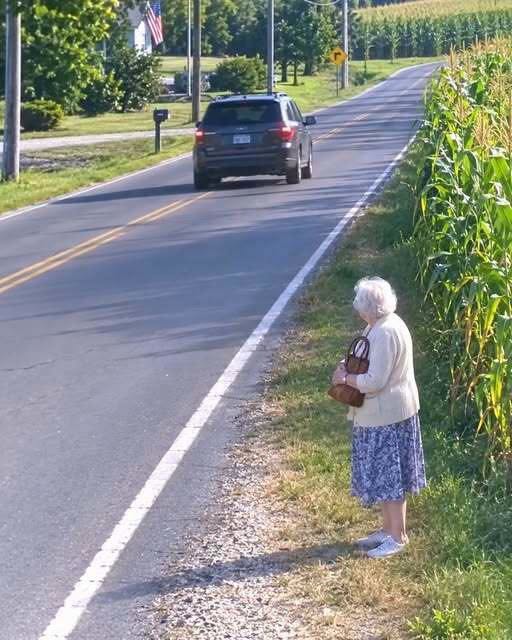
The gravel didn’t just crunch beneath her funeral heels; it seemed to scream with every step. Left alone on a nameless road in the darkness, she finally understood something she had been too afraid to admit before: they hadn’t abandoned her. They had freed her. Her son’s taillights disappeared into the distance, taking with them every pretense of family, duty, loyalty, and love. He probably believed he had left an older woman stranded and powerless, someone with nowhere to go and no choice but to beg for help. What he didn’t know was that she had been preparing for this moment long before he ever opened the car door. She had already emptied the accounts, signed the necessary papers, secured the documents, and quietly removed herself from every record and responsibility that could be used to control her. What looked like helplessness was actually the final stage of a plan they never saw coming.
She didn’t look back at the road or at the SUV’s fading dust trail. There was nothing behind her that she wanted anymore. Every slight, every condescending smile at the dinner table, every conversation that stopped when she entered the room, and every whispered plan made over her head had led to this moment. For years, they had treated her as though she were too fragile to understand what was happening around her. They spoke slowly when discussing money, made decisions without asking her opinion, and assumed that because she was quiet, she was unaware. They mistook patience for weakness and silence for ignorance.
Their arrogance became her camouflage.
While they were busy underestimating her, she was paying attention. She learned which accounts existed, where important documents were kept, which signatures mattered, and which passwords could give someone access to the life she had spent years building. She asked questions without appearing suspicious. She listened more than she spoke. Whenever someone dismissed her concerns, she allowed them to believe they had successfully silenced her. In reality, every assumption they made about her gave her another piece of information.
She learned to become invisible in exactly the right places.
Banks. Deeds. Signatures. Passwords. Legal documents. The details of ownership and responsibility that most families never think about until something goes wrong. She studied them quietly, carefully, without announcing what she was doing. The more confident her family became in their belief that she depended on them, the more freedom she quietly created for herself. They believed they were managing her life. They never realized she was preparing to take it back.
The cruelest part was that they had convinced themselves their behavior was justified. They probably told one another that they were protecting her, making difficult decisions for her own good, or simply doing what was necessary because she was too emotional to understand. But protection without respect becomes control. Love without consideration becomes possession. And family loyalty means very little when it is demanded through fear, guilt, and manipulation.
By the time they finally decided to leave her behind, they thought they had won.
They imagined she would panic.
They imagined she would call her son immediately.
They imagined she would beg them to come back.
Instead, she stood on the roadside and breathed.
The night air was cold against her face, and for the first time in years, she felt strangely calm. There was no dinner table where she had to measure every word. No family member watching her bank account. No one waiting to tell her what she should do next. No voice reminding her how much she supposedly owed them. There was only the road ahead and the knowledge that she had already made arrangements for a life they knew nothing about.
She walked toward it.
By the time she reached the cottage, the sky was beginning to thin from black to gray. Dawn had not fully arrived, but the darkness was already losing its grip. The color of the sky felt less like an ending and more like a choice. She stood outside the cottage for a moment, holding the key in her hand, almost surprised that she was actually there.
When she opened the door, the rooms smelled of fresh paint and possibility.
There were no framed family photographs staring down from the walls. No inherited furniture. No objects placed there because someone else believed they belonged in her home. Nothing connected the cottage to the version of her life that her family had created without her permission. The rooms were almost empty, but she found the emptiness comforting. There was space everywhere, and for once, every inch of that space belonged to her.
She put her things down and walked slowly through the rooms. She opened a window and let the cool morning air inside. She touched the freshly painted walls. She stood in the kitchen and looked at the empty counter. None of it was luxurious or impressive. That was precisely what made it beautiful.
It was hers.
She brewed coffee slowly, deliberately, without anyone rushing her. She listened to the sound of the kettle and the quiet movement of her own hands. There was no television playing in the background, no argument coming from another room, no family member asking where she had been or what she was doing. The silence felt unfamiliar at first.
Then it began to feel like freedom.
She knew their outrage would arrive soon enough. The voicemails would begin. Then the angry messages. Questions. Accusations. Threats. Perhaps even apologies once they realized what she had done. They would want explanations. They would demand to know where the money had gone and how she had managed to disappear so completely. They would insist that she had misunderstood them, that everything they had done had been for her benefit.
But their words would reach only empty echoes.
She had no desire to destroy them. She did not need to ruin their lives to prove that they had hurt her. She did not need revenge in the traditional sense. She had already taken the one thing they had never realized they were giving her every time they underestimated her: the opportunity to leave.
The true revenge was not what they lost.
It was what she finally allowed herself to keep.
Her time.
Her name.
Her privacy.
Her choices.
Her unclaimed days.
For years, her life had been measured according to what other people expected from her. She had been a mother, a wife, a relative, a person who was always supposed to sacrifice something so someone else could remain comfortable. Now she could wake up without asking whether anyone approved. She could spend a morning doing absolutely nothing and not feel guilty. She could make plans without explaining them. She could choose who entered her life and who stayed outside the door.
The road where they left her had been intended as a place of humiliation.
Instead, it became the place where she finally understood that she was free.
And as the first sunlight entered the cottage, she sat beside the window with her coffee and realized that the life she had feared losing had already been gone for years.
What she had now was not a replacement.
It was a beginning.