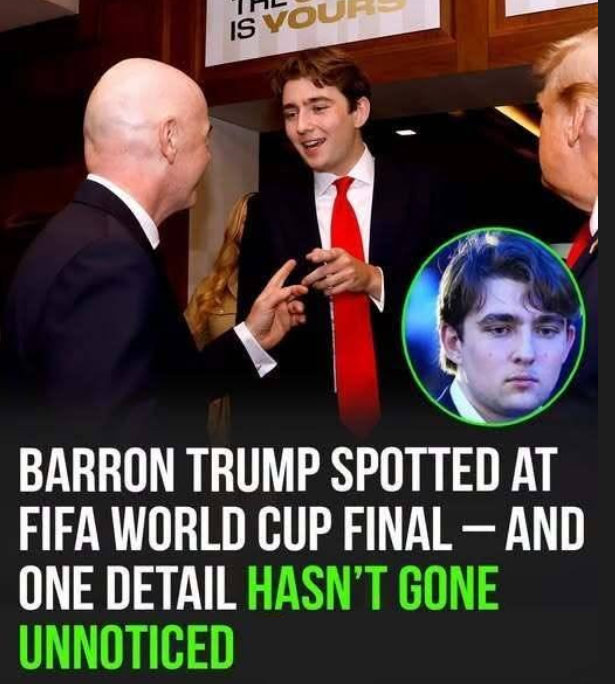
What was meant to be a high-profile appearance at the World Cup quickly became another cultural flashpoint, with a single image fueling widespread online discussion. Standing beside former President Donald Trump and FIFA President Gianni Infantino, Barron Trump was photographed beneath a massive stadium banner reading, “THE STAGE IS YOURS.” To some social media users, the composition felt symbolic, prompting speculation that the youngest Trump could one day step into the political arena occupied by his father and older siblings. Others dismissed the interpretation as little more than an eye-catching coincidence amplified by the internet’s tendency to assign meaning to perfectly ordinary moments.
The photograph quickly took on a life of its own because of the contrast between the people standing beneath the words and the message displayed above them. For viewers already interested in the Trump family’s political future, the image appeared to invite speculation. Yet there was no evidence that the banner was intended as a political message directed at Barron. The meaning came largely from the way people interpreted the visual combination, demonstrating how easily an ordinary photograph can become a subject of political conversation.
The evening also underscored the deeply polarized reactions that continue to surround Donald Trump himself. As he walked onto the field during the trophy presentation, a mix of cheers and boos echoed through the stadium, reflecting the sharply divided opinions that have followed him throughout his public life. He smiled as he presented medals, remained on the stage during the celebration, and was eventually guided away by Gianni Infantino as the ceremony concluded. The moment generated another wave of commentary online, with supporters and critics offering dramatically different interpretations of the same sequence of events.
For supporters, Trump’s presence at the celebration represented a high-profile appearance on an international stage and an opportunity to participate in a major sporting moment. For critics, the reaction inside the stadium highlighted the continuing controversy surrounding his public image. The same sounds coming from the crowd could therefore be interpreted in completely opposite ways depending on the viewer’s political perspective.
That contrast is part of what made the evening so widely discussed. Rather than simply being remembered as a sporting celebration, the event became intertwined with questions about politics, celebrity, family and public perception. Social media users quickly isolated individual moments from the larger ceremony, turning photographs and short clips into subjects of intense discussion.
Together, those images captured more than a championship celebration. A son standing beneath an unintentionally evocative slogan and a father receiving a mixed public reception became visual reminders of how readily modern audiences project larger political narratives onto fleeting moments. Whether the banner carried any deeper significance or was simply a product of camera angles and timing, its impact came from the conversation it inspired.
In an era shaped by viral images and instant analysis, a single photograph can become a canvas onto which millions of people project their expectations, anxieties, and hopes about the future. The image itself may last only a few seconds on a screen, but the discussion surrounding it can continue for days, with people debating meanings that may never have been intended in the first place.
That is ultimately what made the moment so compelling. The World Cup celebration was designed to focus attention on sport and achievement, yet one photograph created an entirely different conversation. Whether viewers saw symbolism, coincidence or simply an interesting camera angle depended largely on what they already believed about the people involved.
The image may eventually fade from the news cycle, but the reaction it generated illustrates something much larger about modern political culture. In a world where photographs travel instantly and every detail can be analyzed publicly, even an ordinary moment can become politically significant once enough people decide that it means something. Sometimes the story is not what the image was intended to say, but what millions of viewers believe they see in it.