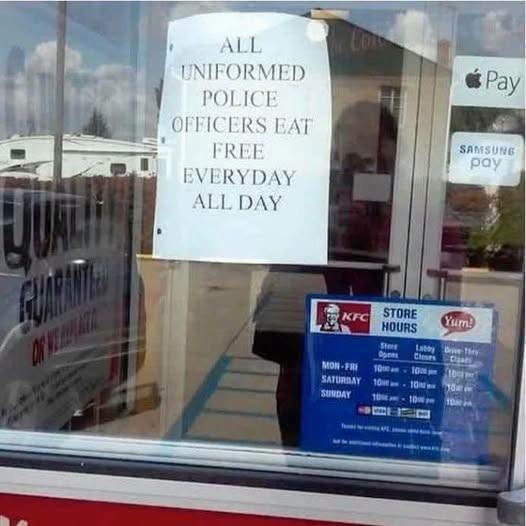
The sign appeared quietly.
The internet did anything but.
When an Ohio KFC restaurant placed a simple message offering free meals to uniformed police officers, what might have been intended as a small gesture of appreciation quickly became the center of a heated online debate. Some customers praised the gesture and called it a meaningful way to recognize officers. Others accused the restaurant of favoritism, political messaging, and what they described as “performative patriotism.”
Within hours, the conversation had grown far beyond the restaurant itself.
People began arguing about whether businesses should offer special gestures to police officers at all. Some questioned why officers were being singled out when firefighters, EMTs, dispatchers, nurses, and other public servants also face difficult and dangerous situations.
Others saw the situation much more simply.
To them, a free meal was not a political statement.
It was a thank-you.
The restaurant eventually chose not to treat the controversy as something that required an angry response. Instead, management emphasized the intention behind the message. The sign was meant to recognize officers who routinely work in stressful environments, respond to emergencies, and sometimes place themselves in dangerous situations while carrying out their responsibilities.
The gesture itself was small.
A meal.
But the discussion surrounding it became much larger.
Supporters argued that businesses should be free to recognize groups they appreciate without every gesture becoming a political debate. Critics, meanwhile, maintained that appreciation should be broader and include every first responder who contributes to public safety.
That disagreement revealed something interesting about modern social media.
A simple act that might once have remained local can now become a national argument within minutes.
A photograph of a sign can be shared thousands of times.
A short comment can be taken out of context.
And before anyone involved has a chance to explain the original intention, strangers from across the country can be debating what the gesture supposedly represents.
For some police officers, the attention itself was uncomfortable.
Many officers reportedly emphasized that they were not looking for special treatment or free food. Their jobs already involve enough public scrutiny, and some would rather receive understanding and respect than become the center of another political argument.
That perspective made the situation even more complicated.
The restaurant was offering something free, but the people receiving the gesture weren’t necessarily asking for it.
So what was the real value of the offer?
Perhaps it wasn’t the food at all.
Perhaps it was the acknowledgment.
Police officers can spend entire shifts dealing with situations most people hope they never encounter. They may respond to accidents, domestic disputes, emergencies, violence, and situations where they have very little information about what awaits them.
Much of that work happens without public recognition.
People usually notice police when something has already gone wrong.
The sirens arrive.
The road is blocked.
An emergency is unfolding.
But the hours before and after those moments are rarely visible to the public.
That is why supporters of the KFC gesture viewed the sign as a simple way of saying, “We see what you do.”
At the same time, the controversy raised a reasonable question about whether that recognition should extend to other professions.
Firefighters enter burning buildings.
EMTs respond to medical emergencies.
Dispatchers answer desperate calls from people they may never meet.
Search-and-rescue teams work in dangerous conditions.
Other public employees routinely perform difficult tasks that rarely make headlines.
There is no shortage of people who could be recognized.
And perhaps that is why the debate became less about one restaurant and more about what appreciation should look like in the first place.
Does recognizing one group mean ignoring another?
Not necessarily.
A gesture toward one profession does not automatically diminish everyone else.
People and businesses can show appreciation in different ways, at different times, for different reasons.
The bigger question may be whether we have become so accustomed to interpreting everything through a political lens that even a free meal can become a national controversy.
The KFC sign didn’t solve any major social problem.
It didn’t change public policy.
It didn’t settle debates about policing.
It was simply a restaurant offering a small gesture to a particular group.
Yet the reaction demonstrated how quickly ordinary acts can become symbols once they enter the online world.
For the restaurant, removing the sign might have been the easiest way to avoid criticism.
But management reportedly chose to leave it in place and explain the intention instead.
That decision sent another message.
They weren’t necessarily asking everyone to agree.
They were simply standing behind the reason they put the sign there.
There is something meaningful about that distinction.
Appreciation does not require universal agreement.
Someone can support police officers while also believing in accountability.
Someone can appreciate firefighters without claiming they are more important than police.
Someone can thank an EMT without turning the gesture into a political declaration.
Recognition and disagreement can exist at the same time.
Perhaps that is what was lost in the online argument.
A small gesture of gratitude does not have to become a referendum on an entire institution.
It can simply be a gesture.
In the end, the most memorable part of the controversy may not be the free meal itself.
It may be the conversation it created about how we recognize people who serve their communities.
Whether someone wears a police uniform, drives an ambulance, works inside a fire station, answers emergency calls, or performs another difficult public-service job, acknowledgment can matter.
Sometimes people don’t need applause.
They don’t need a viral post.
They don’t need a national debate.
They simply want to know that someone noticed.
The sign may have started as a few words on a restaurant door, but it became something much larger once thousands of people began assigning meaning to it.
For some, it represented appreciation.
For others, it represented favoritism.
For the restaurant, however, the message was reportedly much simpler.
It was a thank-you.
And sometimes a simple “we see you” can mean more than the price of a meal.