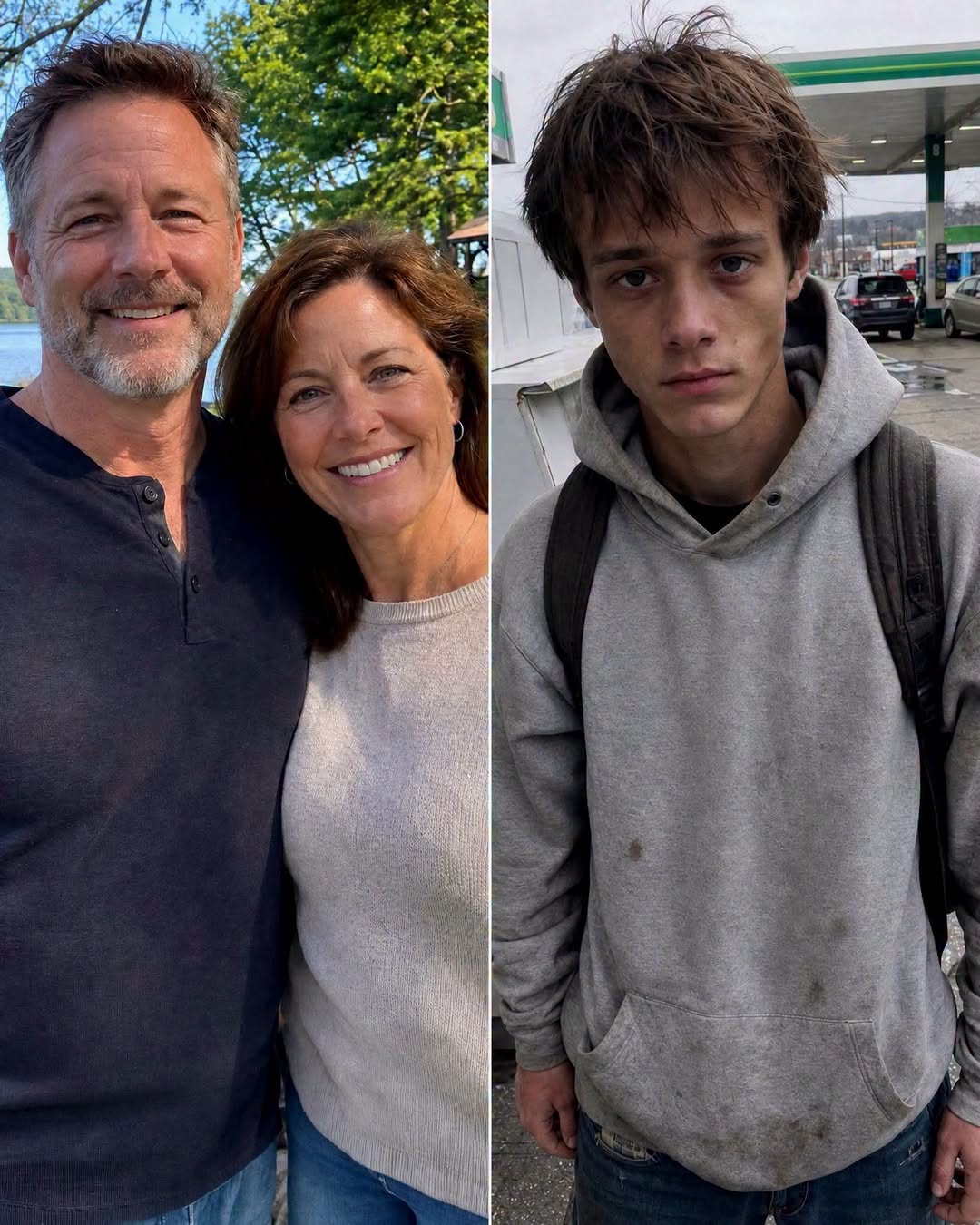
The first warning didn’t come from my husband.
It came from a frightened teenager standing beside a gas station.
It had been an ordinary Tuesday until a boy wearing an oversized hoodie approached me and asked if he could borrow my phone. I thought he simply needed to make a call.
He thanked me, handed the phone back, and started to walk away.
Then he stopped.
He looked over his shoulder and quietly said something that made the entire world around me seem to disappear.
“Someone paid me to watch where you go.”
For a moment, I couldn’t understand what he meant.
I asked him to explain.
He told me that someone had been paying him to keep track of my movements. Where I went. When I left the house. Which stores I visited. How long I stayed away.
He thought he was helping a woman who didn’t realize she was being watched.
I stood there frozen, trying to convince myself there had to be another explanation.
But the fear in his face told me he wasn’t joking.
I drove home that evening with both hands gripping the steering wheel.
Every familiar street suddenly felt different.
The grocery store I’d visited for years seemed suspicious.
The road to the lake felt strangely exposed.
Even the house I’d always considered my safest place no longer felt completely safe.
My husband was there when I arrived.
I looked at him differently.
I wondered whether he knew.
I wondered whether I was imagining things.
And most frightening of all, I wondered how long this had been happening without my knowledge.
That night, I barely slept.
The teenager’s words kept replaying in my mind.
Someone paid me to watch where you go.
The next morning, I decided I needed answers before confronting anyone.
My husband had a locked office that I rarely entered.
He had always told me it contained business documents and private work.
I’d never questioned it.
Until that morning.
I found a way to access the room and stepped inside.
At first, everything looked ordinary.
A desk.
Filing cabinets.
A computer.
Stacks of paperwork.
Then I opened a folder.
What I saw inside made my stomach turn.
There were photographs.
Photographs of me.
Leaving the house.
Shopping.
Driving.
Visiting friends.
Going to appointments.
Ordinary moments from my daily life had been documented as if someone were building a case against me.
There were handwritten notes describing my routines.
What time I usually woke up.
Where I went during the day.
Who I spent time with.
When I returned home.
It wasn’t random.
It was organized.
And then I found something even worse.
There were draft guardianship documents.
Documents that appeared designed to question my ability to make decisions for myself.
The implication was horrifying.
I wasn’t being treated like a wife whose privacy had been violated.
I was being treated like someone who needed to be controlled.
Then I saw the documents relating to our lakeside cabin.
The place had always been special to me.
It was where I went when I needed peace.
It was where we had spent holidays, celebrated birthdays, and imagined growing old together.
But in those papers, it wasn’t a home.
It was an asset.
Something that could potentially be sold once I was legally pushed aside.
I sat at the desk for several minutes without moving.
The realization was almost impossible to accept.
The person I had trusted most seemed to have been preparing for a future in which I no longer had control over my own life.
I wanted to confront him immediately.
I wanted to throw the papers across the room.
I wanted to demand an explanation.
But I stopped myself.
Anger wouldn’t protect me.
Evidence might.
So I photographed everything.
I preserved the messages from the teenager.
I wrote down exactly what he had told me.
And then I contacted an attorney.
For the first time in days, someone helped me look at the situation without emotion.
The attorney told me not to make accusations I couldn’t support.
Keep records.
Preserve evidence.
Protect important documents.
Understand my legal rights.
And, most importantly, don’t confront my husband until I knew what I was dealing with.
Following that advice was one of the hardest things I’d ever done.
Every conversation with him suddenly felt like a test.
He would ask how my day had been.
I would smile.
He would ask whether I was tired.
I would answer normally.
All the while, I knew there were photographs of my life hidden in a locked office only a few rooms away.
The strangest part was how normal he seemed.
He cooked dinner.
He talked about the weather.
He complained about work.
He laughed at something on television.
And I kept wondering how someone could behave so normally while secretly preparing to take control of another person’s life.
Eventually, I decided it was time to confront him.
But I didn’t do it in the house.
I chose the lakeside cabin.
The same place he had apparently planned to treat as nothing more than an asset.
We sat across from each other at the dinner table.
The lake was quiet outside.
For a moment, everything looked exactly as it always had.
Then I placed the first photograph on the table.
He looked at it.
His expression changed.
I placed another beside it.
Then another.
I didn’t raise my voice.
I didn’t accuse him with dramatic words.
I simply continued placing the evidence in front of him.
The photographs.
The notes.
The documents.
The guardianship paperwork.
The plans involving the cabin.
And finally, the messages that had been preserved from the teenager.
My husband stopped speaking.
The confidence that had been on his face only minutes earlier disappeared.
I asked him one question.
“Why?”
He didn’t answer immediately.
There were explanations.
Excuses.
Attempts to redefine what I had discovered.
But none of them could explain away the evidence.
The papers were real.
The photographs were real.
The surveillance had happened.
And whatever story he had created to justify it, he had never trusted me enough to tell me the truth.
That realization hurt more than anything else.
I had spent years believing that love meant safety.
That marriage meant partnership.
That the person beside you would protect your dignity rather than secretly documenting your life.
But love cannot survive where control replaces trust.
A relationship cannot be healthy when one person secretly builds a case against the other.
And no one should have to prove that they are sane simply because someone else has decided to question their independence.
The teenager at the gas station had given me something I didn’t know I needed.
A warning.
He could have walked away.
He could have kept the money.
He could have decided it wasn’t his problem.
Instead, he told a stranger the truth.
That small act of courage changed everything.
With legal guidance, I began taking steps to protect myself.
I secured my important documents.
I reviewed my finances.
I made sure I understood my rights.
And I stopped allowing fear to make decisions for me.
Leaving wasn’t easy.
Walking away from a marriage means more than leaving a person.
It can mean leaving routines, memories, traditions, plans, and an entire version of the future you thought you were going to have.
But staying would have meant accepting a life where my independence could be taken away behind closed doors.
I couldn’t do that.
The lakeside cabin eventually became something different too.
It stopped being a symbol of what my husband had planned to take from me.
It became a reminder of what I had managed to reclaim.
My life.
My choices.
My voice.
My ability to decide what happened next.
Sometimes people imagine that discovering betrayal leads to one dramatic moment of freedom.
In reality, rebuilding yourself happens in much smaller moments.
Making your own decisions.
Sleeping without fear.
Going somewhere without wondering whether you’re being watched.
Opening your own mail.
Making plans without asking permission.
Remembering who you were before someone convinced you that you couldn’t trust yourself.
Those things became victories.
Looking back, I still think about that teenager.
He didn’t know my marriage.
He didn’t know my history.
He didn’t know what would happen after he spoke.
He only knew that something felt wrong, and he decided I deserved to know.
One sentence from a stranger gave me the courage to investigate the life I thought I understood.
And the truth was painful.
But it was also freeing.
Because once I knew what was happening, I could finally choose what happened next.
I learned that real love doesn’t require surveillance.
It doesn’t need secret files.
It doesn’t require locked rooms filled with evidence.
And it certainly doesn’t need someone to invent doubts about your ability to make your own decisions.
Real love allows two people to remain whole.
It respects privacy.
It encourages independence.
It tells the truth.
That Tuesday began with a stranger asking to borrow my phone.
By the end of it, he had unknowingly given me the first piece of information I needed to reclaim my life.
I will never forget what he said.
“Someone paid me to watch where you go.”
At the time, those words terrified me.
Today, they mean something different.
They remind me that sometimes the truth arrives from the last person you expect.
And sometimes, one brave stranger telling the truth is enough to help you finally see what has been hidden in plain sight.