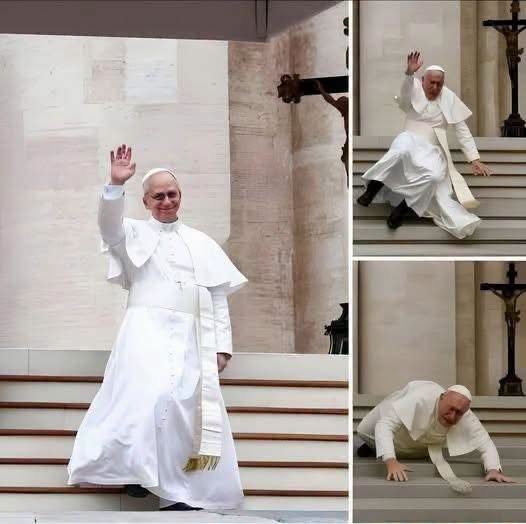
The crowd roared in St. Peter’s Square, but for a moment, it seemed as though Pope Leo XIV’s eyes were somewhere else.
Not Rome.
Not Chicago.
Peru.
For Robert Francis Prevost, Peru was never simply another chapter in a long religious career. He spent decades there as an Augustinian missionary, priest, teacher, and eventually bishop of Chiclayo. The country shaped his ministry, his relationships, and the way he understood the people he was called to serve. When he appeared on the balcony after his election and greeted the faithful in Spanish, he immediately acknowledged the Peruvian community that had become such an important part of his life.
But surrounding his years in Peru is a more mysterious story—one that has circulated about a supposed prediction made during his ministry there.
According to the story, an elderly religious sister once told the young priest that he would one day become something far greater than a parish pastor, describing him as a future “pastor of pastors.” The story is often presented as a prophecy that seemed impossible at the time.
There is an important distinction, however: the Vatican’s official biography and major documented accounts of Leo XIV’s life confirm his extensive work in Peru, but they do not independently establish this alleged prophecy as a verified historical event. The story should therefore be understood as an anecdote or tradition surrounding his Peruvian years, rather than as a proven prediction.
Still, the story is compelling because of what happened afterward.
Long before the white smoke appeared above the Vatican, Prevost was walking through communities in Peru, visiting ordinary families and serving people far removed from the grandeur of Rome. His first missionary assignment in Peru began in 1985 in Chulucanas, and he later returned to the country for extensive pastoral and educational work.
For years, his ministry was centered not on global headlines but on ordinary people.
He celebrated Mass.
He visited families.
He worked with young people.
He helped form religious communities.
He served people living through poverty and natural disasters.
And eventually, he became bishop of Chiclayo, a role that placed him much closer to the center of the Church’s leadership in Peru.
At the time, there was no obvious reason to believe that the quiet American missionary would one day stand before millions of Catholics as pope.
The future was still hidden.
Then the years began to accumulate.
Prevost returned to the United States in 1998 and later served as Prior General of the Order of Saint Augustine. His responsibilities expanded, his experience within the Church grew, and his relationships with senior Catholic leaders developed over decades.
Eventually, Pope Francis appointed him to important positions in Rome, including leadership within the Vatican’s Dicastery for Bishops.
By then, the young missionary who had once worked in Peru had become an influential figure in the wider Catholic Church.
Still, nothing guaranteed what would happen next.
When Francis died, Prevost emerged as one of the cardinals involved in the conclave that would determine the Church’s future.
On May 8, 2025, the white smoke appeared.
The announcement stunned many people who had not considered Prevost the obvious favorite.
Robert Francis Prevost had been chosen as Pope Leo XIV.
He became the first pope born in the United States and also a man with an unusually deep connection to Peru, where he had spent much of his priestly life and later became a Peruvian citizen.
Then came the moment that made the connection feel almost cinematic.
Standing on the balcony overlooking St. Peter’s Square, the newly elected pope addressed the crowd.
And he spoke Spanish.
He specifically greeted the people of Chiclayo, the Peruvian diocese where he had served as bishop and where so many people had come to know him personally.
For Peruvians watching from thousands of miles away, the moment was deeply emotional.
The missionary had returned to the world stage.
Only this time, he was not simply Father Roberto.
He was Leo XIV.
And that is where the old story about the supposed prediction becomes so intriguing.
If the elderly sister really did tell the young priest that he would someday become a “pastor of pastors,” then the words would have sounded almost impossible at the time.
A missionary working far from Rome would hardly have imagined that decades later he would be standing at the Vatican balcony wearing white.
But even without accepting the prophecy as fact, the story captures something real about his journey.
His career was built gradually.
There was no single moment when everything changed.
Instead, there were years of service, responsibility, education, leadership, and relationships that slowly carried him from Peru toward the center of the Catholic Church.
His connection to Peru remained powerful even after he left.
In 2025, he told Peruvian officials that Peru remained deeply present in his life and expressed his affection for Chiclayo.
That affection was not simply ceremonial.
It came from decades of personal experience.
He had lived among the people.
He had celebrated their weddings and funerals.
He had shared their celebrations.
He had witnessed poverty and hardship.
He had experienced the devastating effects of natural disasters.
And he had watched communities continue forward despite enormous challenges.
Those experiences helped shape the priest who eventually became pope.
His Peruvian years also influenced his approach to leadership. People who knew him in Chiclayo have described a pastor who emphasized participation, cooperation, and bringing laypeople more actively into the life of the Church.
That history makes his election feel less like an isolated political event and more like the culmination of a long journey.
From Chulucanas to Chiclayo.
From missionary priest to bishop.
From Peru to Rome.
From Cardinal Prevost to Leo XIV.
And finally, from the quiet work of parish ministry to the balcony of St. Peter’s.
The alleged prophecy, whether one believes it literally or views it as a story that grew around his remarkable journey, adds another layer to the narrative.
But the documented history is already extraordinary enough.
A man who spent decades serving far from the Vatican eventually became the person standing at its center.
The young priest who once walked Peruvian streets could not have known exactly where those years would lead.
Neither could the people around him.
Yet every assignment, every responsibility, and every new chapter gradually brought him closer to a position that almost no one could have predicted.
And when he finally appeared before the world as Leo XIV, his first words included a message for the people of Peru.
That detail mattered.
Because before the white cassock, before the papal ring, before the crowds in St. Peter’s Square, there was Peru.
There was Chiclayo.
There were ordinary families, parish communities, broken pews, difficult neighborhoods, and decades of pastoral work.
Whether the whispered prophecy is true or simply a beautiful story attached to an extraordinary life, one fact cannot be disputed: Peru played a profound role in shaping the man who eventually became Pope Leo XIV.
And perhaps that is why, beneath all the ceremony in Rome, his eyes seemed to belong somewhere else.
For a moment, they belonged to the place where the journey had begun.
Peru.