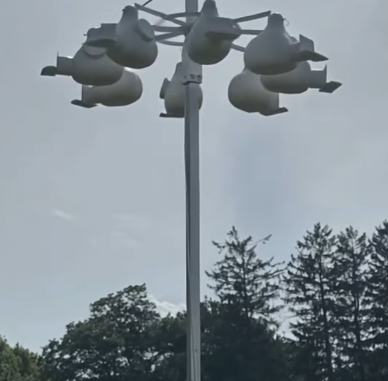
Birdwatchers and nature enthusiasts often notice unusual white, gourd-shaped structures mounted high on poles in parks, gardens, and open spaces. At first glance, these installations can look mysterious, and some people may mistake them for surveillance equipment, weather instruments, or decorative objects. In reality, they serve a much more practical purpose: providing nesting habitat for purple martins, a migratory bird species native to North America.
Purple martins are among the largest members of the swallow family and are known for their graceful flight, distinctive calls, and remarkable seasonal migrations. During warmer months, they can be found across much of North America, where they search for insects and suitable places to raise their young. As winter approaches, many migrate thousands of miles southward to South America before returning the following year.
One of the most recognizable features associated with purple martins is their unusual relationship with humans. In many parts of eastern North America, these birds have become closely associated with artificial housing. People install specialized birdhouses, often made up of multiple compartments, to provide safe and suitable locations where colonies can nest.
The white, rounded structures that resemble gourds are particularly interesting because they imitate natural nesting cavities that birds might historically have used. Their shape and arrangement can create a collection of small nesting spaces, giving multiple pairs of birds an opportunity to establish nests in the same general location.
These structures are usually mounted high above the ground for an important reason. Purple martins are aerial birds that spend much of their time flying and feeding in open spaces. Elevated nesting houses can provide them with a clearer view of their surroundings while making access more difficult for certain ground-based predators.
For bird enthusiasts, installing a purple martin house can also become an opportunity to observe an entire colony throughout the breeding season. The birds may arrive after migration, investigate the available spaces, establish territories, build nests, and eventually raise their young before preparing for another long journey south.
The sight of multiple white gourds hanging from a tall pole can therefore represent much more than an unusual landscape feature. It can be evidence of an intentional effort to create habitat for a species that has developed a fascinating connection with people.
Historically, purple martins have also benefited from changes in human behavior and landscape. In some regions, natural nesting opportunities became less common, while people began providing artificial houses specifically for the birds. Over generations, this relationship became especially important in parts of eastern North America.
The artificial structures are not simply decorative birdhouses. They are carefully designed to meet the nesting needs of the species. Depending on the design, a single housing system may contain numerous compartments, allowing a colony to develop in one location.
Maintaining these houses, however, requires responsibility. Simply putting up a structure does not guarantee that purple martins will use it. Location, height, surrounding habitat, entrance design, predator protection, and regular maintenance can all influence whether birds successfully establish a colony.
Proper management is especially important because artificial nesting sites can attract other species as well. Sparrows, starlings, and other cavity-nesting birds may attempt to occupy the available spaces, potentially creating competition with purple martins. For that reason, experienced colony managers often monitor the houses and take steps to ensure they remain suitable for the intended birds.
The structures can also provide valuable opportunities for education. Children, students, birdwatchers, and community members can observe the birds throughout their breeding cycle and gain a better understanding of migration, nesting behavior, and wildlife conservation.
Watching purple martins arrive in spring can be particularly exciting. After months away, returning birds may once again gather around familiar nesting locations, creating a seasonal spectacle that connects people with a much larger natural cycle.
Their migration itself is extraordinary. These relatively small birds travel enormous distances between breeding and wintering grounds, relying on favorable weather, food availability, and suitable habitat along the way. Their yearly journeys demonstrate how wildlife can connect ecosystems separated by thousands of miles.
The artificial houses are therefore part of a broader conservation story. They show how relatively simple human interventions can help provide resources for wildlife when natural habitats are limited or altered.
At the same time, they highlight an important principle of conservation: artificial solutions should complement, rather than replace, healthy natural ecosystems. Birds need more than nesting spaces. They also require access to insects, water, safe migration routes, and suitable environments throughout their annual cycle.
For that reason, purple martin housing is most effective when combined with broader efforts to preserve open spaces and support healthy ecosystems. A nesting structure can help at the local level, but long-term conservation depends on protecting the wider environment that birds rely upon.
The unusual white gourds also demonstrate how easily an unfamiliar object can have a hidden purpose. Someone walking through a park might see a strange collection of objects suspended high above the ground without realizing that an entire bird colony could depend on them.
Once their purpose is understood, however, the structures become much easier to appreciate. What might initially appear mysterious becomes a carefully designed home for migratory birds.
For nature enthusiasts, these installations offer a reminder that conservation does not always require enormous projects. Sometimes, it can begin with a simple structure placed in the right location and maintained with care.
The next time you see white, gourd-shaped houses high on a pole, take a closer look. You may be looking at one of the most interesting examples of cooperation between people and wildlife—a man-made nesting system designed to welcome travelers that return year after year.
Behind those unusual shapes is a remarkable story of migration, adaptation, conservation, and a bird species that has found an unexpected partner in humans.