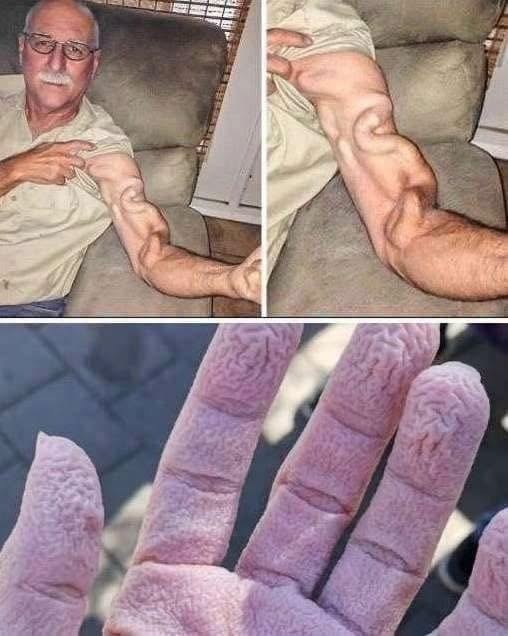
The photo was terrifying. One second, his arm looked completely normal. The next, a grotesque bulge seemed to twist beneath the skin, creating the kind of image that instantly makes people assume something has gone terribly wrong. Within hours, the internet exploded with theories. Comments warned about rare diseases, nerve damage, muscle failure, and even life-threatening conditions developing silently beneath the surface. Then another unsettling photograph appeared: pale, deeply wrinkled fingers that looked almost unnatural. Panic spread faster than facts, until the actual explanations revealed something far less mysterious than social media had imagined.
What millions of people mistook for some bizarre flesh-twisting disease was actually consistent with a well-known type of injury: a biceps tendon rupture.
The biceps muscle in the upper arm is connected to bones by tendons. If one of those tendons tears, particularly the tendon near the shoulder, the muscle can shift or bunch downward. That change can create a dramatic bulge in the arm that looks alarming even when the person can still move the limb.
Because of its distinctive appearance, this is commonly called a “Popeye deformity,” referring to the cartoon character famous for his exaggerated arm muscles.
The visual effect can be shocking.
Instead of the biceps maintaining its usual shape, the muscle may appear gathered lower in the upper arm, producing a rounded bulge closer to the elbow. Bruising, discomfort, weakness, or a sudden popping sensation can sometimes accompany the injury.
The appearance alone, however, doesn’t tell the entire story.
Some people with certain biceps tendon ruptures can retain surprisingly good arm function, particularly when other muscles and remaining tendon attachments compensate. Depending on the location of the tear, the person’s age, activity level, symptoms, and functional needs, treatment can vary considerably.
That is why medical evaluation matters.
A clinician can examine the arm, assess strength and movement, and determine whether imaging or specialist evaluation is appropriate. Some patients may be managed without surgery using rest, rehabilitation, and targeted physical therapy, while others—particularly those with certain injuries or significant functional demands—may be candidates for surgical repair.
The important point is that an unusual bulge shouldn’t automatically be diagnosed from a viral photograph.
It may look catastrophic, but appearance doesn’t determine severity by itself. At the same time, a sudden change in muscle shape following an injury shouldn’t simply be ignored because someone online says it is harmless. Prompt professional evaluation can help identify what actually happened and determine the appropriate treatment.
Then came the second photograph.
The fingers looked pale, deeply wrinkled, and strangely distorted, which encouraged even more dramatic speculation. Some people interpreted the appearance as evidence of poor circulation, disease, or tissue damage.
But wrinkled fingers after spending time in water are usually something much more ordinary.
When hands remain submerged for a while, the nervous system triggers blood vessels beneath the skin to constrict. This reduces the volume of tissue beneath the surface and contributes to the familiar wrinkled appearance of wet fingers and toes.
Interestingly, researchers have proposed that this response may help improve handling or grip in wet conditions, although the exact evolutionary significance continues to be studied.
Either way, the familiar “pruning” of fingers after prolonged water exposure is generally a normal physiological response rather than evidence that the skin is somehow dying or decaying.
Once again, context changes everything.
A photograph of wrinkled fingers without explanation can look unsettling. Tell someone those hands have been soaking in water, and the mystery largely disappears.
Put that image beside a dramatically deformed biceps, remove all context, add an alarming caption, and suddenly two unrelated physical phenomena can be transformed into a frightening story that sounds convincing enough to spread.
That is one of the problems with medical images online.
Photographs are emotionally powerful but medically incomplete. They rarely reveal what happened immediately beforehand, how long the symptoms have been present, whether there was an injury, what other symptoms exist, or what a medical examination found.
Yet social media encourages people to reach conclusions within seconds.
The strangest explanation often travels farther than the ordinary one because fear attracts attention. “Rare deadly disease” creates more urgency than “known tendon injury.” A photograph labeled as mysterious invites thousands of theories before anyone asks whether there is a straightforward anatomical explanation.
That doesn’t mean unusual physical changes should be dismissed.
A sudden muscle deformity, significant weakness, severe pain, major swelling, loss of sensation, or symptoms following an injury deserve proper medical attention. Likewise, finger discoloration or wrinkling that occurs without water exposure, persists unexpectedly, or accompanies pain, numbness, or other concerning symptoms may warrant evaluation.
The lesson is not that everything frightening is harmless.
It is that frightening appearances require context.
The bulging arm and the wrinkled fingers demonstrate how easily ordinary or well-understood biological processes can become terrifying once photographs are separated from their explanations.
One image showed how dramatically anatomy can change after a tendon injury.
The other showed how the human body normally responds to prolonged water exposure.
Neither required an exotic internet theory to explain it.
Together, they expose a larger truth about the digital age: dramatic pictures can travel around the world before accurate information has even put on its shoes. Learning the basic science behind what we see doesn’t merely satisfy curiosity—it helps us distinguish between something that looks frightening and something that genuinely requires urgent attention.
Sometimes the truth is less dramatic than the viral caption.
But when health is involved, the truth is always more useful.