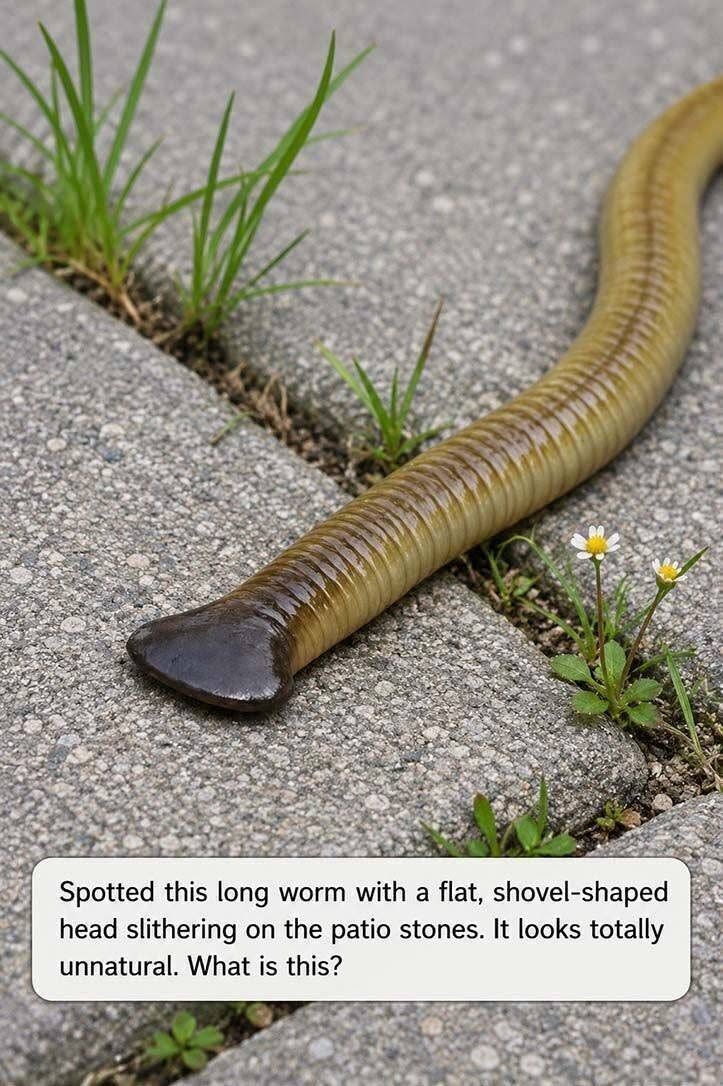
Many homeowners enjoy spending time in their gardens, planting flowers, caring for vegetables, or simply relaxing outdoors. But every now and then, a creature appears that seems completely out of place. One of the most unusual examples is the hammerhead worm, a strange-looking animal that often surprises people when it slowly glides across a patio, driveway, sidewalk, flower bed, or damp patch of soil.
With its unusually long, flattened body and distinctive shovel-shaped head, the hammerhead worm can look more like something from a science-fiction film than a real backyard inhabitant. Its glossy appearance and slow movement only make it seem stranger. Although it may be fascinating at first glance, hammerhead worms are considered invasive in many places where they have been introduced, meaning their presence can potentially affect native ecosystems.
These worms are particularly interesting because they are predators rather than harmless soil recyclers like ordinary earthworms. Their behavior, appearance, and ability to survive in unfamiliar environments have attracted attention from gardeners, homeowners, and scientists alike.
Understanding what hammerhead worms are, where they originated, how they spread, and why experts pay attention to them can help homeowners make more informed decisions if one suddenly appears in the yard.
## What Is a Hammerhead Worm?
Hammerhead worms are land-dwelling flatworms, with many of the commonly encountered species belonging to the genus *Bipalium*. They receive their common name from the unusual shape of the head, which can resemble a hammer, shovel, or small crescent.
Unlike ordinary earthworms, hammerhead worms are flat rather than cylindrical. Their bodies often appear glossy or slimy because they produce mucus that helps protect them and assists with movement. Depending on the species, they may appear brown, tan, gray, yellowish, or even slightly greenish, sometimes with darker stripes running lengthwise along the body.
Their unusual coloration can make them surprisingly difficult to notice when they are moving through damp soil, fallen leaves, mulch, or decaying vegetation. On a light-colored patio or driveway, however, their distinctive body shape becomes much more obvious.
Some hammerhead worms can grow impressively long. Depending on the species and environmental conditions, individuals may reach several inches in length, while certain species can grow considerably longer. Their thin bodies can also stretch while moving, making them appear even larger than expected.
Originally native to parts of Asia, hammerhead worms have spread into numerous other regions. Human activity has played an important role in that expansion. Soil, nursery plants, landscaping materials, and potted vegetation can unintentionally transport flatworms or their egg capsules from one location to another.
A homeowner might therefore discover one without having any obvious idea how it reached the property. It may have arrived hidden in the soil surrounding a newly purchased plant or been transported with gardening materials long before anyone noticed it.
## Why Do They Look So Different?
The hammerhead worm’s appearance is usually the first thing that captures attention.
Its broad, flattened head immediately stands out because it looks dramatically different from the rounded or tapered ends associated with most familiar garden worms. In some species, the head extends outward on both sides, creating the characteristic hammer-like appearance responsible for the animal’s common name.
The unusual head isn’t simply decorative. It contains sensory structures that help the flatworm detect and navigate its environment while searching for food.
Their movement is equally distinctive.
Instead of wriggling through soil in the familiar way earthworms do, hammerhead worms glide smoothly across surfaces. They use microscopic hair-like structures called cilia on the underside of their bodies, together with mucus, to move across damp ground.
This produces an almost effortless sliding motion that can make the animal appear strangely calm and deliberate.
Moisture is particularly important to these flatworms. Because their soft bodies can lose water relatively easily, they are more likely to be noticed in humid environments, beneath logs or rocks, inside mulch, or after rainfall when surfaces remain wet.
That is why a homeowner who has never seen one before may suddenly discover a hammerhead worm crossing a driveway after a storm.
Their shiny skin, unusual head, considerable length, and slow gliding movement combine to create an animal that many people find both fascinating and slightly unsettling.
But strange appearance alone isn’t what makes hammerhead worms noteworthy. Their role as predators and their presence outside their native range are the main reasons scientists and gardeners pay attention to them. They are not simply unusual-looking worms passing harmlessly through the garden; in introduced environments, they can interact with native soil organisms and potentially disrupt ecological relationships.
For homeowners, identifying them correctly is therefore useful. Seeing a hammerhead worm doesn’t necessarily mean a garden is facing an immediate crisis, but recognizing what has appeared in the yard is the first step toward responding appropriately rather than confusing it with an ordinary earthworm.
What looks at first like a bizarre creature from another world is actually a remarkable example of how species can quietly travel across continents, establish themselves in new environments, and eventually appear in the most ordinary place imaginable—right outside someone’s back door.