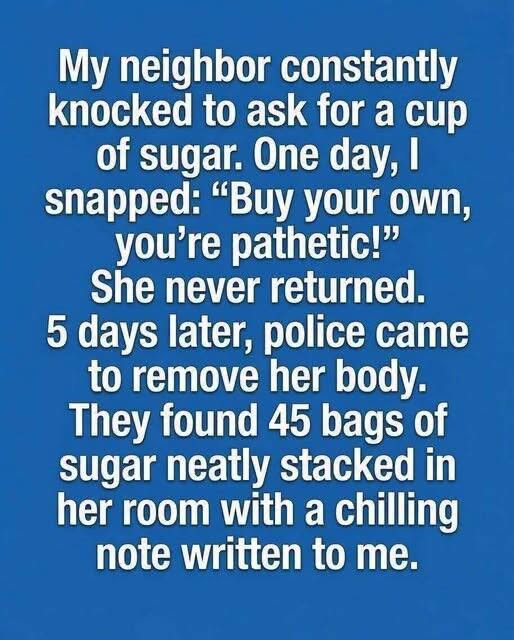
She died quietly. The world didn’t even seem to flinch. There were no crowds outside her house, no dramatic goodbyes, no sudden flood of people realizing what had been lost. But when I unlocked her door and stepped inside, the secret she’d been keeping stared back at me from a single, ordinary room. Forty-five unopened bags of sugar, lined up with almost religious precision, transformed her small kitchen into a silent accusation. Every bag felt like a story I had never bothered to hear. Every bag represented another week she had waited for something that never came. And then I saw my name written on a folded note beside the sink, and my chest tightened.
For several seconds, I simply stood there. The kitchen looked almost exactly as I remembered it—the same faded curtains, the same little table, the same cups waiting inside the cupboard. The air carried the faint scent of old coffee and lemon cleaner, as though she might return at any moment and begin preparing tea. But she wasn’t coming back, and suddenly every ordinary object in that room seemed to carry a meaning I had missed while she was alive.
That was when I realized the bags of sugar weren’t clutter or the strange habit of an elderly woman buying more than she needed. They were a calendar of her hope. Every purchase marked another week she believed someone might finally stay long enough for tea, knock on her door without needing anything, or sit at that little table and ask how she was really doing. Forty-five bags meant forty-five small acts of expectation, quietly accumulating while life continued just outside her door.
I began remembering all the times I had seen her. The hurried greetings from the driveway. The quick conversations near the fence. The moments when she seemed ready to say something more and I glanced at my phone or told her, “Sorry, I’ve got to run.” At the time, I thought I was being friendly. I believed those brief exchanges were enough because I was busy, because there would always be another day, another weekend, another chance to stop.
To her, apparently, those fragments had meant much more. My rushed hellos and five-minute conversations had been received like gifts she carefully saved, while I had treated them as scraps of leftover time. She remembered details I had forgotten almost immediately. She asked about my family, noticed when my routine changed, and seemed genuinely pleased whenever I slowed down for even a few minutes. I had never considered that those minutes might have been among the most important parts of her week.
Then I unfolded the note.
I expected accusation. Maybe part of me believed I deserved one. I expected words asking why I had never stayed longer or why someone living only ten feet away had been allowed to become so completely alone. But her note didn’t blame me. It thanked me. She wrote with gratitude about the tiny pieces of companionship I had given her, as though I had done something generous instead of merely squeezing her into the empty spaces of my schedule.
That was the part that hurt the most.
She had been grateful for fragments when she deserved whole afternoons. She deserved someone sitting across from her while the kettle boiled, someone listening to the stories she had probably told herself a hundred times because nobody else was there to hear them. She deserved laughter at that little kitchen table and the simple reassurance of knowing someone would return next week. Instead, she kept buying sugar for guests who rarely came.
When I finally left her house, the walk back to mine was only ten feet. Yet somehow it felt like miles. I kept thinking about how close we had physically lived and how enormous the distance between our lives had actually become. I had been near enough to see her windows every day, but somehow too busy to notice the loneliness sitting behind them.
The forty-five bags stayed in my mind long after the kitchen had been cleared. They became a symbol of how easily loneliness can hide behind clean curtains, polite smiles, and closed doors. Not everyone who is struggling asks loudly for company. Sometimes they simply keep the house ready. They buy another bag of sugar. They place another cup in the cupboard. They wait.
Now, whenever I pass a solitary figure sitting on a porch or notice a neighbor standing alone near their gate, I remember that kitchen. I remember the old coffee smell, the lemon cleaner, the folded note, and those perfectly arranged bags of sugar. And when I can, I choose to slow down. I ask another question. I listen a little longer. Because sometimes the difference between being noticed and disappearing quietly is nothing more dramatic than someone deciding they have five more minutes to stay.