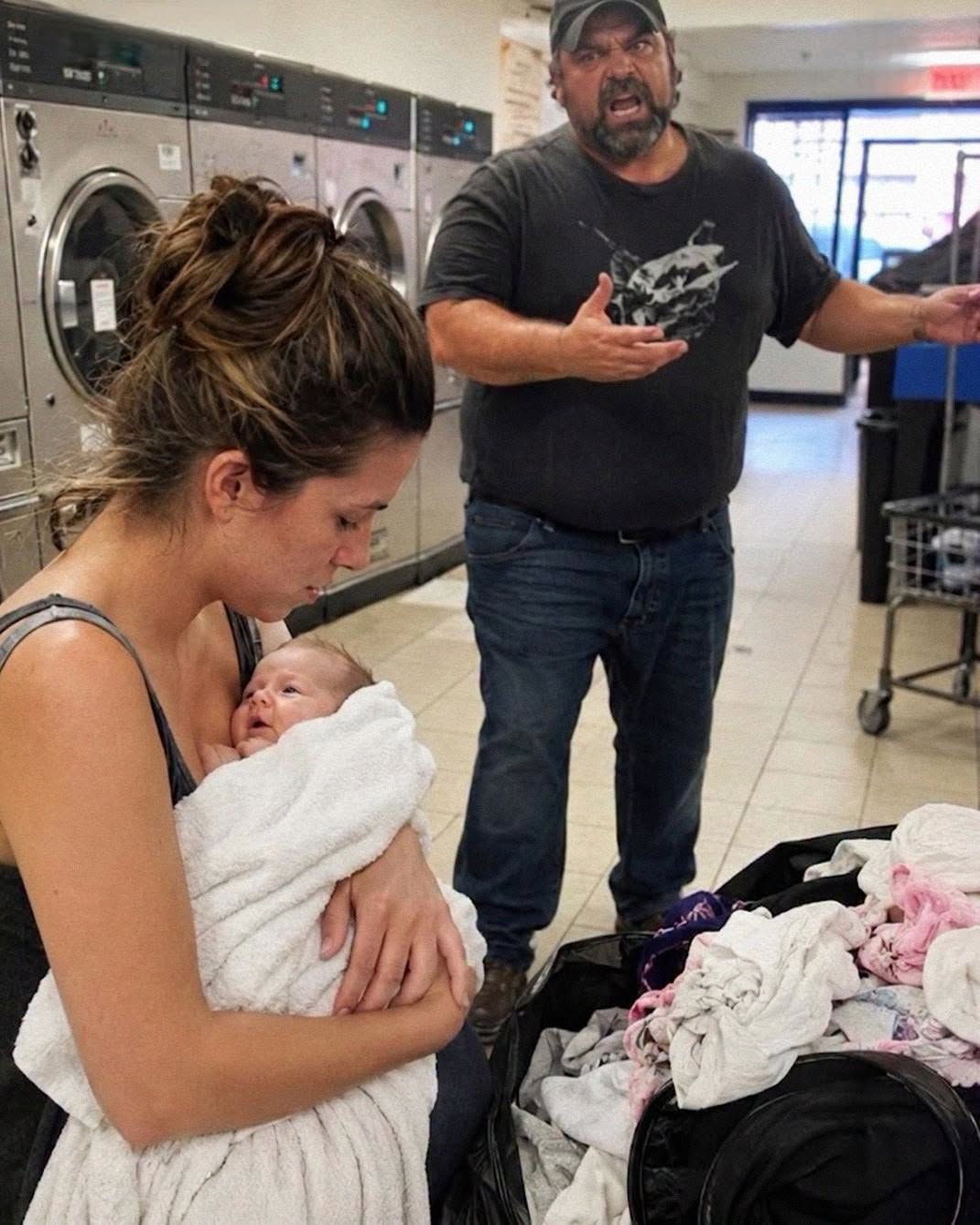
The heavy glass door of the Maple Street Laundromat rattled on its hinges as the summer heat rolled off the asphalt outside. Inside, the rhythmic hum of washing machines usually masked the small heartbreaks people brought through the entrance, but today was different. A young woman stood frozen in front of machine number four, her face drained of color as a towering man screamed insults at her from inches away. When an elderly observer finally stepped up, nobody expected the dark truth that would spill into the open—or the silent signal that was about to change three lives forever.
Working behind the counter of a neighborhood laundromat for nearly two decades teaches you how to read people without speaking a single word. You learn that a single suit washed alone usually heralds a quiet divorce, while overflowing trash bags filled with mismatched clothes often signal a sudden eviction. For almost a week, I had watched a pale young woman pace outside our front window, holding a infant tightly against her chest. She would linger for a minute, stare at the prices listed on the glass, and keep walking. On Thursday afternoon, she finally gathered enough courage to push open the door.
She couldn’t have been older than twenty-three. Deep circles shadowed her eyes—not the kind from typical newborn sleep deprivation, but the lingering exhaustion of someone who sleeps with one eye open. She carried a single faded canvas tote bag, an unusually small amount of luggage for a parent. When she emptied her pockets on my counter to ask for the cheapest washer, she carefully counted out three dollars in quarters, dimes, and pennies. It was clearly the last of her physical money.
After starting machine number four, she approached me again with her head low, whispering a request to borrow a clean towel. She explained with evident shame that she needed to wash every item of clothing her baby girl was wearing, as they had no other clean clothes left. I handed her a thick, worn towel from our supply cabinet. Sitting back on the bench, she gently stripped her three-week-old daughter, wrapped her snugly in the towel, and placed every bit of the infant’s wardrobe into the wash.
The quiet moment ended abruptly when Frank walked in. Frank was a long-time customer who never hesitated to remind everyone that he knew the building’s owner. As he loaded his own laundry, his eyes drifted toward the young woman. His expression hardened, and he began muttering under his breath before slamming his washer lid shut.
He marched toward her, pointing an angry finger. He declared that a public laundromat was no place to strip a baby and loudly complained about an imaginary foul smell, accusing her of ruining the environment for paying customers. The young mother apologized repeatedly, her voice shaking as tears welled in her eyes, but Frank escalated his tirade, sneering that people who couldn’t afford clothes shouldn’t have children in the first place. Nobody in the room dared to speak up, and as an employee, fear of losing my job kept my own tongue tied.
Then the front door jingled open. Linda, the owner of the laundromat, walked in holding a crate of supplies. She took in the scene instantly, setting the box down and walking directly over to the young mother. Rather than addressing Frank immediately, Linda leaned in softly, asking the baby’s name and age. As she did, Linda’s eyes fixed on the young woman’s arm. Pushed up slightly beneath her sleeve was a series of dark, deliberate bruises surrounding her wrist and forearm.
Linda turned to Frank with absolute composure. When Frank attempted to justify his outburst by claiming the mother was making everyone uncomfortable, Linda systematically polled the surrounding customers, who all confirmed they smelled nothing and were only made uncomfortable by Frank’s cruelty. Calmly, Linda informed Frank that after twenty-seven years in business, she valued basic human kindness over his patronage. She ordered him to pack his wet clothes and leave the property immediately, banning him permanently. Stunned and humiliated, Frank stuffed his damp laundry into a basket and stormed out into the heat.
Once the door closed, Linda guided the tearful mother into the back office. When they emerged a short while later, Linda asked me to watch the baby’s laundry while she stepped out to make phone calls. The young mother sat back down, clinging tightly to her swaddled infant. She quietly confessed to me that she had fled her abusive husband six days prior and had spent nearly a week counting her spare change outside, terrified of being found.
Suddenly, the front door swung open once more. A tall, well-dressed man stepped into the room, scanning the space until his eyes locked onto the young mother. The atmosphere instantly turned ice-cold. She went rigid, pulling her daughter as close as possible while whispering for help.
The man assumed a warm, concerned smile, addressing Linda and the room at large. He claimed his wife was simply exhausted from postpartum stress and had walked out in a state of confusion, pleading with her to come back home. But the façade vanished the moment his wife found her voice and firmly stated she was never going back. His warm expression flattened into cold anger.
Before he could take another step, Linda stepped directly into his path, blocking his access to the young mother and child. She made it clear that he was not welcome and that authorities were already notified. Realizing he was outnumbered and exposed in front of a room full of witnesses, the man turned around and left, his truck tires screeching as he sped away from the lot.
Moments later, the local shelter transport Linda had arranged arrived at the front door. As the young mother gathered her daughter’s fresh, warm clothes from the dryer, her shoulders finally dropped. Laundromats see endless piles of dirty clothes, but sometimes the heaviest burdens people carry have nothing to do with laundry at all.