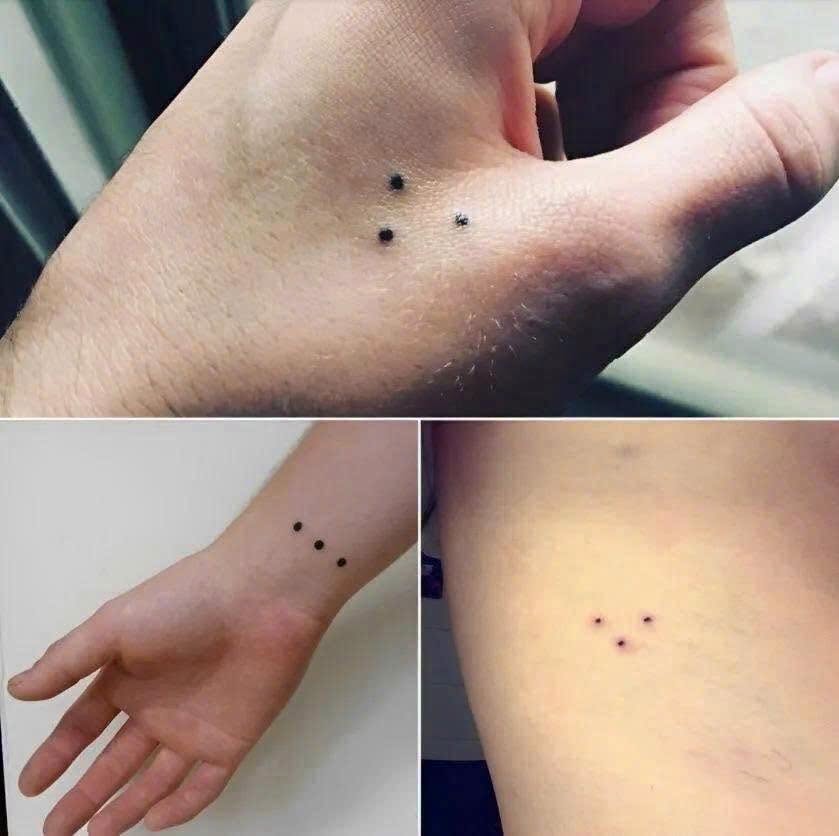
When viral internet posts began warning that seeing a simple three-dot tattoo on a stranger’s hand meant you should immediately stay away, millions of people reacted with fear and confusion. Across social media, alarming claims spread rapidly, suggesting that this tiny ink symbol was a universal warning sign connected to dangerous criminal gangs, violent initiation rituals, and serious street crime. Posts were shared thousands of times, often without context or evidence, causing ordinary people to become suspicious of anyone carrying the mysterious mark. But as the panic grew and people began distancing themselves from completely harmless strangers, a much more complicated reality started to emerge. The truth behind the three-dot tattoo is far different from what sensational headlines suggested, showing just how easily one exaggerated internet claim can distort reality and unfairly damage people’s reputations.
The internet has become incredibly effective at manufacturing outrage and fear, often taking a small fragment of truth and transforming it into something far more dramatic than the facts actually support. The viral “run as far as you can” warnings surrounding three-dot tattoos are a perfect example of how online fear-mongering can spread. For anyone who has ever noticed three tiny dots tattooed on someone’s hand, wrist, finger, or ankle, being told that the design automatically signals a violent criminal connection can naturally create anxiety. People may begin making assumptions before knowing anything about the person standing in front of them. Yet once the dramatic clickbait is removed, the story becomes far more nuanced, revealing a fascinating mixture of cultural history, artistic expression, spirituality, personal identity, and individual experience.
The three-dot tattoo, commonly arranged in a small triangle or sometimes placed in a straight line, is actually one of the simplest and most recognizable minimalist tattoo designs found around the world. Far from serving as a universal symbol of violence, criminal behavior, or danger, its meaning can vary dramatically depending on cultural background, geographic region, personal beliefs, and the individual story of the person wearing it. Two people can carry nearly identical three-dot tattoos while attaching completely different meanings to them. Treating every person with three dots of ink as potentially dangerous is therefore not only misleading but deeply unfair, potentially turning an innocent personal symbol into a reason for unnecessary suspicion or discrimination.
One of the most frequently discussed cultural interpretations of the three-dot triangle tattoo comes from Chicano and Mexican-American street culture, where it has historically been associated with the Spanish phrase *Mi Vida Loca*, meaning “My Crazy Life.” Even within this particular context, however, the tattoo should not automatically be interpreted as a threat toward strangers or proof that someone intends violence. Instead, it can function as an autobiographical statement reflecting a turbulent life, survival through difficult circumstances, personal resilience, or experiences shaped by unpredictable environments. For some people who wear the symbol within this tradition, the three dots represent where they have been, what they have endured, and the challenges they managed to overcome—not necessarily what they plan to do in the future.
Beyond associations with particular communities or subcultures, the number three itself has carried powerful symbolic meaning throughout human history. That makes three dots a natural choice for simple yet meaningful body art. Across numerology, sacred geometry, philosophy, religion, and numerous spiritual traditions, groups of three frequently represent harmony, balance, unity, and completeness. For some individuals, three dots symbolize the Holy Trinity—the Father, Son, and Holy Spirit—turning the tattoo into a discreet but deeply personal expression of Christian faith. Others interpret the dots as representing mind, body, and spirit, using the design as a permanent reminder to maintain balance, remain grounded, and pay attention to their emotional and spiritual well-being.
The three points can also represent the passage of time and the continuous movement of life, symbolizing the relationship between the past, present, and future. Some people choose the tattoo during major turning points—after surviving hardship, beginning a new chapter, leaving something painful behind, or deciding to change the direction of their lives. In that sense, one dot can honor where they came from, another can represent where they stand today, and the final dot can symbolize the unknown future still waiting ahead. A design that appears almost meaningless to an outside observer can therefore carry years of memories and deeply personal significance for the person wearing it.
Family and close relationships provide another common interpretation. Three dots may represent three children, three siblings, three generations of a family, or a trio of lifelong friends who share an unbreakable connection. In other cases, one or more of the dots may honor loved ones who have passed away, allowing the wearer to keep their memory permanently close without displaying names, dates, or elaborate imagery. Because the design is so understated, its true meaning can remain private—understood only by the person wearing it and those closest to them.
Ultimately, a three-dot tattoo cannot tell you everything about the person wearing it. Like countless other symbols, its meaning changes according to context, history, culture, and personal intention. While the design has appeared in certain street and prison cultures and can carry specific meanings in those environments, that does not make it a universal warning sign of imminent danger. The viral claim that everyone should immediately run from anyone displaying three dots strips away that essential context and replaces it with fear. Sometimes three tiny dots may represent hardship or a complicated past; other times they may symbolize faith, family, friendship, balance, remembrance, or simply an appreciation for minimalist art. The real lesson may have less to do with the tattoo itself and more to do with how quickly the internet can transform an ambiguous symbol into a frightening story—and how important it is to understand the person and context before allowing a viral headline to define them.