The internet turned two little girls into the center of an argument they never asked to join.
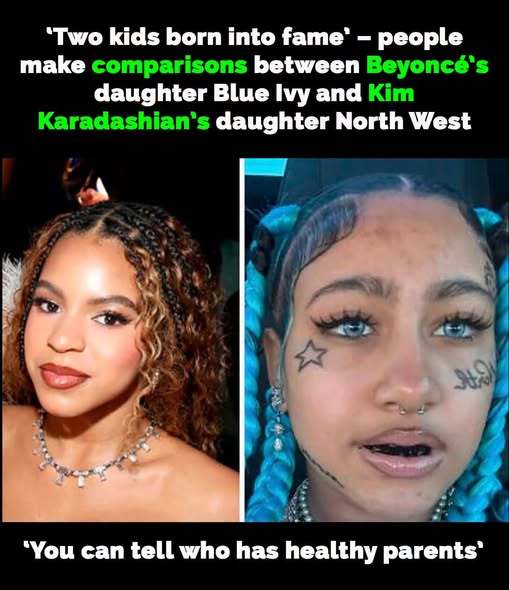
A split-screen video comparing Blue Ivy Carter and North West began circulating online, attracting enormous attention and increasingly harsh commentary.
What might have remained a simple comparison of two celebrity children quickly became something much uglier.
Adults began analyzing their clothes.
Their appearances.
Their behavior.
And eventually, their parents.
North’s playful, spooky-looking outfit was interpreted by some commenters as supposed evidence that something was wrong in her family life.
Meanwhile, Blue Ivy’s appearance was presented by others as proof of supposedly better or more stable parenting.
But there was one enormous problem with the entire debate.
These are children.
A photograph or short video cannot tell strangers whether a child is happy, loved, secure, or struggling.
Nor can clothing reveal the quality of parenting happening behind closed doors.
Children experiment.
They wear costumes.
They follow trends.
They develop interests that change almost as quickly as they grow.
North West should be allowed that freedom without strangers turning every outfit into a psychological diagnosis.
Blue Ivy deserves exactly the same protection.
Neither girl should become evidence in arguments about celebrity marriages, divorce, parenting styles, or what constitutes a “healthy” family.
Fortunately, many people online recognized how inappropriate the comparison had become.
They pushed back against comments attacking either child and reminded others that celebrity children don’t stop being children simply because their parents are famous.
That’s an important distinction.
Blue Ivy didn’t choose Beyoncé and Jay-Z’s level of fame.
North didn’t choose the enormous public attention surrounding Kim Kardashian and Kanye West.
Yet both have grown up under cameras capable of turning ordinary childhood moments into global conversations.
Imagine experiencing your teenage years while millions of strangers freeze-frame your photographs and decide what kind of person you’re becoming.
Most adults would find that unbearable.
Children deserve considerably more grace.
Families also don’t come in one perfect configuration.
Parents can be married, separated, divorced, remarried, or raising children in countless other arrangements.
None of those labels alone tells us whether a child receives love, attention, stability, and support.
That’s why reducing these girls to symbols is so unfair.
Blue Ivy isn’t proof of one parenting philosophy.
North isn’t proof of another.
They’re two young people growing up under extraordinary circumstances.
Years from now, they’ll have their own identities, opinions, successes, mistakes, and stories.
They deserve the opportunity to discover those things without millions of adults writing the ending for them first.
Perhaps the most revealing thing about the viral comparison wasn’t anything Blue Ivy or North did.
It was how quickly adults forgot they were talking about children.
Because protecting kids online sometimes requires something remarkably simple:
Knowing when not to comment.