He thought he was untouchable. Just another late night, another drive home, another chance to laugh his way out of trouble. When flashing blue lights appeared in his rearview mirror, he wasn’t afraid—he was amused. He believed a quick joke, a confident smile, and a little cleverness would be enough to convince the officer that everything was fine. But what he didn’t understand was that the officer standing beside his car had seen this scene countless times before. Behind the humor and misplaced confidence was a dangerous reality, one that could have ended in heartbreak instead of handcuffs.
The stop began like many others.
The officer noticed signs that raised concern.
The vehicle had drifted within its lane.
Its speed changed without explanation.
Small driving mistakes, taken together, suggested something might not be right.
After safely stopping the vehicle, the officer approached and began asking routine questions.
Almost immediately, subtle warning signs appeared.
The driver’s speech seemed different.
His movements lacked coordination.
His confidence, however, remained untouched.
“I’m fine,” he insisted with a grin.
“I can drive.”
The officer had heard those exact words many times before.
Years of experience had taught him that people impaired by alcohol often overestimate their own abilities. Many genuinely believe they are capable of driving safely, even when their judgment, reaction time, and coordination have been significantly affected.
That’s precisely why standardized field sobriety tests exist.
They are not designed to embarrass anyone.
They are intended to help officers assess whether a driver’s physical and mental abilities may be impaired.
The driver laughed through the instructions.
He treated each task like entertainment.
Standing still became a balancing act.
Walking a straight line became an opportunity for another joke.
Each stumble was met with another attempt to laugh it off.
To him, everything felt harmless.
To the officer, every mistake painted a clearer picture.
Field sobriety exercises measure much more than balance.
They evaluate divided attention—the ability to perform simple physical and mental tasks at the same time. Safe driving requires exactly that skill: steering, observing traffic, reacting to hazards, following road signs, and making quick decisions simultaneously.
Alcohol can interfere with those abilities long before someone realizes it.
The officer then introduced another simple challenge.
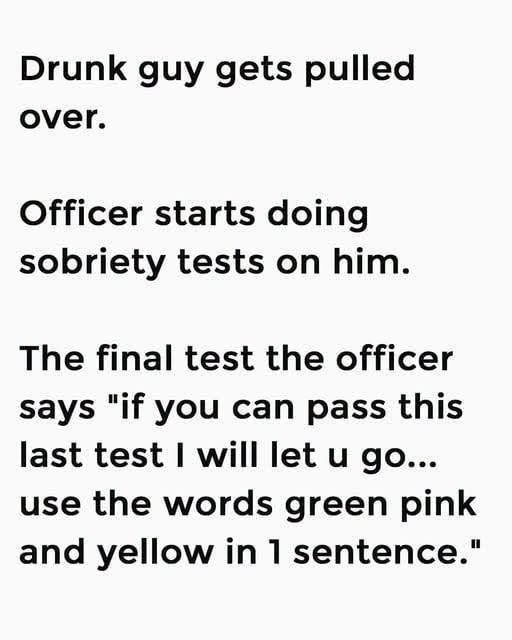
“Use the words green, pink, and yellow in one sentence.”
The request sounded almost playful.
The driver smirked.
He paused for a moment, obviously pleased with himself, before delivering what he believed was the perfect answer.
He expected laughter.
Instead, the officer quietly continued the investigation.
The sentence itself wasn’t really the point.
Rather, exercises involving memory, attention, language, and concentration can sometimes provide additional observations about a person’s mental functioning. They are only one part of a much broader assessment and are not, by themselves, proof that someone is impaired.
To the driver, it had felt like a game.
To the officer, it was another opportunity to observe thinking, attention, and coordination.
Experience had taught him that bravado often disappears once the seriousness of the situation becomes clear.
He had seen countless people insist they were perfectly capable of driving.
He had also seen the devastating consequences when that confidence proved dangerously misplaced.
Crashes.
Serious injuries.
Families receiving life-changing phone calls in the middle of the night.
Those memories remained with him during every impaired-driving investigation.
Each traffic stop carried the possibility of preventing another tragedy before it happened.
Eventually, the officer informed the driver that he was under arrest based on the totality of the investigation, not on a single answer or one isolated mistake.
The handcuffs clicked into place.
The joking stopped.
Reality settled in.
For the driver, the evening had changed completely.
What began as an inconvenience had become an arrest that could carry legal, financial, and personal consequences.
More importantly, it marked the moment when a potentially dangerous situation ended before someone else was harmed.
Driving while impaired remains one of the leading contributors to serious traffic crashes in many countries.
Alcohol affects reaction time, decision-making, vision, coordination, and the ability to recognize hazards—all critical skills behind the wheel. Even when someone feels “okay,” their actual driving ability may be significantly reduced.
That’s why public safety campaigns consistently encourage people to plan ahead.
Use a designated driver.
Call a taxi or rideshare.
Stay where you are until you’re sober.
Ask a friend for a ride.
A small decision before getting behind the wheel can prevent irreversible consequences.
The officer understood that his job extended beyond writing citations or making arrests.
His responsibility was protecting everyone sharing the road.
Every driver.
Every passenger.
Every child asleep in a back seat.
Every family simply trying to make it home safely.
Sometimes the most important success in law enforcement is the tragedy that never happens.
No headlines.
No crash scene.
No emergency calls.
Just another dangerous situation quietly prevented.
The man who believed he was untouchable eventually learned an important lesson.
Confidence cannot overcome impairment.
Humor cannot change the effects of alcohol.
And clever words cannot replace clear judgment.
What seemed like an ordinary traffic stop became something far more meaningful—a reminder that the difference between arriving home safely and causing unimaginable harm can be one simple decision.
In the end, the officer wasn’t trying to win an argument or spoil someone’s evening.
He was trying to ensure that everyone on the road had the chance to return home to the people waiting for them.
That night, the story didn’t end with laughter.
It ended with accountability—and perhaps the prevention of a tragedy that no joke could ever erase.