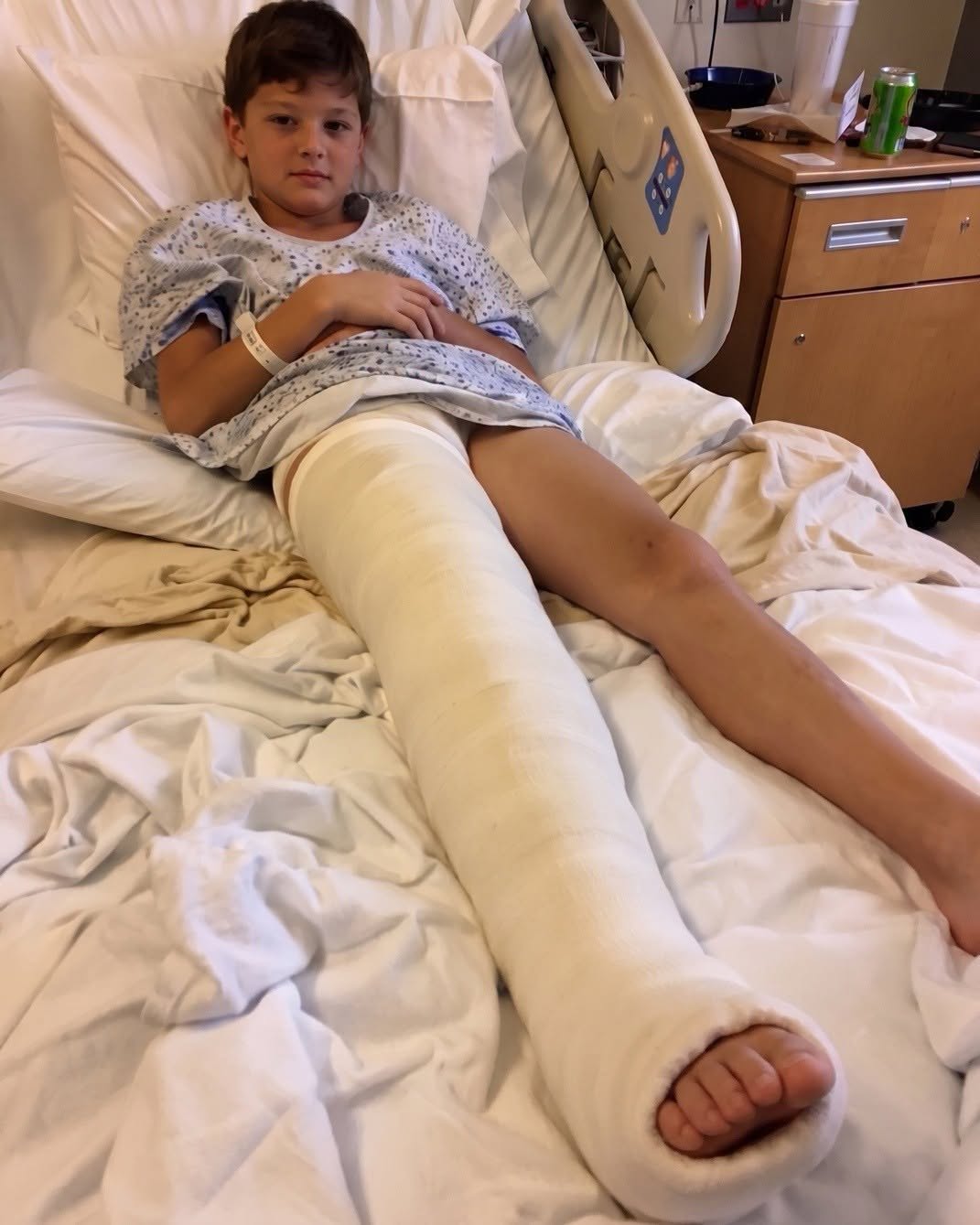
The phone rang just after sunset, and before I even answered, something deep inside me knew my world was about to change. My ex-husband, Jasper, sounded unusually calm as he explained that our twelve-year-old son, Howard, had taken a spill from his scooter while spending the weekend at his house. “It’s nothing serious,” he insisted. “Just a broken leg. Kids bounce back.” His voice carried the practiced confidence of someone who expected to be believed without question. I wanted to believe him. Every parent wants to believe that accidents are simply accidents.
Still, something didn’t sit right.
By the time I arrived at the hospital, Howard was asleep beneath thin white blankets, his leg wrapped in a heavy cast that stretched from his thigh to his ankle. His face looked pale beneath the fluorescent lights, and there were dark circles under his eyes that seemed far older than twelve years should allow. Jasper greeted me with the same carefully rehearsed explanation. Howard had lost control of his scooter while riding down a neighborhood sidewalk. End of story. Simple. Unfortunate. Nothing more.
Except it wasn’t.
As I leaned over to kiss Howard’s forehead, I noticed something that made my heart tighten. His fingers instinctively gripped my wrist, almost as if he wanted to stop me from leaving. His lips barely moved as he whispered, “I’m sorry.”
Sorry?
For what?
Children apologize when they believe they’ve done something wrong.
Not when they’ve simply fallen off a scooter.
Before I could ask another question, a nurse quietly entered the room to check Howard’s medications. She worked silently for several minutes before handing me a folded piece of paper beneath a clipboard. Her expression never changed, and she never looked directly at me. Softly she whispered, “Please read this when you’re alone.”
Then she walked away.
Confused, I slipped the note into my pocket.
A few minutes later, standing alone in the hallway, I unfolded the small piece of paper.
It contained only one sentence.
**The injury doesn’t match the story. Ask to speak with hospital security before you leave.**
My stomach instantly turned to ice.
Suddenly every detail replayed inside my head.
Howard’s apology.
Jasper’s unusual calmness.
The strange silence in the room.
Nothing felt ordinary anymore.
I immediately requested to speak with security, pretending I needed directions around the hospital so Jasper wouldn’t become suspicious. After several quiet conversations, one of the security supervisors led me down a narrow hallway into a small monitoring room filled with glowing surveillance screens.
It was nearly three o’clock in the morning.
The room was dark except for flickering monitors.
One screen displayed security footage from the hospital ambulance entrance captured shortly after Howard arrived.
I watched in stunned silence.
Howard wasn’t crying because of his broken leg.
He was crying because Jasper kept leaning toward him, repeatedly speaking before doctors approached.
Though there was no audio, the meaning became painfully clear.
Jasper wasn’t comforting him.
He was coaching him.
Over and over again, he appeared to repeat the same instructions while Howard silently nodded through tears.
The supervisor paused the video.
Then showed me another angle.
This one captured the emergency room intake area.
When medical staff briefly separated Jasper from Howard for X-rays, my son immediately became visibly calmer. The moment Jasper returned, Howard’s shoulders tightened again. He lowered his eyes and stopped speaking almost entirely.
Every instinct inside me screamed that something was terribly wrong.
A hospital social worker joined us shortly afterward.
She explained that several members of the medical staff had independently expressed concerns. Howard’s fracture pattern didn’t resemble the injuries normally seen from simple scooter falls. There were also bruises at different stages of healing along his back and upper arm—injuries that couldn’t easily be explained by a single accident.
No one accused anyone outright.
But everyone agreed one thing deserved further investigation.
The social worker gently asked whether Howard had ever seemed afraid of disappointing his father.
The question hit me harder than I expected.
I remembered dozens of little moments I’d dismissed over the years.
Howard hesitating before answering questions about weekends with Jasper.
The way he’d become unusually quiet after returning home.
How he’d immediately defend his father whenever I casually asked whether everything had gone well.
I had mistaken loyalty for happiness.
Now I wondered if it had actually been fear.
The following morning, once Jasper stepped out to make a phone call, I sat beside Howard’s bed and simply held his hand.
I didn’t pressure him.
I didn’t ask leading questions.
I quietly said, “You never have to protect anyone from the truth.”
For several long minutes, he stared at the blanket.
Then tears filled his eyes.
“It wasn’t the scooter,” he whispered.
Everything inside me stopped.
Howard explained that he had accidentally knocked over an expensive tool inside Jasper’s garage. Jasper exploded in anger, grabbed him forcefully, and shoved him toward a workbench. Howard lost his balance, fell awkwardly, and his leg struck the concrete floor beneath him.
Afterward, Jasper immediately began apologizing.
Then came the instructions.
“If anyone asks, you fell off your scooter.”
Howard nodded because he was scared.
Not because it was true.
Walking back into that hospital room later that day, I knew nothing about our lives would ever be the same again.
The cast wrapped around Howard’s leg was no longer simply helping a broken bone heal.
It had become physical evidence of something much deeper—a fracture in trust, safety, and the family we thought we understood.
When confronted, Jasper denied everything.
He insisted Howard had misunderstood.
He claimed the hospital staff were overreacting.
He accused me of trying to manipulate custody arrangements.
Months earlier, those tactics might have made me question myself.
Not anymore.
This time there was too much evidence.
The nurse’s observations.
The surveillance footage.
The medical findings.
Howard’s own words.
None of it could be explained away.
In the weeks that followed, I stopped worrying about being seen as difficult.
Instead, I focused entirely on being protective.
Emergency custody arrangements were requested.
Howard began meeting regularly with a child therapist who specialized in helping young people process trauma and rebuild confidence. Week by week, he slowly learned that telling the truth wasn’t something to fear. He discovered that honesty didn’t destroy families—silence did.
Little by little, his laughter returned.
His shoulders relaxed.
The anxious habit of apologizing for things that weren’t his fault gradually disappeared.
One evening after therapy, while we were eating dinner together, Howard looked up at me and quietly said something I’ll never forget.
“I don’t like keeping secrets anymore.”
Those seven words healed something inside both of us.
Because this story was never really about a broken leg.
It wasn’t even about surveillance cameras or hidden hospital notes.
It was about a child finally realizing he deserved to feel safe.
And a mother finally realizing that protecting her son sometimes meant refusing to accept easy explanations simply because they were convenient.
The nurse’s tiny folded note changed everything.
Not because it contained proof.
But because it reminded me to trust the voice inside that refused to believe something was right.
Today, Howard knows one truth above all others.
No matter how uncomfortable the conversation may be…
No matter who the truth involves…
His safety will always matter more than someone’s reputation.
His honesty will always matter more than someone else’s excuses.
And as long as I am his mother, he will never have to carry someone else’s lies on his shoulders again.