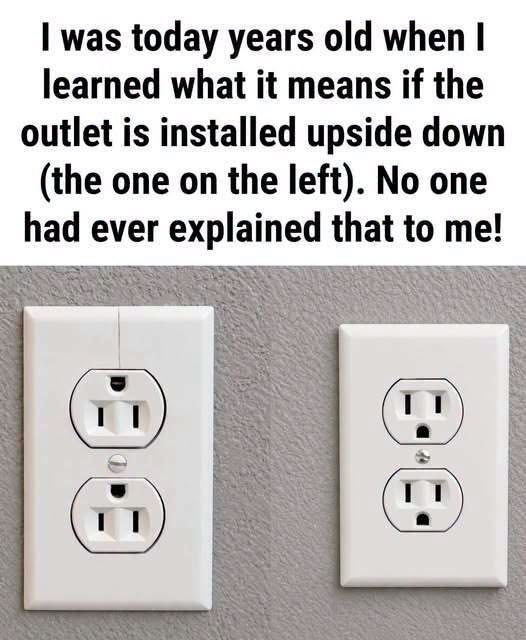
Have you ever noticed a wall outlet installed upside down, with the round ground hole at the top instead of the bottom, and wondered if someone made a mistake? It’s a surprisingly common sight in many homes, offices, and commercial buildings. While it may look unusual, an upside-down outlet is often installed intentionally. In most cases, it reflects a practical decision made by the electrician rather than an installation error. Understanding why these outlets are sometimes oriented differently offers an interesting glimpse into electrical design, safety practices, and the evolution of home wiring.
Most people rarely think about electrical outlets until something doesn’t work. Because the majority of outlets are installed with the ground hole facing downward, any variation naturally catches the eye. This difference has led to countless theories, ranging from construction mistakes to hidden electrical problems. In reality, there is no single explanation. Several legitimate reasons exist, and the orientation often depends on the purpose of the outlet, the preferences of the installer, or the standards followed during construction.
One of the most common reasons for an upside-down outlet is to identify a switched receptacle. In many older homes, especially those built before ceiling light fixtures became standard in every room, a wall switch near the entrance often controlled one half of a nearby electrical outlet. This allowed homeowners to plug a floor lamp into the switched portion and illuminate the room simply by flipping the switch as they entered.
These split outlets were designed so that one socket remained permanently energized while the other responded to the wall switch. The always-on half could power items like clocks, televisions, or phone chargers, while the switched half controlled a lamp. Since both outlets looked identical, electricians sometimes installed these receptacles upside down to provide a quick visual reminder that the outlet functioned differently from a standard one.
Although this practice became common in many areas, it was never a universal requirement. Electrical codes generally do not specify that outlets must face one direction or the other. As a result, installation practices vary widely between regions, contractors, and even individual electricians. Two neighboring homes built by different companies may have outlets oriented in completely different ways while still fully complying with local electrical regulations.
Another frequently discussed reason involves safety. Some electricians prefer installing outlets with the ground pin on top because of what could happen if a plug is partially pulled out while remaining connected. In that situation, the metal prongs may become exposed. If a conductive object such as a metal ruler, picture frame, paperclip, or piece of jewelry were to fall between the wall and the plug, it could potentially contact the energized prongs.
When the ground opening is positioned at the top, a falling metal object would likely contact the grounded portion of the plug before reaching the energized blades. This could reduce the chance of creating a short circuit or electrical arc. While such accidents are relatively uncommon, some electricians consider this orientation an additional safety precaution, particularly in commercial or institutional settings.
Hospitals provide one of the best-known examples of this practice. Many medical facilities intentionally install outlets with the ground pin facing upward, partly because this orientation can reduce certain risks involving partially unplugged medical equipment. It also creates a consistent visual standard throughout the building, making electrical installations easier for maintenance personnel to identify.
Commercial buildings often follow similar conventions. Office buildings, schools, laboratories, and industrial facilities may use upside-down outlets to distinguish certain electrical circuits from others. In some cases, different outlet orientations indicate emergency backup power, generator circuits, or specialized electrical systems. The exact meaning depends on the building’s electrical design rather than a universal rule.
Homeowners occasionally encounter upside-down outlets after remodeling projects as well. An electrician may choose that orientation simply to distinguish a newly installed circuit or to match existing wiring practices elsewhere in the house. Sometimes the decision is based entirely on convenience, particularly if bulky power adapters fit more comfortably when the outlet is installed in a particular direction.
Large charging bricks and transformer-style plugs often occupy significant space around an outlet. Depending on the design of the receptacle and nearby furniture, flipping the outlet may allow these larger adapters to hang more naturally without interfering with adjacent plugs. Although this isn’t the primary reason most outlets are installed upside down, it illustrates how practical considerations sometimes influence installation choices.
It’s important to understand that an upside-down outlet does not automatically indicate a switched outlet or any particular wiring arrangement. Some homeowners assume that every inverted receptacle must be connected to a wall switch, but this isn’t always true. Others believe it signals a wiring problem, which is also generally incorrect. The orientation alone cannot reveal how the outlet is wired internally.
If you’re curious whether an outlet is controlled by a switch, the easiest method is simply to test it. Plug a small lamp into each socket individually and flip nearby wall switches to see whether either half turns on and off. This simple test quickly determines whether the outlet has a switched section without requiring any electrical work.
If you ever suspect an outlet has loose wiring, intermittent power, discoloration, unusual warmth, buzzing sounds, or visible damage, the issue should be inspected by a qualified electrician. Those symptoms deserve attention regardless of which direction the outlet faces. Orientation by itself is not an indicator of an electrical hazard.
Modern electrical systems include many features that most homeowners never notice. Ground fault circuit interrupters, arc fault protection, tamper-resistant receptacles, surge protection, and improved grounding methods all contribute to making homes safer than ever before. The direction an outlet faces is only one small detail within a much larger electrical system designed to provide reliable and safe power throughout the home.
What initially appears to be an odd construction decision is often the result of thoughtful planning, professional convention, or practical experience. Whether an outlet was installed upside down to identify a switched receptacle, provide an additional visual cue, support a particular safety philosophy, or simply match the electrician’s preferred style, the choice is usually intentional rather than accidental.
The next time you notice an upside-down outlet in your home or another building, you’ll know there’s often more to the story than meets the eye. Behind that simple change in orientation lies decades of evolving electrical practices, practical problem-solving, and careful attention to how people use their homes every day. Sometimes the smallest details hidden in plain sight reveal the most interesting examples of thoughtful engineering and everyday design.