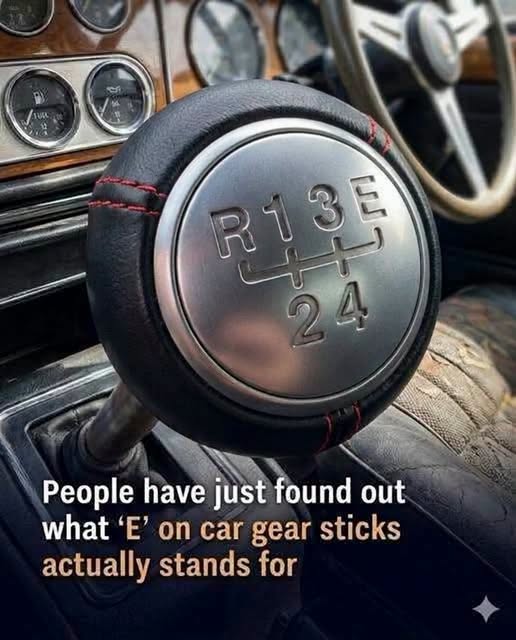
Many drivers today would be surprised to learn that older vehicles once featured a little-known function that has almost completely disappeared from modern automobiles. If you’ve ever climbed into the driver’s seat of a car from the 1980s or early 1990s, you may have noticed a single letter—**”E”**—displayed near the gear selector or even printed directly on the shift pattern. To someone unfamiliar with classic vehicles, it might have seemed like an odd design choice with no obvious purpose. In reality, however, that simple letter represented a specialized driving mode that allowed motorists to influence how their vehicle behaved, offering a practical way to improve fuel efficiency long before today’s advanced computer systems took over that responsibility.
The **”E”** stood for **Economy**, sometimes referred to as **Efficiency**, and it emerged during a period when fuel conservation had become an important priority following the oil crises of the 1970s. Automakers began searching for ways to help drivers reduce fuel consumption without completely sacrificing everyday usability. Unlike modern vehicles, which constantly analyze countless driving variables automatically, older cars gave much of that control directly to the person behind the wheel. Selecting Economy mode wasn’t something the vehicle decided on its own—it required the driver to consciously activate it, signaling that smooth, fuel-conscious driving was more important than maximizing acceleration or performance.
How the system functioned depended largely on the type of transmission installed in the vehicle. In many automatic models—particularly premium European cars such as classic Mercedes-Benz sedans—the **”E”** appeared as a physical switch positioned near the gear selector. Activating it changed the transmission’s shifting characteristics, encouraging it to move into higher gears at lower engine speeds. Rather than allowing the engine to rev aggressively before changing gears, the transmission shifted earlier, keeping engine revolutions lower and reducing fuel consumption during everyday driving.
Many of these automatic systems also incorporated another clever feature: starting the vehicle in second gear instead of first under appropriate conditions. Because first gear produces the greatest torque multiplication, bypassing it created much smoother takeoffs while reducing unnecessary fuel use on normal road surfaces. Acceleration became more gradual and refined, and the transmission became less eager to downshift every time the driver pressed the accelerator slightly harder. Instead of responding with aggressive bursts of power, the vehicle relied on the engine’s natural torque to increase speed steadily and comfortably. The result was a calmer, quieter driving experience that emphasized efficiency without making the vehicle feel overly sluggish.
Drivers who preferred manual transmissions encountered the **”E”** in a different form. Rather than appearing as a separate switch, it was often integrated directly into the gear pattern on the shift knob itself. Alongside the familiar sequence of first, second, third, and fourth gears, the final position carried the letter **”E”** instead of a conventional fifth gear designation. Popular vehicles such as the classic Volkswagen Golf and Rabbit used this arrangement to provide an exceptionally tall overdrive gear intended specifically for relaxed highway driving.
Once the car reached cruising speed, the driver could shift into the **”E”** position and immediately notice the difference. Engine RPM dropped significantly, cabin noise became noticeably quieter, vibrations decreased, and the vehicle settled into a relaxed, fuel-efficient rhythm ideal for long-distance travel. The engine no longer worked as hard to maintain highway speeds, making extended journeys both quieter and more economical.
Of course, this specialized gear also came with compromises. Because the gear ratio was extremely tall, acceleration while remaining in **”E”** was minimal. If the driver suddenly needed additional power to pass a slower vehicle or climb a steep incline, simply pressing harder on the accelerator wasn’t enough. Instead, the transmission needed to be shifted back into a lower gear where the engine could produce greater pulling power. Using Economy gear effectively required anticipation and a better understanding of how the vehicle responded under different driving conditions, making the driving experience more involved and interactive than many modern vehicles.
As automotive technology advanced into the new millennium, features like the traditional **”E”** gradually disappeared. The goal of maximizing fuel economy certainly remained, but the method changed dramatically. Instead of relying on manual driver input, increasingly sophisticated electronic control units began monitoring throttle position, engine load, vehicle speed, transmission operation, and even road conditions in real time. These computers could make thousands of calculations every second, selecting the most efficient gear far more quickly and accurately than any driver could manage manually.
At the same time, transmission technology evolved rapidly. Older three-speed and four-speed gearboxes gave way to modern six-, eight-, nine-, and even ten-speed automatic transmissions capable of keeping engines operating within highly efficient RPM ranges almost continuously. Because these newer systems automatically selected ideal shift points, the need for a dedicated Economy gear or switch gradually disappeared. In its place came today’s electronically controlled **Eco Mode**, which extends far beyond transmission behavior alone. Modern Eco settings may also adjust throttle sensitivity, climate-control performance, engine response, and numerous other vehicle systems to maximize overall efficiency.
Although today’s technology delivers far greater fuel savings with far less driver involvement, many automotive enthusiasts still remember the original **”E”** with affection. It represented an era when drivers played a much more active role in managing their vehicle’s performance. Sliding a gear lever into the Economy position or flipping a physical switch created an immediate sense of participation, reminding the driver that fuel efficiency wasn’t simply something handled by software—it was a deliberate choice made behind the wheel. While modern electronics now perform those adjustments almost invisibly, the old mechanical **”E”** remains a fascinating reminder of a time when efficiency depended not only on engineering, but also on the driver’s awareness, judgment, and willingness to work together with the machine.