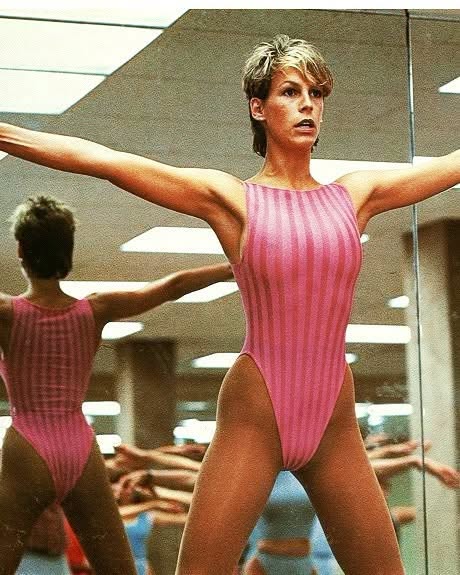
When **John Travolta** and **Jamie Lee Curtis** signed on to star in *Perfect* in 1985, the project appeared to have all the ingredients of a major Hollywood success. It paired two of the industry’s most recognizable stars, featured an experienced director, carried a substantial production budget of roughly $20 million, and attempted to capture two of the biggest cultural trends of the decade: investigative journalism and the exploding aerobics fitness movement. Expectations were enormous. Few could have predicted that the film would instead become one of the most infamous commercial and critical disappointments of the era, earning harsh reviews, disappointing box-office returns, and several Golden Raspberry Award nominations that overshadowed its ambitious intentions.
The origins of *Perfect* were surprisingly promising. The screenplay drew inspiration from a series of **Rolling Stone** magazine articles exploring modern relationships, journalism, and the rapidly growing fitness culture that had swept across Southern California during the early 1980s. The magazine’s publisher, **Jann Wenner**, became involved with the production, even making a cameo appearance after reportedly testing for a larger role. Director **James Bridges**, known for thoughtful dramas, envisioned combining serious reporting with contemporary social commentary while presenting the glamorous world of upscale health clubs that had become symbols of the decade.
The production spared little expense. Columbia Pictures invested heavily in the project, while elaborate sets were constructed to recreate a sophisticated New York magazine office inside a Los Angeles soundstage. Among the most impressive builds was a detailed two-story newsroom designed specifically for the film. The cast spent months preparing, with Jamie Lee Curtis undergoing extensive aerobics training and John Travolta immersing himself in the role of investigative journalist Adam Lawrence. Behind the scenes, everyone believed they were creating an intelligent, stylish drama that would resonate with audiences.
Yet as filming progressed, creative decisions gradually shifted the movie’s focus. Instead of emphasizing journalism and character development, increasingly long fitness sequences began dominating the film. What had initially been intended to illustrate the culture surrounding Curtis’s character slowly evolved into extended scenes filled with synchronized exercise routines, dramatic lighting, and lingering close-up shots. By the time the final cut reached theaters, many viewers felt those sequences overshadowed the central story almost entirely.
Critics responded with overwhelming negativity upon the film’s release. While some acknowledged the commitment of the cast, many questioned the movie’s uneven tone and storytelling. Reviewers argued that *Perfect* struggled to balance serious drama with stylized fitness imagery, leaving audiences uncertain whether they were watching a romantic drama, a satire, or an extended exercise video. Several publications specifically criticized the lengthy aerobics scenes, describing them as unintentionally excessive and distracting from the narrative.
The commercial performance proved equally disappointing. Despite its considerable budget and the star power of its leading actors, *Perfect* earned only about $12.9 million worldwide during its theatrical run, falling well short of expectations. The financial loss represented a significant setback for Columbia Pictures and became one of the industry’s most talked-about disappointments of the mid-1980s.
For John Travolta, the consequences were especially significant. Having enjoyed extraordinary success with films such as *Saturday Night Fever* and *Grease*, he entered *Perfect* as one of Hollywood’s most recognizable leading men. Following the film’s disappointing reception, however, his career entered a difficult period during which leading roles became increasingly scarce. Although he continued acting, it would take several years before he regained widespread critical and commercial momentum, eventually revitalizing his career through later performances that reminded audiences of his remarkable versatility.
Jamie Lee Curtis experienced the film’s aftermath quite differently. Her portrayal of fitness instructor Jessie Wilson introduced her to a broader international audience and reinforced her image as one of Hollywood’s most physically dynamic performers. Yet the experience of making the film proved personally challenging. Already committed to maintaining an athletic lifestyle, Curtis underwent an especially demanding training schedule to prepare for the demanding choreography required throughout production.
The filming process became physically exhausting. Because many of the aerobics sequences were scheduled early in production, Curtis worked intensely to maintain peak physical condition under constant pressure. In later interviews, she explained that she significantly restricted her diet while meeting the demands of rehearsals and filming, ultimately losing approximately ten pounds of muscle during production. What audiences saw as effortless energy on screen reflected months of rigorous preparation and considerable physical sacrifice behind the scenes.
More troubling for Curtis than the physical demands was her discomfort with how many of the fitness scenes were ultimately presented. Looking back years later, she expressed disappointment that sequences she believed should have served the story instead became highly stylized visual spectacles. She explained that the camera frequently emphasized prolonged close-ups and choreography in ways she felt shifted attention away from character development. Curtis later said she had asked for some of those scenes to be shortened during editing but felt her concerns were not reflected in the final version released to audiences.
The experience profoundly influenced her approach to future roles. Having already navigated the complexities of fame following *Halloween* and several early-career performances that included nudity, Curtis decided after *Perfect* to establish much firmer personal boundaries regarding how she would be portrayed on screen. She became increasingly selective about projects and insisted that any intimate material be carefully discussed and agreed upon before filming. That commitment remained an important part of her career for decades afterward and reflected her growing determination to maintain greater control over her work.
Although *Perfect* became synonymous with disappointment during the 1980s, public opinion gradually softened over time. As years passed, many viewers began revisiting the film with fresh perspective, appreciating it as an unmistakable time capsule of its era. The fashion, music, fitness culture, and unmistakably 1980s aesthetic gave the movie a nostalgic quality that later audiences often embraced with affection rather than ridicule.
Some influential filmmakers even defended the movie. Director **Quentin Tarantino** publicly praised *Perfect* during the 1990s, arguing that it had been unfairly dismissed and highlighting Jamie Lee Curtis’s committed performance as one of its greatest strengths. His comments encouraged many film enthusiasts to reconsider a movie that had long been remembered only for its commercial failure. Meanwhile, the official Razzie guide eventually recognized it among the most entertaining “so-bad-it’s-good” films ever made, acknowledging that its unusual qualities had earned it a lasting place in pop culture.
Today, *Perfect* occupies a unique place in Hollywood history. It remains an example of how enormous expectations, ambitious ideas, and major studio resources do not always guarantee success. At the same time, it illustrates how reputations can evolve with time. What was once dismissed as an embarrassing failure has gradually become a fascinating cultural artifact—one remembered not only for its infamous reception, but also for the lessons it taught its stars, the conversations it sparked about creative control, and its unexpected transformation into a cult favorite appreciated by a new generation of movie lovers.:::