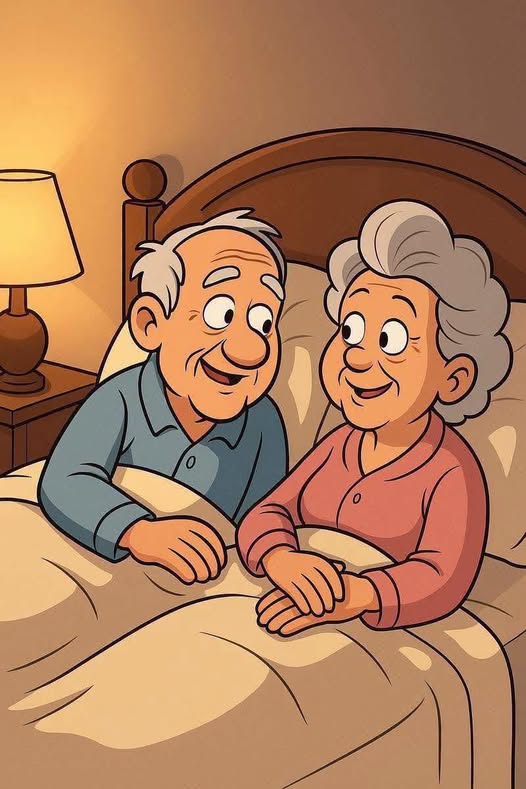
Henry knew his time was running out, and there was only one thing he wanted before he closed his eyes for the last time—the truth. After fifty years of marriage, countless shared memories, and a lifetime of standing beside one another through joy and hardship, he looked at Martha with quiet determination. There had always been stories she refused to tell completely, moments she brushed aside with a smile, and sacrifices she hinted at but never fully explained. Now, with the weight of time pressing heavily upon them both, he asked her to tell him everything.
Martha hesitated. Her hands rested quietly in her lap as she searched his face, wondering whether revealing the past would bring him peace or only reopen old wounds. For years she had carried certain secrets alone, convinced that protecting Henry mattered more than protecting herself from guilt. She had always believed there would be another day to explain, another opportunity to confess. Suddenly, there wasn’t.
With remarkable honesty, she admitted that there had been three moments during their marriage when she crossed lines she never imagined crossing. None of those decisions, she insisted, had been made for excitement, selfishness, or revenge. Each one had been driven by fear—fear of losing their home, fear of losing Henry, and fear of watching everything they had built together collapse. Whether her choices were right or wrong remained impossible to answer, but in her heart she had always believed she was fighting to save the life they shared.
Henry listened without interrupting, his expression revealing little beyond quiet exhaustion. Some of what she described surprised him, while other parts explained mysteries he had quietly wondered about for decades. As painful as the confessions were, he found himself appreciating her willingness to finally place the entire truth between them. After half a century together, there seemed little value in pretending either of them had lived perfect lives.
Yet one confession continued to trouble him more than the others.
“The third time,” he whispered, his breathing growing slower. “Tell me about the third time.”
Martha closed her eyes for a brief moment before nodding.
“It happened during your campaign.”
Henry’s brow furrowed as memories slowly returned. Years earlier, he had run for local office against an opponent many believed would easily defeat him. The election had been close, far closer than anyone expected, until the final results showed Henry winning by an astonishing margin. Friends celebrated the upset victory, newspapers praised his campaign, and he spent years believing that hard work and the community’s trust had carried him across the finish line.
There had always been one detail he never fully understood.
He had won by exactly seventy-three votes more than almost every political observer had predicted.
Now, lying quietly in his hospital bed with the soft rhythm of the oxygen machine filling the room, he looked toward Martha once more.
“Seventy-three more votes?” he asked, his voice barely louder than a breath.
The room fell silent.
Martha folded her hands together and lowered her eyes, almost embarrassed despite the decades that had passed. A small smile touched the corner of her lips—not one of pride, but one of gentle resignation.
“Do you remember,” she asked softly, “how surprised you were when you won by such a landslide?”
For several long seconds, Henry simply stared at her.
Then understanding slowly settled across his face.
Not suddenly.
Not dramatically.
It arrived like an old family joke whose meaning finally became clear after years of hearing it.
His campaign.
The unexpected victory.
The mysterious seventy-three-vote difference.
He finally understood exactly what she had been trying to tell him.
A thousand emotions collided inside him at once. There was disbelief, frustration, affection, sadness, gratitude, and an almost overwhelming sense of disbelief that this woman—his wife of fifty years—had somehow managed to keep such a story hidden for so long. He wanted to be angry, yet the absurdity of the moment made anger surprisingly difficult to hold onto.
Martha reached gently for his hand.
“I did what I believed I had to do,” she whispered. “Whether it was right… I’ve questioned it every year since.”
Henry looked at the woman who had shared his entire adult life.
They had weathered financial hardship, illness, disappointment, children leaving home, celebrations, heartbreak, and countless ordinary days that quietly became extraordinary simply because they lived them together. Neither of them had been perfect. Both had made mistakes. Both had forgiven more than either ever expected they would.
For the first time in years, Henry laughed.
It was soft.
Weak.
Interrupted by coughing.
But it was genuine.
The sound filled the room, carrying with it decades of shared memories that neither confession nor regret could erase.
He squeezed Martha’s hand.
“Our marriage,” he said with a tired smile, “never was ordinary.”
She laughed through tears.
“No,” she replied. “It never was.”
As the evening light filtered softly through the window, neither of them spoke for several minutes. They no longer needed to. The secrets had finally been shared. The questions had finally been answered. What remained was something that had survived every mistake, every sacrifice, and every impossible decision life had placed before them.
Love is rarely flawless. Long marriages are not built on perfection but on forgiveness, endurance, and the willingness to keep choosing one another despite life’s complications. Looking at Martha one final time, Henry realized that their story had never been defined by the secrets they carried. It had been defined by the extraordinary lengths they had gone to protect each other—even when those choices were imperfect, complicated, and impossible to explain.
And somehow, after fifty unforgettable years, that crooked, imperfect love was still enough.