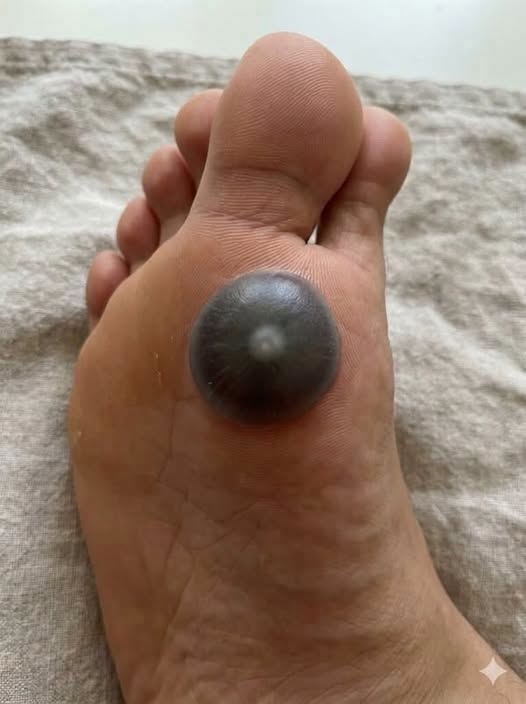
The photo immediately catches your attention, and it’s completely understandable to feel concerned. A dark, swollen, painful spot that seems to appear suddenly on a child’s foot should never be ignored. While it may turn out to be something relatively minor, such as a blood blister caused by pressure or an unnoticed injury, there are also other possibilities—including an infection or another condition—that require prompt medical evaluation. Because it’s impossible to determine the exact cause from a photo alone, having a healthcare professional examine it is the safest course of action.
One possible explanation is a blood blister. These can develop after repeated friction, tight shoes, a pinch, or minor trauma that a child may not even remember. Instead of filling with clear fluid, the blister fills with blood from tiny damaged blood vessels beneath the skin, giving it a dark red, purple, or nearly black appearance. Blood blisters can be quite painful, especially when located on the sole of the foot or another area that bears weight while walking.
However, appearance alone cannot confirm that this is a blood blister. A painful, swollen area can also result from a skin or soft-tissue infection, an infected blister, an insect or spider bite, a puncture wound, or another medical condition. If the area feels increasingly warm, becomes more swollen, or the pain continues to worsen, those possibilities become more important to consider.
For that reason, it is important **not to pop, cut, or drain the area at home**. Although it may seem like relieving the pressure would help, opening the skin yourself can introduce bacteria, increase the risk of infection, delay healing, and make the injury more painful. If the blister or swelling needs to be drained, it is much safer for a healthcare professional to decide whether that is appropriate and perform the procedure under clean conditions.
Until your child is evaluated, try to keep pressure off the affected foot as much as possible. If walking is painful, encourage rest and avoid activities that increase discomfort. Keep the area clean and protected with a loose, clean dressing if needed, and make sure footwear does not rub directly against the sore spot.
You can also gently observe a few things without pressing hard on the area. Does it feel soft and fluid-filled, like a blister? Or is it firm, very warm, and extremely painful even with light touch? Is the swelling increasing? Has the color changed rapidly? These observations may help the healthcare provider, but they should not replace an examination.
**Seek urgent medical care today** if your child has any of the following:
* Fever or chills.
* Red streaks spreading away from the area.
* Rapidly increasing swelling, redness, or pain.
* Pus or foul-smelling drainage.
* The foot becomes very hot, or the skin turns pale, blue, or black.
* Your child refuses to put any weight on the foot because of the pain.
* The child seems unusually sleepy, ill, or difficult to wake.
If none of those warning signs are present and your child otherwise feels well, it is still a good idea to **contact your pediatrician or visit an urgent care clinic the same day**. A clinician can examine the area, determine whether it is a blood blister, an infection, or another condition, and recommend the safest treatment and appropriate pain relief.
The good news is that many blood blisters heal well when properly protected, and many other causes can also be treated successfully once diagnosed. The most important step is having the area evaluated promptly so that, if treatment is needed, it can begin before the problem becomes more serious.