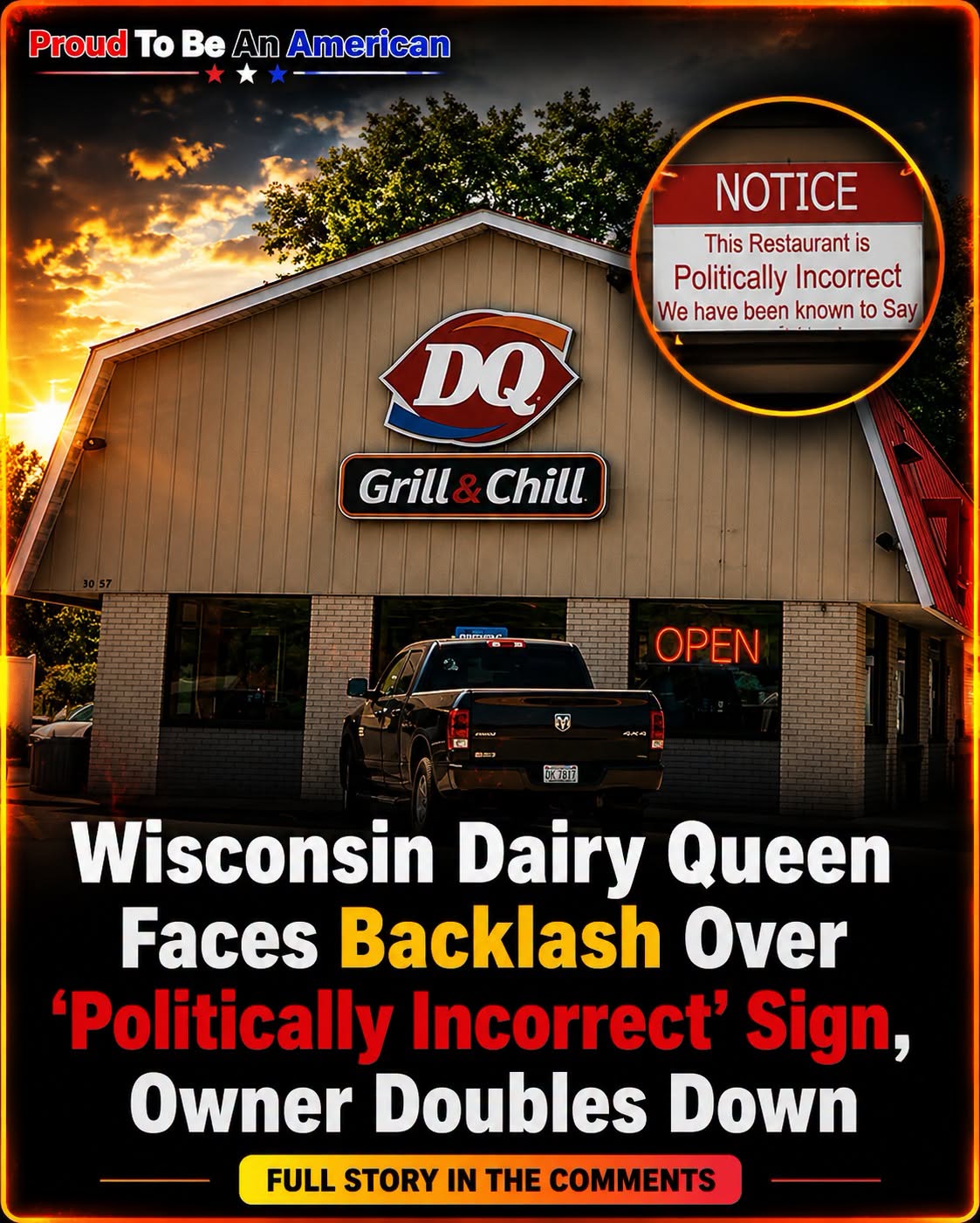
What began as a simple handwritten sign in the window of a small-town Dairy Queen quickly grew into a national conversation about faith, patriotism, free expression, and the role businesses play in reflecting the beliefs of their owners. A quiet street in Kewaskum, Wisconsin, suddenly found itself at the center of an online firestorm as thousands of people across the country debated whether the message represented personal conviction or unnecessary exclusion. What had gone largely unnoticed for years was suddenly being shared across social media, transforming one neighborhood restaurant into the focus of a much larger cultural debate.
The sign itself was direct and unapologetic. It described the restaurant as “politically incorrect” and stated that employees would continue saying “Merry Christmas,” “Happy Easter,” “In God We Trust,” and “God Bless America.” It also expressed respect for the American flag, support for military veterans, and announced that veterans were offered complimentary sundaes as a gesture of appreciation for their service. To some readers, these statements reflected traditional values and community pride. To others, they raised questions about whether every customer would feel equally welcome.
According to owner Kevin Scheunemann, the sign was never intended to provoke controversy. He explained that it was created after a customer complained about Christian music playing inside the restaurant. Rather than changing the atmosphere of the business, Scheunemann chose to openly communicate the values he believed the restaurant represented. From his perspective, the sign simply allowed customers to know what to expect before deciding whether to dine there.
For years, the message attracted relatively little attention outside the local community. Regular customers continued visiting much as they always had, and many residents viewed the sign as simply another reflection of the town’s character. It remained in the window without becoming a significant public issue, quietly blending into everyday life.
Everything changed when an out-of-state visitor photographed the sign and shared it on Facebook. Accompanied by criticism describing the message as exclusionary, the image quickly spread far beyond Wisconsin. Within hours, thousands of people who had never visited the restaurant were debating its meaning, sharing opinions, and arguing passionately across social media platforms.
As the post gained momentum, reactions became increasingly divided. Supporters praised the owner for standing by his beliefs despite growing criticism. They viewed the sign as an example of free expression and argued that business owners should have the right to communicate their personal values openly. Many also emphasized that customers who disagreed remained free to choose another restaurant.
Critics interpreted the message differently. Some questioned whether language emphasizing particular religious and patriotic expressions might unintentionally make certain visitors feel less included or less welcome. Others argued that businesses serving the general public should strive to create environments where people from all backgrounds feel equally comfortable.
The online discussion soon extended well beyond the restaurant itself. Comment sections became filled with arguments about religious freedom, freedom of speech, patriotism, customer expectations, and the increasingly visible cultural divisions within American society. What had begun as one local business owner’s decision evolved into a broader national conversation touching on issues far larger than ice cream or window signs.
Unfortunately, as often happens on social media, the discussion also became increasingly personal. The individual who originally shared the photograph reportedly received intense criticism and hostile responses from people on both sides of the debate. As the attention continued growing, the original Facebook post was eventually removed after the conversation became increasingly difficult to manage.
Within the Kewaskum community, however, many local residents expressed continued support for Scheunemann. Longtime customers described him as someone active in the community who had consistently supported local veterans and charitable efforts over the years. To them, the controversy unfolding online did not accurately reflect their own experiences with the restaurant or its owner.
As national attention intensified, Dairy Queen’s corporate office released a statement clarifying its position. The company emphasized that independently owned franchise locations operate under individual ownership while reaffirming that every customer deserves to be treated with dignity, courtesy, and respect. The statement also noted that the views expressed by individual franchise owners do not necessarily represent those of the broader company.
That response highlighted another important aspect of the controversy: the relationship between national brands and locally owned franchise businesses. While customers often associate every location with the same corporate identity, franchise owners frequently maintain considerable independence in operating their individual businesses within company guidelines. Situations like this can therefore create complex public discussions about where corporate responsibility begins and individual ownership ends.
The debate surrounding the Kewaskum Dairy Queen ultimately became about much more than a handwritten sign. It reflected broader disagreements over personal expression, community identity, religious traditions, and the expectations placed on businesses operating within increasingly diverse societies. Supporters viewed the sign as an honest declaration of personal beliefs, while critics questioned how such messages may be perceived by people with different backgrounds or perspectives.
Years later, the controversy continues to be referenced whenever discussions arise about free speech, religious expression, and the responsibilities of business owners. Whether people viewed the sign as courageous, controversial, welcoming, or divisive often depended as much on their own experiences and beliefs as on the words written in the window themselves. In that sense, the small Dairy Queen in Wisconsin became a reminder that even the simplest handwritten message can spark conversations reaching far beyond the community where it first appeared.