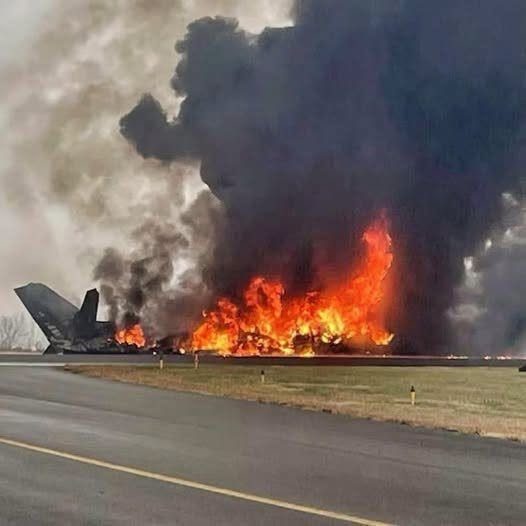
Chaos erupted in the skies over Dubai as Emirates Flight EK521 attempted to land after a routine journey from India. What should have been an ordinary arrival at one of the world’s busiest airports turned into a terrifying fight for survival when the aircraft crash-landed, skidded along the runway, and burst into flames. Hundreds of passengers suddenly found themselves trapped inside a smoke-filled cabin while emergency crews rushed toward the burning jet. In a matter of minutes, a normal flight became one of the most dramatic aviation emergencies in Emirates’ history, ending with an extraordinary evacuation but also a heartbreaking loss that would forever be remembered.
Emirates Flight EK521 departed from Thiruvananthapuram International Airport in Kerala, India, on August 3, 2016, carrying 282 passengers and 18 crew members aboard a Boeing 777-300. The flight progressed normally for most of its journey as it crossed the Arabian Sea toward Dubai. Travelers relaxed, prepared for landing, and anticipated reuniting with loved ones or continuing their journeys through Dubai International Airport, unaware that they were only minutes away from a life-threatening emergency.
As the aircraft approached Dubai during the afternoon, weather conditions became increasingly challenging. Reports indicated the presence of strong winds and possible wind shear near the runway—rapid changes in wind speed and direction that can significantly affect an aircraft during the critical final stages of landing. Pilots are trained extensively to manage these conditions, but even highly experienced crews must make split-second decisions when confronted with rapidly changing weather close to the ground.
During the landing attempt, the aircraft touched down but quickly became unstable. Instead of slowing safely on the runway, the Boeing 777 bounced, briefly became airborne again, and then slammed back onto the runway with tremendous force. The landing gear collapsed beneath the enormous weight of the aircraft, causing the jet to slide across the pavement before grinding to a halt. Moments later, fire erupted beneath the fuselage, sending thick black smoke billowing into the air as stunned airport personnel watched the unfolding disaster.
Inside the cabin, confusion quickly gave way to panic. Passengers described hearing loud impacts followed by the smell of smoke as cabin crew immediately shouted evacuation commands. Flight attendants moved rapidly through the aisles, directing frightened travelers toward emergency exits while reminding everyone to leave their belongings behind. Every second mattered as flames continued spreading beneath the aircraft.
Emergency slides deployed almost instantly, allowing passengers to escape onto the runway. Families, business travelers, children, and elderly passengers scrambled away from the burning jet as airport firefighters raced toward the aircraft. Despite the frightening conditions, the evacuation was completed remarkably quickly, with all 300 people aboard successfully escaping before the fire engulfed much of the aircraft.
Although every passenger and crew member survived the evacuation, the incident was not without tragedy. During efforts to extinguish the intense blaze, firefighter Jasim Al Baloushi lost his life when an explosion occurred while emergency crews battled the flames. His sacrifice deeply affected both the United Arab Emirates and the international aviation community, reminding the world that first responders often place themselves in extreme danger to save others.
Several passengers and emergency personnel were treated for minor injuries, smoke inhalation, and the effects of the chaotic evacuation. Many later described the experience as the most terrifying moment of their lives. Survivors recalled hearing explosions behind them as they ran away from the aircraft, realizing only afterward how narrowly they had escaped a far greater catastrophe.
The destruction of the aircraft forced Dubai International Airport to temporarily suspend operations, creating significant disruption throughout one of the busiest aviation hubs in the world. Flights were diverted to neighboring airports, departures were delayed, and thousands of travelers experienced lengthy disruptions while emergency responders secured the scene and investigators began their work.
Attention quickly turned to determining exactly what had caused the accident. Investigators from the United Arab Emirates, assisted by aviation experts from Boeing, engine manufacturers, and international safety agencies, carefully examined every aspect of the flight. Both the cockpit voice recorder and flight data recorder were recovered and analyzed to reconstruct the final minutes before the accident.
The official investigation eventually concluded that the accident resulted from a combination of factors rather than a single mechanical failure. Strong wind conditions played an important role, but investigators also determined that difficulties during a go-around maneuver—a procedure in which pilots discontinue a landing attempt and climb away for another approach—contributed to the accident. The report found no evidence that a structural defect or catastrophic mechanical failure had caused the crash.
The investigation also highlighted how complex modern aviation can be. Even highly trained flight crews operating technologically advanced aircraft may encounter situations where multiple factors combine within seconds, leaving little margin for error. As a result, aviation authorities issued recommendations aimed at improving pilot training, aircraft systems, and operational procedures to reduce the likelihood of similar accidents in the future.
Despite the destruction of the aircraft, one remarkable fact continues to stand out: every passenger and crew member survived. Aviation safety experts frequently cite EK521 as an example of the importance of rigorous crew training, effective aircraft evacuation procedures, and rapid emergency response. Cabin crew members remained calm under extraordinary pressure, directing hundreds of frightened passengers to safety while smoke and flames rapidly spread around the aircraft.
The actions of airport firefighters were equally courageous. Their immediate response prevented the fire from spreading further and helped ensure the successful evacuation, even though one firefighter ultimately gave his life in the effort. His bravery remains one of the defining memories of the incident and serves as a reminder of the risks emergency responders willingly accept to protect others.
For those who experienced the crash firsthand, the emotional impact extended long after the flames were extinguished. Many survivors later spoke about struggling with anxiety, recurring memories of the evacuation, and renewed appreciation for life. Some formed lasting friendships with fellow passengers who had shared those terrifying minutes, while others credited the professionalism of the cabin crew with saving their lives.
The destruction of Emirates Flight EK521 also underscored the remarkable safety record of modern commercial aviation. Although accidents receive worldwide attention because of their dramatic nature, commercial air travel remains one of the safest forms of transportation. Each major investigation contributes valuable lessons that lead to improved aircraft design, pilot training, emergency procedures, and international safety standards.
Today, Emirates Flight EK521 is remembered not simply as a dramatic aviation accident but as a powerful story of survival, professionalism, and sacrifice. Hundreds of lives were saved through quick thinking, disciplined emergency procedures, and extraordinary courage under unimaginable pressure. At the same time, the memory of firefighter Jasim Al Baloushi reminds us that acts of heroism often come at a profound personal cost. While the aircraft itself was lost, the lessons learned from that day continue to strengthen aviation safety around the world, ensuring that the tragedy contributes to making future flights even safer for millions of passengers.