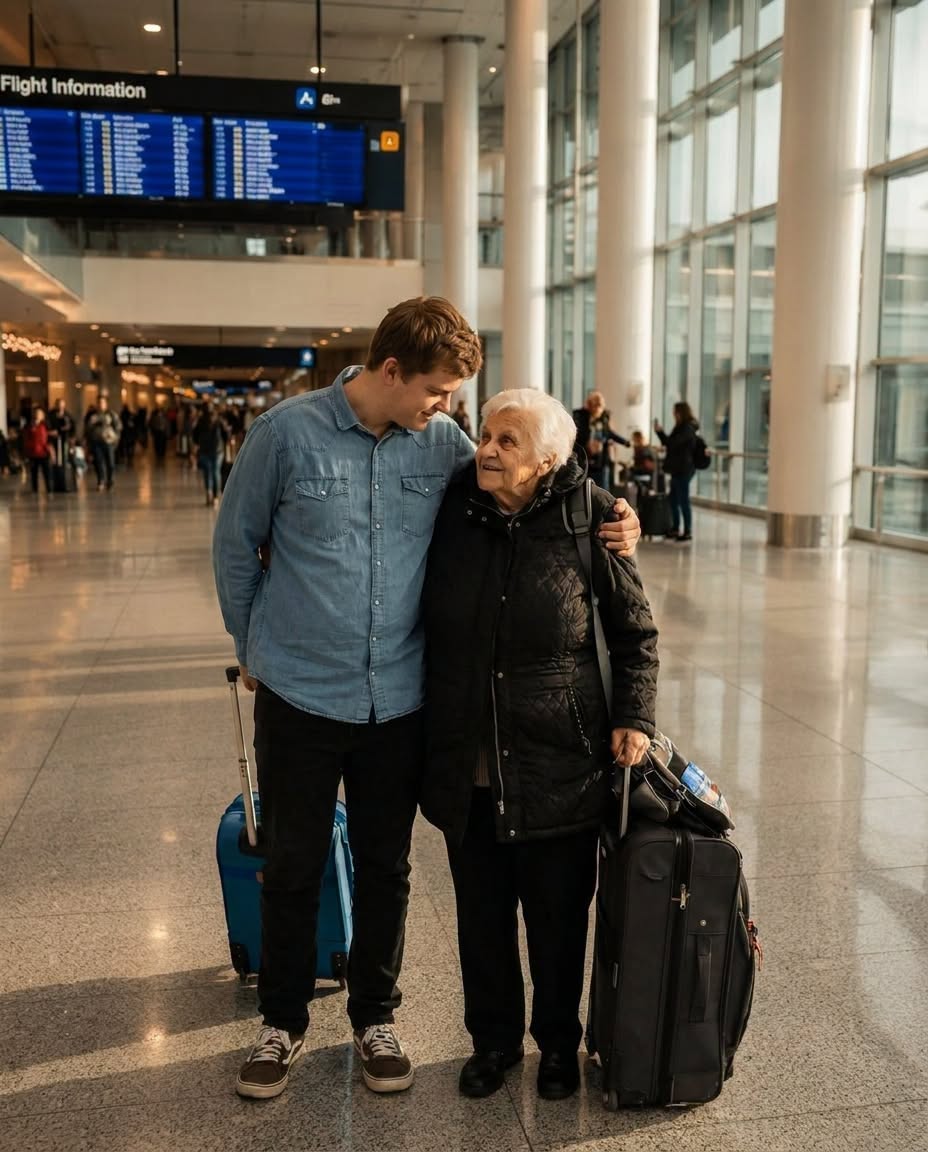
Hazel’s smile disappeared the moment the airline employee looked up from the computer and quietly said, “I’m sorry, ma’am, but there isn’t a reservation under your name.” At first, she thought it had to be a simple mistake. She had spent months looking forward to this family vacation, trusting every detail to her son and daughter-in-law after transferring nearly thirty thousand dollars from her retirement savings to cover what they described as a once-in-a-lifetime trip. Yet as her family gathered near the security checkpoint, avoiding eye contact and pretending to be distracted by their phones, the horrifying truth slowly emerged. Her money had paid for everyone else’s luxury vacation—but no ticket had ever been purchased for her. In the middle of the bustling airport, surrounded by strangers rushing toward their own destinations, Hazel realized she had been deliberately left behind. The betrayal wasn’t just financial. It was deeply personal, carefully planned, and meant to humiliate her without causing a public scene. Her family expected her to quietly accept the loss, go home alone, and never speak of it again.
For a few painful moments, it seemed their plan would succeed. Tears welled in Hazel’s eyes as she gripped the handle of her suitcase, trying to steady herself while passengers hurried past without knowing her world had just collapsed. Her son barely muttered an excuse about “booking complications,” while other relatives avoided looking directly at her. They had already begun moving toward the security line, convinced that guilt would fade once their vacation began. But one person refused to take another step. Her oldest grandson, Calvin, stopped in his tracks. Watching his grandmother stand alone with confusion written across her face shattered something inside him. He looked back at his parents, then at Hazel, and made the decision that would forever change every relationship in his family. Without raising his voice or creating a dramatic confrontation, he calmly walked back across the terminal, picked up Hazel’s suitcase, placed a reassuring hand on her shoulder, and simply said, “You’re not staying here alone. We’re going home.”
That single decision became the turning point in both of their lives. While the rest of the family boarded their international flight believing they had escaped any consequences, Calvin drove his grandmother home in complete silence. Once they arrived, he made her a cup of tea and asked her to tell him everything from the beginning. Together they reviewed bank transfers, emails, travel confirmations, text messages, and financial records stretching back several years. What initially appeared to be one cruel act quickly revealed a much larger pattern of manipulation. Hazel realized she had spent years quietly funding family vacations, home renovations, expensive gifts, and business ventures through what she believed were temporary loans or shared family expenses. Instead, her generosity had slowly become something her relatives expected rather than appreciated. Every sacrifice she had made had only convinced them she would continue giving forever.
Calvin refused to let the matter remain a painful family secret. Despite pressure from his parents, emotional phone calls from relatives, and accusations that he was “destroying the family,” he contacted an attorney specializing in elder financial abuse. The legal team carefully assembled every document, every receipt, and every electronic transfer into an overwhelming timeline that exposed years of exploitation. What began as a dispute over an airline ticket evolved into a full civil lawsuit. During depositions, several family members contradicted one another under oath. Some claimed Hazel had willingly gifted the money. Others insisted she had misunderstood the arrangements. But the written evidence told a very different story. Emails promising reimbursement, messages discussing how to keep Hazel “calm until after the trip,” and financial records clearly demonstrated deliberate deception. For the first time, their private betrayal was examined not around a family dinner table, but inside a courtroom where facts mattered more than excuses.
Months later, the judge delivered a ruling that stunned everyone involved. Hazel recovered every dollar that had been taken from her retirement account, along with additional damages and legal costs. Even more significantly, the court ruled that the relatives responsible would have no legal authority over Hazel’s finances, healthcare decisions, or future estate planning. Years of manipulation collapsed under the weight of documented evidence. While the financial victory provided security, it could never restore the trust that had been quietly eroded over decades. The courtroom ended the legal battle, but the emotional wounds would require much longer to heal.
Throughout the entire process, Calvin never left Hazel’s side. He accompanied her to every legal meeting, every doctor’s appointment, and every difficult conversation where painful memories resurfaced. Rather than allowing bitterness to consume her remaining years, he encouraged her to rebuild the life she deserved. Together they repainted the small garden she loved, replanted marigolds outside her porch, organized old family photographs, and slowly filled the silence left behind by those who had chosen greed over love. Their evenings became filled with long conversations about Hazel’s childhood, her marriage, and the dreams she once believed had disappeared forever. Calvin often admitted that he felt he was learning more about life from his grandmother than from any university lecture.
Inspired by everything she had endured, Calvin continued pursuing his medical education with renewed determination. He often remembered how Hazel had spent countless nights caring for sick neighbors without expecting anything in return, believing compassion was life’s greatest gift. Those lessons followed him into every hospital corridor, every clinical rotation, and every patient interaction. While classmates saw medicine as a profession, Calvin increasingly viewed it as a way to honor the woman who had taught him that dignity matters most when people are at their most vulnerable. Hazel attended his graduation despite walking slowly with a cane, proudly watching her grandson receive the diploma that represented years of sacrifice shared by both of them.
When Hazel’s own health eventually began to decline, Calvin became her caregiver without hesitation. He rearranged work schedules, slept in the chair beside her hospital bed during difficult nights, and made sure she was never left to face illness alone. Every time she opened her eyes, she found the same reassuring face beside her—the grandson who had once refused to abandon her in an airport terminal. The betrayal that had nearly broken her family had instead created an unbreakable bond between grandmother and grandson. During quiet evenings, Hazel often smiled and told Calvin that missing that flight had been the greatest blessing of her life because it revealed who truly loved her when money no longer mattered.
Today, visitors entering Dr. Calvin Morgan’s medical office often notice a colorful painting of bright marigolds hanging above his desk. Most admire its cheerful appearance without giving it much thought. To Calvin, however, it represents far more than flowers. It reminds him of the afternoon he chose compassion over convenience, truth over silence, and his grandmother over the comfort of pretending nothing was wrong. Every patient who asks about the painting hears the same lesson Hazel taught him through both heartbreak and resilience: family is not defined by blood, inheritance, or shared last names. Family is the person who stays when everyone else walks away, the one who carries your suitcase when your strength is gone, and the one who chooses love even when betrayal would have been far easier to ignore.