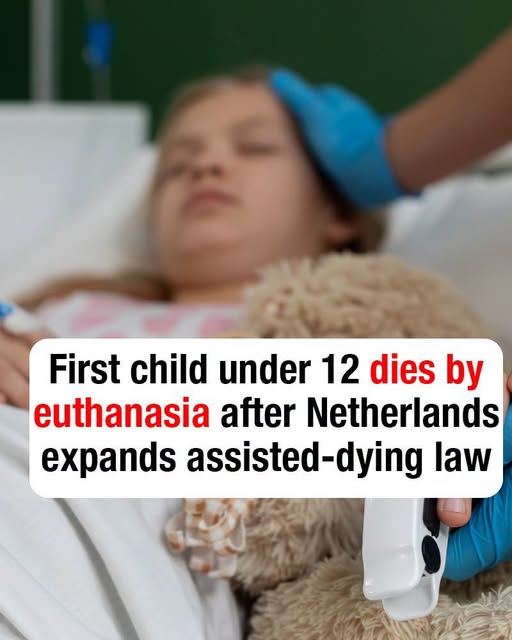
A child’s life ended under the authority of the law.
A nation found itself divided between compassion and concern.
And families around the world were left confronting one of the most painful ethical questions medicine has ever faced.
In the Netherlands, a terminally ill child under the age of 12 became the first known patient in this age group to receive legal euthanasia under recently introduced regulations designed for exceptionally rare and extreme circumstances. The decision did not emerge from a sudden crisis or a single heartbreaking moment. It followed months of medical evaluations, difficult conversations, and careful legal review. Doctors, parents, specialists, and independent experts all faced an impossible reality: a child whose suffering could no longer be relieved, whose illness offered no path toward recovery, and whose future promised only worsening pain.
The case has immediately drawn international attention, reigniting one of the world’s most emotionally charged debates. Supporters describe the decision as an act of profound compassion carried out only after every available treatment and palliative option had failed. Critics argue that crossing the line into intentionally ending a child’s life raises moral questions that society may never fully answer. Between those opposing viewpoints lies the unimaginable grief of one family forced to make a decision no parent ever hopes to confront.
Inside a quiet hospital room, the final hours unfolded far from television cameras and political arguments. There were no dramatic headlines, no courtroom battles, and no public speeches. Instead, there were parents saying goodbye to their child while surrounded by physicians whose professional duty had shifted from seeking a cure to easing suffering. The disease itself had already removed every realistic hope of recovery. What remained was the question of how that suffering should end.
Under the Dutch regulations, euthanasia for children in this age group is permitted only under extraordinarily strict conditions. Physicians must determine that the child is experiencing unbearable suffering with no reasonable prospect of improvement. All realistic medical treatments and palliative care options must first be explored and found insufficient to relieve that suffering. Independent medical experts are consulted throughout the process to ensure that the legal and medical requirements have been fully satisfied.
Parents play a central role in the decision, carrying an emotional burden that few people can truly imagine. When the child is capable of participating in discussions appropriate to their age and condition, their views are also considered as part of the evaluation. Every conversation takes place within an environment focused on medicine, ethics, and the child’s best interests rather than politics or public opinion.
Even after the procedure, the process does not simply end.
Each case undergoes detailed review by an independent committee consisting of physicians, legal experts, and ethicists who examine whether every safeguard established under Dutch law was properly followed. Prosecutors may also review the findings to confirm compliance with the legal framework. These multiple layers of oversight were designed to ensure that euthanasia remains limited to the most exceptional circumstances rather than becoming a routine medical practice.
For supporters of the law, these safeguards represent an attempt to balance compassion with accountability. They argue that when modern medicine can no longer relieve relentless pain, allowing a peaceful and medically supervised death may be the most humane option available. In their view, the focus remains on preserving dignity when life has become nothing but unavoidable suffering.
Opponents see the issue through a very different moral lens.
Many believe that intentionally ending the life of a child, regardless of the circumstances, crosses an ethical boundary that should never be crossed. Some fear that expanding eligibility, even under strict regulations, could gradually alter society’s understanding of medical care, disability, and the value of life. Religious organizations, disability advocates, and some medical professionals continue to express deep concern about where such policies could eventually lead.
The debate extends well beyond the Netherlands.
Countries around the world continue to wrestle with questions surrounding assisted dying, end-of-life care, palliative medicine, and patient autonomy. While some nations have legalized various forms of assisted dying for certain adult patients, policies involving children remain among the most controversial issues in modern bioethics. Every legal system approaches these questions differently, reflecting distinct cultural, religious, and philosophical traditions.
Medical advances have prolonged life in situations that previous generations could scarcely imagine. At the same time, those advances have introduced new ethical dilemmas about suffering, quality of life, and the limits of medical intervention. Physicians increasingly find themselves balancing technological possibilities against deeply personal questions that medicine alone cannot answer.
For the family at the center of this case, however, public debate may feel distant compared with private loss.
Regardless of where individuals stand on euthanasia, one heartbreaking reality remains unchanged: a child died after a long battle with terminal illness, leaving behind grieving parents whose lives have been permanently altered. Long after political arguments fade and headlines disappear, they will continue living with memories that no law, medical procedure, or public opinion can erase.
This first reported case under the new Dutch framework has become more than a legal milestone. It has become a symbol of one of the most difficult questions any society can confront: how should compassion be defined when medicine can no longer heal? Is mercy found in preserving life at every possible moment, or in ending unbearable suffering when every hope has vanished?
There may never be universal agreement.
Some will always view the decision as an act of extraordinary mercy carried out under the strictest safeguards imaginable. Others will always regard it as a moral line that should never be crossed. Between those positions lies a reality far more complex than slogans or headlines can capture—a reality shaped by terminal illness, profound grief, medical ethics, parental love, and impossible choices.
As countries continue debating the future of end-of-life legislation, this case will likely remain part of that conversation for years to come. It reminds the world that behind every law, every policy, and every ethical argument stands a real family facing unimaginable pain. Whatever conclusions people ultimately reach, the discussion begins with the same undeniable truth: no parent ever wants to stand in a hospital room confronted with a decision that medicine itself cannot make easy.