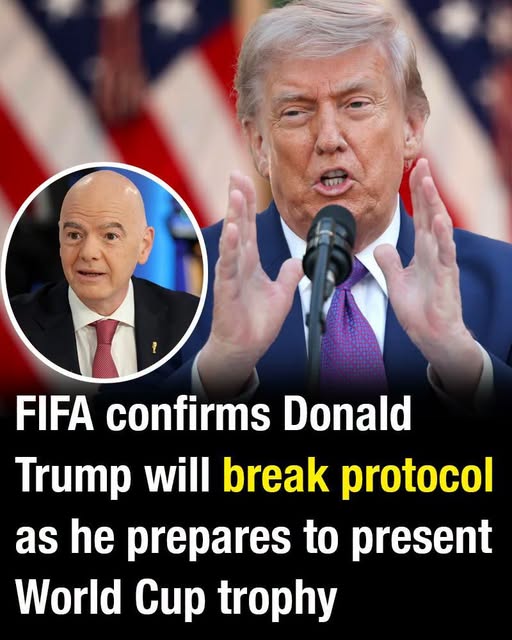
Donald Trump is reportedly set to return to one of the world’s biggest sporting stages, and if current plans hold, he may do far more than watch from the stands. Reports suggest he could stand alongside FIFA President Gianni Infantino during the presentation of football’s most coveted prize at the 2026 FIFA World Cup Final. Even before a ball has been kicked, the possibility has already sparked passionate debate. Supporters see the moment as a reflection of the United States hosting one of the largest sporting events on Earth. Critics worry that one of football’s most cherished celebrations could become overshadowed by political symbolism. Either way, the discussion has already begun, and millions of fans are watching closely.
For many people, the World Cup final represents one of the few remaining global events capable of bringing together countries, cultures, and generations through a shared love of sport. The trophy presentation traditionally belongs to the players who have fought through weeks of competition to reach the pinnacle of international football. Because of that, any figure standing beside the champions inevitably becomes part of the story, whether intentionally or not.
The reported decision has therefore generated sharply divided reactions. Some believe the presence of a U.S. president or national leader at a home World Cup would be entirely appropriate, particularly given the significance of hosting the tournament. They argue that major sporting events have long featured heads of state, royalty, and political leaders participating in ceremonial roles, making such appearances part of international tradition rather than an unusual exception.
Others see the situation very differently. They argue that Donald Trump remains one of the most politically polarizing figures in modern American history, and they fear his presence could shift attention away from the athletes and toward political debate. For those critics, the concern is not necessarily about protocol but about perception. They worry that conversations following the final might focus as much on podium photographs and political symbolism as on the team lifting the trophy.
Those concerns have been reinforced by memories of previous high-profile football events involving Trump. Images and videos from earlier ceremonies circulated widely online, prompting discussion about whether similar moments could unfold during the World Cup final. Critics argue that even brief interactions involving prominent political figures can dominate headlines, while supporters counter that such attention is an unavoidable part of hosting a tournament of this magnitude.
The close working relationship frequently observed between FIFA President Gianni Infantino and Donald Trump has also become part of the conversation. Over the years, the two have appeared together on multiple occasions connected to international football and preparations for major tournaments. Supporters view that relationship as practical cooperation between FIFA and the leadership of a host nation. Critics interpret it as evidence that politics and sport are becoming increasingly intertwined.
As anticipation builds toward the 2026 tournament, many fans are expressing a simple hope: that the players remain the central focus. After years of qualification, months of preparation, and ninety minutes—or perhaps even longer—of football at the highest level, they believe the defining images should belong to the champions, their teammates, and the supporters who have followed them throughout the journey.
History shows that major sporting events often exist alongside political symbolism whether organizers intend it or not. Olympic Games, World Cups, and other global competitions have frequently reflected broader diplomatic relationships, national identity, and international attention. The challenge for organizers is finding the balance between acknowledging official hosts and preserving the integrity of the sporting occasion itself.
Players themselves rarely control the environment surrounding championship ceremonies. Their responsibility ends with the match, while the symbolism of the podium is shaped by organizers, officials, and invited dignitaries. Yet photographs from those moments often become part of sporting history, remembered alongside the goals, saves, and celebrations that defined the competition.
As the countdown to the 2026 FIFA World Cup continues, speculation is likely to persist until official ceremony details are finalized. Every new report will fuel further discussion about what role political leaders, sporting officials, and host nations should play during one of the world’s most watched events.
Ultimately, when the final whistle blows, the attention of billions will first belong to the players who earned the right to lift football’s greatest prize. But if the reported plans move forward, the ceremony itself may become part of the global conversation. For some, it will symbolize national pride and international cooperation. For others, it will raise questions about the intersection of politics and sport. Either way, the images from that stage are certain to be examined long after the trophy has been lifted, reminding the world that in global events of this scale, the moments surrounding victory can sometimes become almost as memorable as the victory itself.