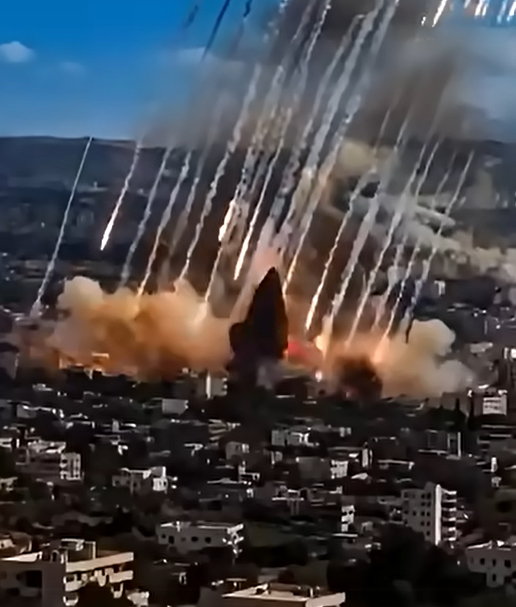
The nightmare began with a single explosion.
One deafening blast shattered the normal rhythm of the city and transformed an ordinary day into a scene of fear and confusion.
Within moments, thick smoke swallowed the skyline.
People poured into the streets, desperate to escape danger they could neither see nor fully understand.
Parents searched frantically for their children.
Children cried out for loved ones.
Friends became separated in the chaos.
Every second felt heavier than the last as uncertainty spread faster than the flames themselves.
The sound of sirens quickly filled the air.
Emergency vehicles raced through crowded streets while first responders attempted to reach areas where destruction was at its worst.
Yet every new explosion seemed to create fresh obstacles.
Buildings shook.
Windows shattered.
Entire blocks disappeared behind clouds of dust and debris.
Communication became increasingly difficult.
Phone networks overloaded.
Power outages spread across parts of the city.
For many families, the inability to contact loved ones became almost as terrifying as the disaster itself.
As darkness and smoke settled over the area, emergency crews faced impossible conditions.
Firefighters entered unstable structures despite the risk of collapse.
Paramedics treated victims wherever they could find space, often working in dangerous environments with limited resources.
Every rescue represented a race against time.
Hospitals quickly reached capacity.
Waiting rooms overflowed.
Hallways became treatment areas.
Medical teams worked tirelessly, treating injuries and saving lives despite exhaustion and growing shortages.
Doctors, nurses, and support staff pushed themselves far beyond ordinary limits.
Amid the devastation, countless ordinary citizens stepped forward to help.
Volunteers distributed water and supplies.
Neighbors opened their homes to those who had nowhere else to go.
Strangers comforted one another during moments of unimaginable fear.
In the middle of tragedy, compassion became a powerful force.
Community centers transformed into shelters.
Religious institutions welcomed displaced families.
Local organizations coordinated donations and emergency assistance for those who had lost everything.
The city’s spirit proved stronger than many expected.
Rescue teams continued searching through damaged buildings hour after hour.
Using specialized equipment and, at times, their bare hands, they refused to abandon hope of finding survivors beneath the rubble.
Every sound beneath the debris brought renewed determination.
Engineers inspected structures to identify additional risks.
Investigators worked carefully to reconstruct the sequence of events and understand how the disaster unfolded.
Their work would eventually provide answers, but in those early hours, survival remained the priority.
The first forty-eight hours were especially critical.
Rescuers understood that every passing minute could determine whether someone lived or died.
Despite fatigue and danger, they continued pressing forward.
As dawn finally arrived, the scale of the destruction became painfully clear.
Entire neighborhoods had been changed forever.
Many families faced losses that could never be replaced.
The road ahead would be long and difficult.
Recovery would require patience, resources, and years of effort.
The physical scars left behind would take time to heal.
The emotional wounds would take even longer.
Yet something remarkable emerged from the darkness.
Despite grief, fear, and uncertainty, the people of the city refused to surrender to despair.
They chose resilience.
They chose solidarity.
They chose to rebuild.
History often remembers disasters for the destruction they cause.
But it also remembers the courage that follows.
The firefighters who entered danger.
The doctors who refused to stop.
The volunteers who gave everything they could.
And the ordinary citizens who stood together when it mattered most.
By the time the smoke began to clear, one truth had become impossible to ignore.
The city had been wounded, but not broken.
Its people, though grieving and exhausted, had already made a decision.
They would rise again.